


Most children show potty training readiness sometime between 18 months and 3 years, with many American families starting around age 2 to 3, according to the American Academy of Pediatrics. The right time depends on the specific readiness signs your toddler shows, not their birthday. Once a child is genuinely ready, most are dry in the daytime within about a week.
What age do most kids start potty training?
There is no single correct age. HealthyChildren.org, the parent site of the American Academy of Pediatrics, describes toilet training readiness as typically emerging somewhere between 18 months and 3 years, with plenty of children ready closer to the middle or later end of that window.
Starting well before 18 months usually means the parent has learned the child’s schedule and is managing timing on the child’s behalf, rather than the child recognizing the need and acting on it themselves. That is not wrong to do, but it is a different thing from potty training, and it does not fast-forward true independence.
There is no prize for starting at 20 months and no penalty for starting at 3. Once a child is genuinely showing the readiness signs described below, most are dry in the daytime in about a week. Some manage it in three days, others take two or three weeks, and either pace is completely normal.
The readiness signs that actually predict success
Readiness shows up in four groups: physical, awareness, communication, and cooperation. A child does not need every sign in every group, but a cluster across at least the physical and awareness groups is what actually predicts a smooth start.
Physical signs
Look for a diaper that stays dry for roughly two hours at a stretch, a bowel movement that happens at roughly predictable times of day, the physical ability to pull pants up and down, and the coordination to walk to the bathroom and sit down on their own.
Awareness signs
A toddler who tells you during or right after a wet diaper, who hides or goes quiet to poop, or who seems uncomfortable in a dirty diaper and wants a change quickly, is starting to connect the sensation with the event. That connection is the whole foundation of potty training.
Communication signs
Your child does not need spoken words for pee and poop, a consistent gesture or sign works just as well. What matters more is that they can understand and follow a simple two step instruction, like “get your shoes and bring them to me.”
Cooperation signs
A toddler who wants to copy what you do, who shows curiosity about the toilet, and who is not in the thick of a phase where every request gets a flat no, is in a workable window. Signals matter more than spoken language for children who are autistic, non-verbal, or have Down syndrome or another developmental delay, and these children are trained successfully every day by parents who learn to read gestures and routines rather than wait for words.
How many signs does my toddler need before we start?
No child shows every single sign on the list, and waiting for a perfect scorecard means waiting forever. A handful of signs spread across the physical and awareness groups is enough to start.
Physical readiness carries more weight than enthusiasm. A toddler who is fascinated by the toilet and loves flushing it but still soaks a diaper every 20 minutes is not physically ready yet, no matter how excited they seem.
On the other hand, a toddler who shows the physical and awareness signs clearly but currently says no to everything, from broccoli to socks, is usually just going through a phase. That calls for a short wait of a few weeks, not a decision that potty training itself is a bad idea.
Signs your toddler is not ready yet (and that is fine)
A child who is frightened of the potty or the toilet is not ready, and pushing through fear rarely works. The honest fix is to build familiarity first through books, watching a sibling, or simply sitting fully clothed near the toilet, and to start training later once the fear has eased.
Constant wet diapers with no dry stretches at all usually mean the bladder simply has not matured enough yet to hold urine for any length of time. Dry stretches tend to appear on their own as most children get a little older. If they never do, that is a good question to bring to a pediatrician or your child’s health clinic rather than something to push through with a method.
Big changes in the household, a new baby, a move, starting at a new daycare, or recovery from a recent illness, all make this a poor window to begin. Children learn new physical skills best when the rest of their world feels steady.
Ongoing constipation or a pattern of a child holding in bowel movements is a medical question, not a training one, and it belongs with a pediatrician before any method is tried. Waiting for the right window is not falling behind, and there is no scoreboard other than your own child’s readiness.
Should I potty train at 2 or wait until 3?
Both ages work, and the deciding factor is the readiness signs, not the number on the calendar. What differs is the shape of the week you are likely to have.
At around 2 years old, many toddlers are eager to please and enjoy the process, but are less verbal and need more offering and noticing from the parent to catch the right moments. At around 3 years old, many children grasp the mechanics faster and can tell you clearly what they need, though a slightly older toddler can also be more opinionated and occasionally more resistant simply because they know how to argue now.
If a daycare or preschool has a diaper-free deadline, work backwards from that date but do not force a child who is not showing the signs. It is far better to start a few weeks later, once readiness is clearly there, than to begin on schedule and stall out with a frustrated child and a missed deadline anyway. Summer versus winter is worth thinking about for convenience. Lighter clothing dries faster and outdoor time means fewer indoor accidents to clean, but it is a comfort question, not a readiness one.
How to tell readiness from interest: a one week watching plan
Spend a week simply noticing, with no pressure and no sitting your child on a potty yet. This tells you far more than guessing from age alone.
Check the diaper at a few natural moments across the day, first thing in the morning, after a nap, mid-afternoon, to see whether dry stretches of two hours or more are starting to appear. Watch for the freeze mid-play, the sudden hiding behind the couch, or the tug at the waistband. These are the physical tells that a child is starting to notice the sensation before it happens.
A cup of water drunk in one go tells you far more than the same amount sipped across an hour, because you can actually see how long it takes before the pee follows. That single observation, cup of water in, time until pee out, is the exact relationship the tracking schedules used in training are built to capture once you start for real.
As an Amazon Associate we earn from qualifying purchases. Some links in this article are affiliate links: if you buy through them we earn a small commission, at no extra cost to you, and it does not affect what we recommend.
Reading a potty-themed picture book together during this watching week is a low-pressure way to build familiarity, and a title like Once Upon a Potty is a common choice for this age. There is no need to push it, just leave it around and read it if your child asks.
If you want something short and silly enough that your toddler asks for it again, this one is a good pick for this age:
| Sign | What it looks like in real life | Ready, almost, or wait |
|---|---|---|
| Dry stretches | Diaper stays dry two hours or more | Ready |
| Predictable poop | Bowel movement happens around the same time most days | Ready |
| Tells you after | Says or signs “wet” after the fact, not before | Almost |
| Hides to poop | Goes quiet, walks off, or crouches to go | Almost |
| Interest, no dry stretches | Loves the toilet, still wets constantly | Wait |
| Fear of the potty | Cries, refuses to go near it or the toilet | Wait |
| Follows two step instructions | Can fetch shoes and bring them without repeating | Ready |
What the seven day method looks like once you decide to start
Once the signs are there, the Potty Training Box Method, a seven-day, child-led potty training approach, moves a child from potty to toilet over the course of a week using positive reinforcement rather than a fixed schedule. The diaper comes off and regular cotton underwear goes on from day one, rather than training pants, because a child feels wetness in cotton underwear in a way that training pants are designed to prevent, and feeling it is what teaches the connection.
The first three days are spent at home, since that is when a child learns the most, with short outings following once things settle. The method is built around a single running question, will you tell me when you need to pee, so the initiative sits with the child rather than the parent running a timer. The fixed exceptions are before and after sleep and before leaving the house, both during training and afterward, where you simply go regardless of whether the child has asked.
Tracking schedules are used to record when this particular child actually goes, not to impose a fixed timetable on them. Over a few days a clear pattern of that child’s own timing emerges, and the parent relies less and less on offering as the child’s own signals take over. Sticker cards come in four sizes, 3, 5, 7 and then 9 squares, so a reward arrives quickly at first when a child needs to see that the system works, and then becomes rarer as the habit sets in, which is what lets the habit outlast the stickers instead of stopping the moment they do.
Day 4 or 5 is often the hardest day of the week for a very ordinary reason: the child gets tired of being asked “will you tell me when you need to pee” over and over and starts pushing back. The fix is to ask less often at that point, not more, and hand more of the responsibility over to the child. If you are still deciding between approaches before committing to one, how the main potty training methods compare is worth reading first. Night-time dryness is a separate skill that develops later and is not something any daytime method promises.
What if we start and it does not work?
Stopping and waiting before trying again is part of this method, not a failure of it. If a week has gone by with constant accidents and no sign of progress, if your child seems genuinely distressed rather than just having an off day, or if they are visibly holding it in rather than learning to let go, that is a pause, not a push-through.
A common gap between a first attempt and a second is a few weeks to a couple of months, giving the physical and emotional readiness time to catch up. Revisiting how the main potty training methods compare can help you decide what, if anything, to do differently on a second attempt. In the meantime, treat every accident as ordinary learning rather than a setback to correct, since shame slows a child down far more than a wet pair of pants ever does.
A temporary regression after an illness, a new sibling, or a house move is common and usually settles on its own within a few weeks as routines steady out. It is worth talking about openly with your child, but a full restart of formal training is rarely the right response to a short regression. Patience and consistency usually are.
What to have ready before day one
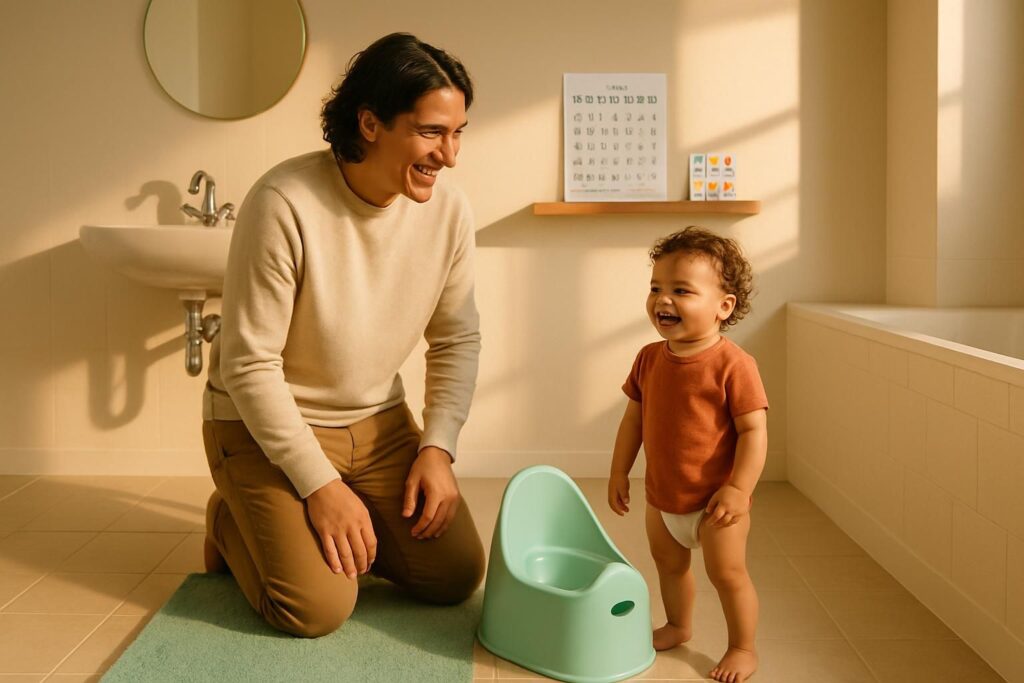
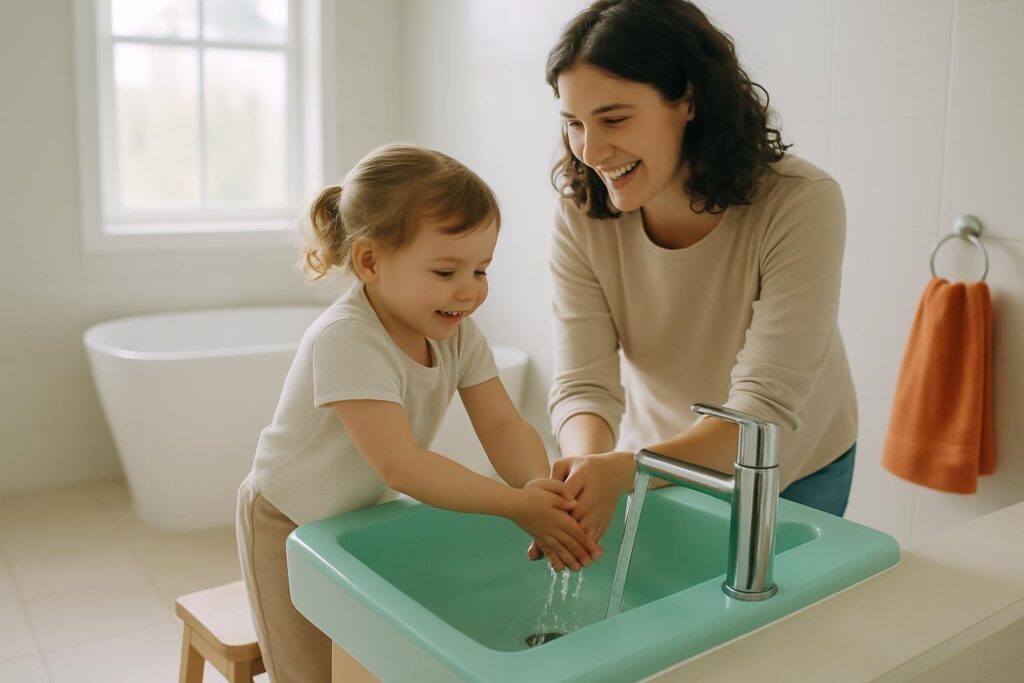
Before starting, it helps to gather a potty for the first few days, a toilet seat reducer for the switch to the big toilet, and a step stool so your child can climb up and reach the sink independently. Add at least 15 pairs of cotton underwear, something to protect the mattress and sofa, a small handful of little rewards, and pull-ups reserved for sleep only.
Clear the calendar for three days at home if you can, since the first stretch is where most of the learning happens and outings are easier once a pattern is established. Reading a picture book about the potty together in the weeks beforehand, with no pressure attached, is a simple way to make the idea familiar before training day one arrives.
Where the 7-Day Potty Training Video Course fits
For parents who want the plan rather than piecing it together from articles, the 7-Day Potty Training Video Course delivers the same seven day method as about forty short videos of roughly three minutes each, grouped by day so you always know what today is for. It includes a digital AI coach available at any hour for the questions that come up outside office hours, and the sticker cards, tracking schedule, and certificate are all part of the course, printed at home as you go, with the handbook included inside as a reference.
What it adds over a free article is specificity, what to actually do on day one, day two, and day three, including the days that go sideways, plus somewhere to turn when they do. It is also reusable if you have another child later, since the method and materials do not expire after one use.
Frequently asked questions
What is the best age to potty train?
There is no single best age, most children show genuine readiness somewhere between 18 months and 3 years, and many American families begin around age 2 to 3 according to the American Academy of Pediatrics. The right moment is decided by your child's specific readiness signs, not their birthday. A child who shows several clear signs at 22 months is more ready than one who is 3 but shows none.
Is 2 too early to potty train?
No, 2 is a common and workable age to start as long as the readiness signs are present. Two year olds are often eager to please and enjoy the process, though they typically need more offering and noticing from a parent since they are less verbal at that age. If the physical and awareness signs are not there yet, waiting a bit longer past 2 is completely reasonable.
Can you potty train a 1 year old?
Most one year olds do not yet have the bladder control or body awareness that potty training relies on, so this is usually too early for true readiness-based training. A parent can certainly catch a child's timing at that age, but that reflects the parent learning the schedule rather than the child recognizing the need themselves. Waiting until closer to 18 months or later, when the readiness signs start to appear, tends to go faster overall.
How do you know when your child is ready to potty train?
Readiness shows up as a cluster of signs rather than one single moment: staying dry for around two hours, predictable bowel movement timing, telling you about a wet diaper, and being able to follow a simple two step instruction. No child shows every sign, but a handful across the physical and awareness groups is a reliable signal to start. Interest alone, without the physical signs, usually means wait a little longer.
What is the 10-10-10 rule for potty training?
The 10-10-10 rule is a phrase that circulates in parenting circles, but it has no fixed or medically recognized definition, and different sources fill it in differently. Rather than chasing a specific timed formula, it is more useful to go back to the core idea behind child-led methods: let your child's own signals and timing guide when you offer the potty, instead of running training by the clock. That is also exactly what a tracking schedule is for, learning when your particular child actually needs to go.
What if my toddler is scared of the potty?
A toddler who is frightened of the potty or the toilet is not ready to begin formal training yet, and pushing through the fear tends to backfire. The honest fix is to build familiarity first, through picture books, watching a sibling or parent use the toilet, or simply sitting nearby fully clothed with no pressure to perform. Once the fear has eased, usually after a few weeks of this low-key exposure, training tends to go far more smoothly.
Ready for the next step?
The 7-Day Potty Training Video Course walks you through this program in forty short videos, grouped per day, with a digital AI coach you can ask a question at eleven at night on day four. The full handbook comes with it as a PDF to read and print. Nothing is shipped, so you can start today.
Sources
This article was written with AI assistance and checked by Dustin van de Sande.




My 3 and half daughter just started potty training she doing really good at nursery she sits on the toilet but will not sit on toilet at home I brought her a toilet seat go on toilet at home she does not like it also gone out brought her another toilet seat with ladder she will not sit on that she likes her potty so when I take her out has put nappies on has she Will not use toilet while we out but she’s back home she takes her nappies off
The toilet can be exciting/scary because she might feel she can fall in. So good of you to try a toilet seat and a step so she has stability and can stand up if she pleases. I guess the nursery has smaller toilets which are less scary. Take her feelings seriously and comfort her while she goes to the toilet. Guide her (hold her hand) and tell her it’s not scary and you will be there to help her all the way. When you do this (or maybe several times) she will feel more at ease and can go to the toilet herself.
My son is 3 and a half and I’m having trouble potty training. He doesn’t speak at all either which is making it harder. I feel like I have tried everything. He does not come to me when he has pooed or peed in the nappy, I have to check it to see what’s in it.
I have got a potty and a kids toiletseat with steps and handles.
I get him to sit on the toilet everyday and he is still yet to pee in it, he will only sit on it for a few seconds then go wash his hands. I have got him pants and it still doesn’t help. He has seen me and my husband go to the toilet aswel.
Any advice.
Would you be able to free up a week to potty train your little son? It is normal for a 3 and a half to act like this, because he gets used to the nappies. Therefore, our training programme starting with developing a routine for the little ones.
From what you have described, you are prepared and your little son has also got some ideas what is going on. However, I think you would need our training programme to guide both you and your son step-by-step to be completely potty trained. You also need to prepare some small gifts to help encouraging your son and in our training programme, there is a check-list for you to prepare before starting the potty training.
Hope this information helps, and we look forward to provide further support to you and your cutie little son.
Best regards
Try using his favourite toys sitting on the potty and making them have a Wee congratulate his toy getting ur son to be involved in giving his toy some special attention for doing so well then ask him if he would like to try this worked with my son as he refused to sit on either until I tried this hope it helps and good luck. ?
Hi my son tuned 3 today we did try potty training a couple of time as he seemed to be ready or showing signs of been ready but unfortunately he seemed uninterested and I didn’t won’t to pressure him as didn’t want him feeling more uncomfortable, he’s fully aware of when he wees and when he’s filling Is nappy, but he goes and hides tho when this happens, he as always done this tho it’s kinda difficult to ? he’s my 3rd boy and my other 2 where the same and there was almost 3 to so is it just a boy thing or is there more ways I can try to encourage him people have said he will be ready when he feels more ready i do encourage him loads but I feel he’s just just 100 percent comfortable within himself at the moment!!
Hi Clare, this is normal behaviour, not specific to boys. The feeling of pooing can be exciting or an akward feeling, that’s why he’s searching privacy. This could result in some struggles not wanting to go on the potty. But if you comfort him or put the potty on a private spot you can turn this to a positive thing. Just acknowledge his feelings and make suggestions that make him feel comfortable.
Make small steps and you will achieve your goal.
Hi my boy is 18 months old and showing signs of potty training. Tells us when he’s had a poo and wants his full wet nappy changing etc. Is he too young to start potty training?
Hi Rachel, these signs are telling you he is mentally ready. Kids are getting physically ready around 18-20 months. We like too keep some margin here and advise to start around 24 months to be sure he’s physically ready too. That does not mean you can’t try. There are parents who try and succeed around 18 months. Keep it accessible and keep in mind it’s early for him if you plan on trying it.
My toddler is showing signs of being ready but cries when we ask him to go on the potty before going in the bath and will hold his wee until he is in the bath. How do I help him not be afraid of the potty?
Hi Zoe, the potty can be an exiting thing. Take small steps to let him get used to the potty. For instance use a teddy bear and let it wee on the potty to let your boy know it isn’t scary. Next step is to let him sit on the potty with his clothes still on. Reward him if he takes this step. Next step with his nappy on, and so on.
It’s important to take his fear seriously, so you can guide him step by step.