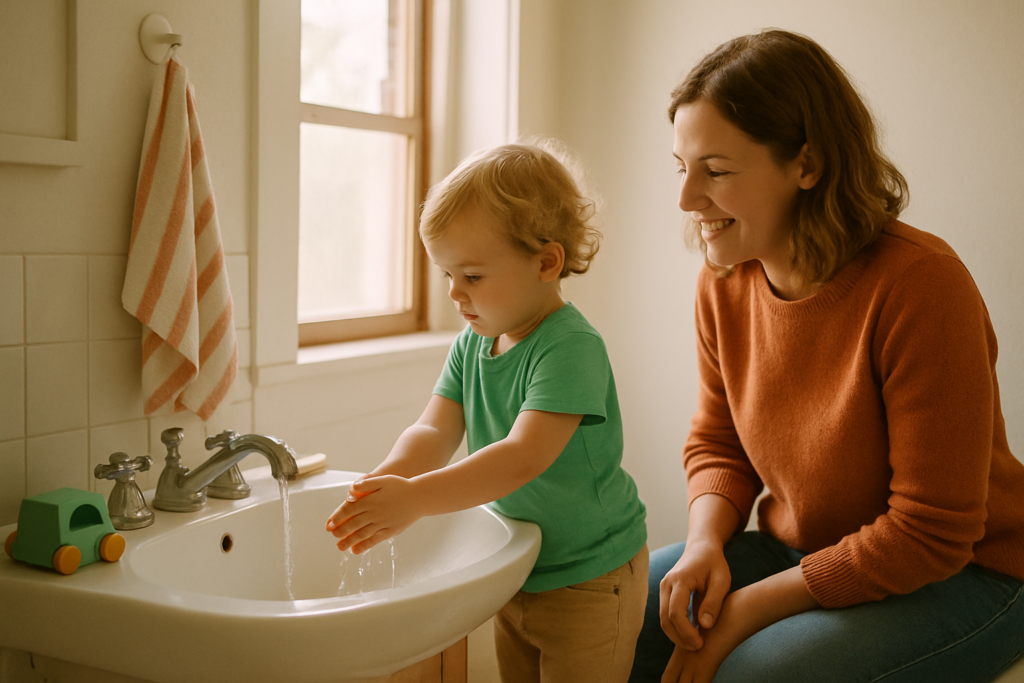


A potty training kit is a set of teaching materials, such as a day-by-day program, tracking charts, and a reward system, paired with gear the parent gets ready at home. A complete kit follows a structured method where the child learns to say when they need to go, rather than a fixed schedule imposed by the parent. A pile of supplies without a plan is just supplies.
Most parents searching for a kit have already bought a potty, and maybe a sticker chart from the dollar aisle, and found that none of it tells them what to actually do on day one, or day four when things fall apart. A complete setup has two halves: the materials that teach the method, and the everyday gear the family sets up around it. Neither half works alone, and a seven-day, reward-based program is what connects them.
What’s inside a complete potty training kit?
A complete program includes a day-by-day booklet that walks the parent through the week, along with daily instruction prompts and compliment prompts built into each day’s guidance, so a parent always knows what to focus on and how to keep praising a child without running out of ways to say it. These are the pieces that turn a stack of supplies into an actual plan.
It also includes fourteen tracking schedules, used to learn the specific times of day this child tends to need the bathroom, and a reward system of twenty sticker cards in four graduated sizes, plus 100 animal stickers and 20 poop stickers. Two certificates, one for pee and one for poop, mark the milestones for the child.
In the United States, the same seven-day method is delivered as the 7-Day Potty Training Video Course, an online program parents follow from home. The sticker cards, the tracking schedule and the certificates are part of the course and are printed at home by the parent.
| Materials in the program | What it’s for | When you use it |
|---|---|---|
| Program booklet | Day-by-day coaching for the parent | Throughout the week |
| Daily instructions and compliments | Quick daily focus and praise ideas | Each day of the program |
| Tracking schedules | Learn this child’s timing | Days 1 to 3, then as needed |
| Sticker cards (3, 5, 7, 9) | Reward system that fades out | Whole week and after |
| Certificates | Celebrate pee and poop milestones | Once each is achieved |
| Potty, seat reducer, step stool, cotton underwear | Everyday gear the parent has ready at home | Set up before day one, used throughout |
What does the tracking chart actually record?
The tracking schedule has specific columns: time of drinking, time on the toilet, whether nothing happened, pee marked green for success or red for an accident, poop marked the same way, and a notes column. Green is not a grade and red is not a failure, both are simply data the parent is collecting about this particular child.
For the chart to actually work, the child should drink a cup in one go rather than in sips spread across the afternoon. That is the only way a parent can see how much went in and how long it then takes before the child needs to go, and that link between amount and timing is exactly what the chart is meant to reveal.
It is easy to read the chart backwards. It is not a timetable that tells a parent to put the child on the potty every thirty minutes. Instead of offering the potty on a schedule, the method has the parent ask the child directly, ‘will you tell me when you need to pee?’, so the child learns to signal on their own. The offering only stays fixed around a few moments: before and after sleep, and before leaving the house, both during training and afterward.
An accident is not a setback in this system, it is simply a red mark on the chart, one more piece of information about this child’s timing.
Why the sticker cards step up from 3 squares to 9
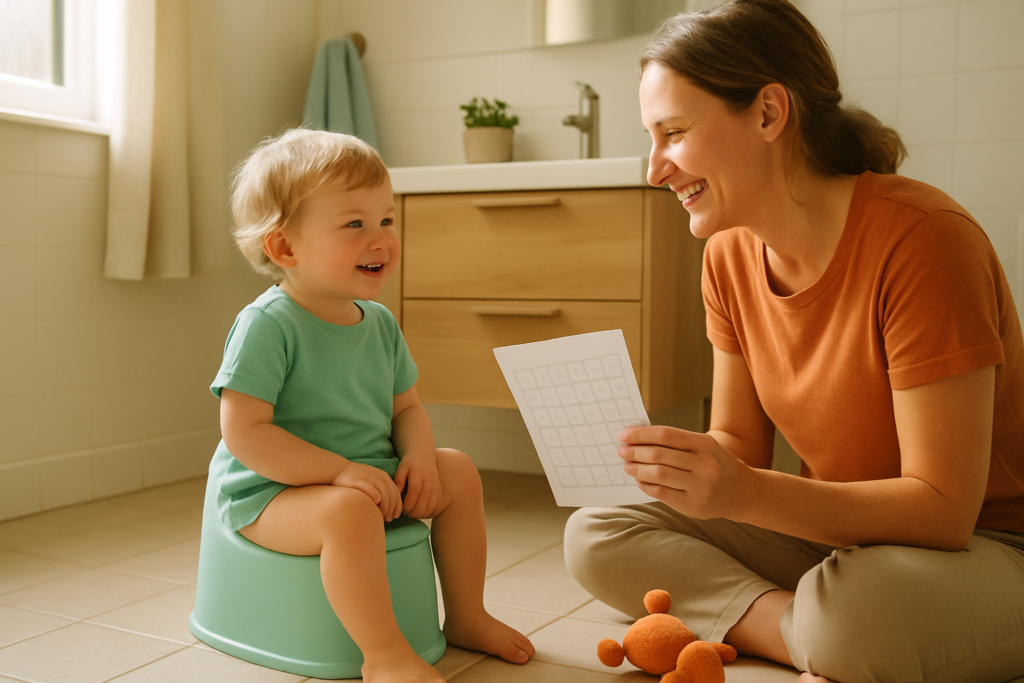
The sticker cards come in four sizes, used in that order: 3 squares, then 5, then 7, then 9. The reward comes fast at three squares so the child sees quickly that the system works, and then it gets rarer as the child improves, so the new habit outlasts the stickers instead of stopping the moment they run out.
Parents pick their own small rewards to go alongside the stickers, whatever feels meaningful for that child. This is never a single fixed chart with one set number of boxes to fill, the whole point of the mechanic is that the number climbs.
The first time it actually happens, that first sticker on the card, is worth celebrating together as a family moment, not just marking off. Watch this together when it happens for the first time:
What do parents get ready themselves?
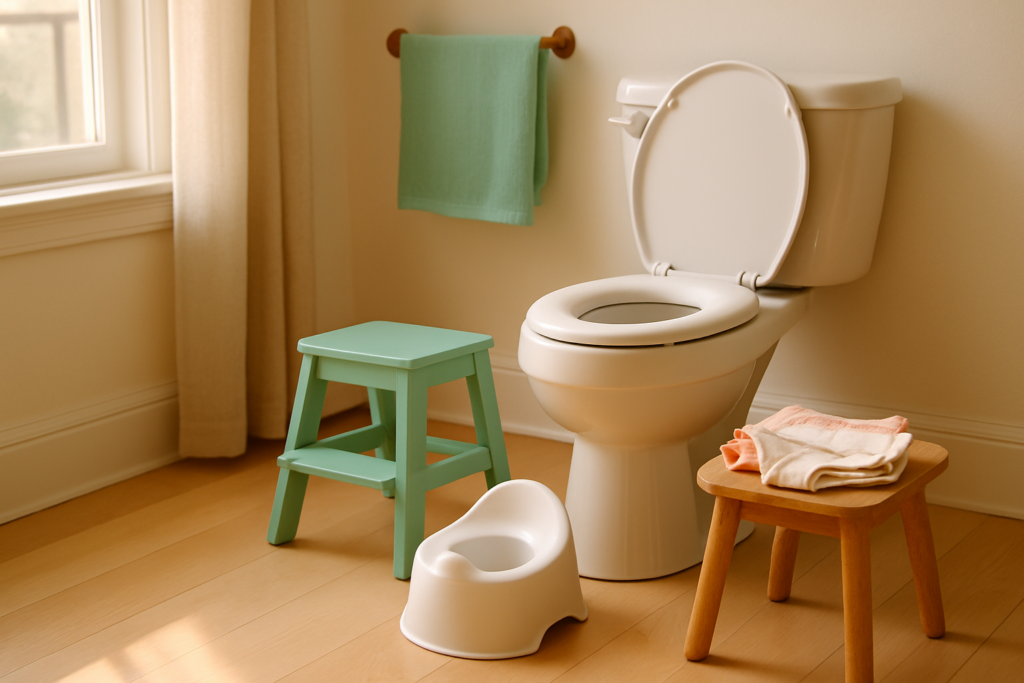
Alongside the teaching materials, most families have a potty ready, mostly for the first two or three days, a toilet seat reducer and a step stool for the move to the big toilet, and at least 15 pairs of regular cotton underwear. Training pants are deliberately skipped in this method, because a child feels wetness less clearly in them, and feeling it is part of learning.
It also helps to have something to protect the mattress and the sofa, a handful of small rewards on hand, and pull-ups for sleeping, since night dryness is a separate stage that comes later. For the full list laid out item by item, the complete potty training checklist walks through what to have on hand before you start.
How a kit differs from a potty, a book or a loose sticker chart
As an Amazon Associate we earn from qualifying purchases. Some links in this article are affiliate links: if you buy through them we earn a small commission, at no extra cost to you, and it does not affect what we recommend.
A potty on its own gives no plan for what to do on day one, day two, or the day it goes badly. A book gives a philosophy, which matters, but not the daily materials a parent actually hands to a two or three year old. Parents comparing options often come across Oh Crap! Potty Training, which lays out a similar underwear-first, no-training-pants philosophy but leaves the parent to assemble their own charts, cards and rewards from scratch.
What a full program adds on top of that philosophy is specific: what to do on day one, day two and day three, including on the days that go badly, plus somewhere to ask a question when they do. It also gives ongoing access to the same program, so a parent can return to it for a later child. To see the whole week laid out, the full 7-day method walks through it from start to finish.
What a complete kit looks like day by day
The first three days are spent mostly at home, since that is when a child learns the most, with short outings following once things settle. Those first outings tend to work best kept brief and close to home, a quick trip to the mailbox or a short errand, so the child gets practice recognizing the need to go somewhere new without the whole day riding on it. The method moves from potty to toilet, and the parent’s job across the week shifts from offering to asking, using the same question each time: ‘will you tell me when you need to pee?’
That question stays fixed only around a few moments, before and after sleep and before leaving the house, both during the training week and after it ends. Everywhere else, the aim is for the child to bring it up first, not for the parent to keep checking in.
Many parents find day four or five the hardest, not day two. By then the child has often heard ‘will you tell me when you need to pee?’ so many times that they push back, ignore the question, or have an accident right after answering it. That resistance is not a sign the method has stopped working, it is a fairly ordinary part of a toddler testing a new routine, and it tends to show up right around the point where the novelty of the potty has worn off but the habit is not yet automatic.
The fix is usually to ask less, not more, and to hand the child more responsibility for noticing and saying it themselves. A parent who backs off the constant checking in around day four or five often sees the child start to volunteer it instead, because the pressure of being asked has eased. For a fuller breakdown of what changes from one day to the next, what each day actually looks like covers the shift in detail.
Is your child ready for a kit yet?
Common signs of readiness include staying dry for a couple of hours at a stretch, showing interest in the bathroom or the potty, being able to follow a short instruction, and reacting to a wet or dirty diaper. According to HealthyChildren.org from the American Academy of Pediatrics, readiness varies a great deal between children, and there is no single correct age to begin.
A child who is frightened of the potty or the toilet is not ready yet. The honest move is to build familiarity first, let the child sit on it fully clothed, watch a sibling or parent use the toilet, and start the actual training later. A program keeps until then, there is no clock running.
Most children are dry in the daytime in about a week using a structured, reward-based approach. Some manage it in as little as three days, others take two to three weeks, and a child who is not ready yet should wait rather than start. Night-time dryness develops separately and typically later, according to HealthyChildren.org, so a program does not promise it as part of daytime training.
If a first attempt does not take, the method’s own advice is to stop and leave it a while before trying again, rather than pushing through. That pause is part of the process, not a sign it failed. If you are watching a preschool or daycare start date, how much time you need before preschool lays out a realistic timeline to work backward from.
The same structured approach is also used successfully with children who are autistic, have Down syndrome, or are non-verbal, usually over a longer stretch and by reading the child’s own signals rather than waiting to be told in words. If a child shows ongoing constipation, stool withholding, or repeated signs of a urinary infection, that belongs with a pediatrician rather than being worked through with a training program alone.
Where US parents get the full program
In the United States, the full program is sold as the 7-Day Potty Training Video Course, forty short videos of about three minutes each, grouped by day, along with a digital AI coach that answers questions any time of day or night. The sticker cards, tracking schedule and certificates are part of the course and are printed at home by the parent.
What carries over from the method is the same seven-day, reward-based approach: a day-by-day plan, a way to track this child’s own timing, and a reward system that fades out on purpose rather than stopping all at once.
A child frightened of the potty is not behind, and neither is a family starting later than a friend’s. The plan works the same whether it starts this month or next.
Frequently asked questions
What is the 3 day potty training rule?
The 3 day potty training rule is the idea that a child can be taught to use the potty in three consecutive days spent mostly at home, without diapers. Most structured methods, including this one, treat those first three days as the heaviest learning period, with short outings following once the child is more reliable. Some children do finish in about three days, though a full week is more typical.
What is the 10, 10, 10 rule for potty training?
This numeric rule is not part of this method. Rather than following a fixed rule about intervals or counts, this approach uses a tracking chart to learn when this particular child actually needs to go, and shifts from parent-led offering to the child's own signal over the course of the week.
What do pediatricians recommend for potty training?
The American Academy of Pediatrics, via HealthyChildren.org, generally recommends waiting for signs of readiness rather than starting by a fixed age, since readiness varies widely between children. If a child shows ongoing constipation, stool withholding, or signs of a urinary infection, that is a question for a pediatrician rather than something to work through with a training method alone.
Do I need a potty training kit, or is a potty enough?
A potty alone gives the child somewhere to go, but it does not tell a parent what to do on day one, day two, or the day an attempt falls apart. A kit or structured program adds the day-by-day plan, the tracking tools, and the reward system that a potty by itself cannot provide.
How often should I put my child on the potty?
Rather than offering the potty on a fixed interval, this method has the parent record when the child actually goes, using a tracking chart, and gradually shift from offering to asking the child to say it themselves. The main exceptions are before and after sleep and before leaving the house, which stay part of the routine both during and after training.
What should be in a potty training kit for a 2 year old?
For a two year old, a complete kit should include a day-by-day plan rather than just supplies, tracking schedules to learn that child's own timing, a graduated reward system that starts small and steps up, and simple certificates to mark the moment they get it. Alongside those materials, the parent typically has a potty, a toilet seat reducer, a step stool, and plenty of regular cotton underwear ready at home. The exact pieces matter less than having a plan that says what to do on a good day and on a hard one.
Ready for the next step?
The 7-Day Potty Training Video Course walks you through this program in forty short videos, grouped per day, with a digital AI coach you can ask a question at eleven at night on day four. The full handbook comes with it as a PDF to read and print. Nothing is shipped, so you can start today.
Sources
- HealthyChildren.org (American Academy of Pediatrics)
- HealthyChildren.org (American Academy of Pediatrics)
- HealthyChildren.org (American Academy of Pediatrics)
This article was written with AI assistance and checked by Dustin van de Sande.