3-Day Potty Training: Does It Actually Work, and What Happens on Day 4?


Yes, in the sense that three days at home is a real and useful start: most children are dry in the daytime in about a week, some in three days, others in two or three weeks. Three days is where your child learns the most because you are home and watching everything, but it is a checkpoint, not a finish line.
If your child is not showing signs of readiness yet, waiting a few more weeks and starting then will get you further than pushing through three rough days on a schedule that assumes they are ready when they are not.
What is the 3-day potty training method, exactly?
The basic version goes like this: diapers come off, cotton underwear goes on, you clear your calendar, and you stay home for three days straight. The idea is that a child who feels every accident in plain cotton learns faster than one cushioned by a diaper.
The approach is popular partly because of Potty Training in 3 Days, and it shares DNA with the older, more intense Oh Crap! Potty Training. If you want to see how the well-known books stack up against each other, how the popular potty training books compare is worth a look before you pick one to follow.
In its common form, the three days involve a lot of drinks, a lot of sitting, and a big, excited reaction for every success. What it gets right is real: three uninterrupted days at home means you actually see what your child does, and not switching back to diapers in the daytime keeps the lesson consistent instead of confusing.
Where the 3-day version usually goes wrong
The most common mistake is treating day three as a deadline instead of a checkpoint. A child who is mostly dry by day three has made genuine progress, not finished the job, and expecting them to be fully trained by dinnertime on day three sets everyone up to feel like it failed when it did not.
A second mistake is potty training by the clock: sitting a child down every twenty or thirty minutes because the schedule says so. That teaches your timing, not your child’s. The goal is for your child to tell you they need to go, and a fixed interval works against that because the child never has to notice the feeling themselves.
Other common issues: starting before any readiness signs have shown up, using training pants or pull-ups during the day (which blunt the feeling cotton underwear lets a child notice), and relaxing the moment three days are up, which is exactly when a wobble tends to show up.
What the signs of readiness actually look like
Concrete readiness signs include staying dry for longer stretches between diaper changes, telling you during or right after they have gone, showing interest in the bathroom or in you using it, being able to pull pants up and down, and following a simple two-step instruction.
Most children show some of these signs somewhere between 18 months and 3 years, and training in the United States typically begins between 2 and 3 years of age, according to the American Academy of Pediatrics. Age alone does not decide readiness; the signs do.
A child who is frightened of the potty or the toilet is not ready, no matter their age. The honest move is to build familiarity first, with no pressure, and start the actual training later.
If you are not sure where your own child stands, a short readiness quiz can help you read the signs more clearly before you commit to a start date.
What really happens on day 4 and day 5
Day four or five, not day two, is usually the hardest day of the whole process. By then the novelty has worn off, and your child starts pushing back on something specific: being asked over and over, "will you tell me when you need to pee?"
A child who has heard that question thirty times in two days gets bored of it and starts saying no just to say no. That is not a sign the training failed, it is a sign the question has become background noise.
The fix is to ask it less often rather than more, and hand more of the responsibility back to your child. Keep a few fixed moments that work well on their own, such as before and after sleeping and before you leave the house, and let the rest of the day be quieter. We cover this stretch in detail in why day 4 is the hardest day, including what to do when your child starts refusing outright.
Accidents during this stretch are part of learning, not a verdict on the whole attempt. If one happens, this short video is meant to be watched together right afterward, calmly, as part of moving on rather than dwelling on it.
Three days or seven days: what is the actual difference?
A three day plan covers the first stretch of at home learning and then stops, leaving the parent to figure out outings, naps, and setbacks alone. A seven day structure covers the same three days at home, then adds short outings and a plan for the days that go badly, which is usually days four and five.
| What happens | 3-day approach | 7-day structure |
|---|---|---|
| Days 1 to 3 | Home, diapers off, lots of sitting | Home, diapers off, watching and recording patterns |
| Day 4 to 5 | Usually undocumented, parent improvises | Planned for: fewer prompts, more child responsibility |
| Days 6 to 7 | Not typically covered | Short outings begin |
| Outings | No guidance given | Introduced gradually once home is steady |
| Who decides when to go | Often the clock or the parent | The child, once they can signal it |
| What counts as done | Dry by day 3 | Daytime dryness most of the time, roughly by the end of the week |
This seven day structure is what the Potty Training Box Method teaches: three days at home first, then short outings, built around rewards and aimed at the child eventually signaling the need themselves rather than being asked or sat down on a fixed interval. If you want to see what each day of a week looks like laid out day by day, that is the natural next read.
Nighttime dryness is a separate matter that usually comes later, sometimes well after daytime training is solid, and no method promises it on a fixed timeline.
How do you know when your child needs to go, if not by the clock?
You find out by recording what your child actually does, not by imposing a timetable on them. A tracking schedule is simply a record: time of drinking, time on the toilet, whether nothing happened, pee marked green for a success and red for an accident, poop marked the same way, and a notes column for anything else worth remembering.
It helps to let your child drink a full cup in one go rather than in sips spread across the afternoon. Only then can you see how much went in and how long it took before they needed to pee, which is exactly the pattern the schedule is built to show you.
Instead of constantly offering the potty, ask "will you tell me when you need to pee?" That single shift, from offering to asking the child to notice and say so, is what moves the responsibility from you to them. The exceptions worth keeping as fixed moments, during training and afterward, are before and after sleeping and before you leave the house.
What to have ready before day 1
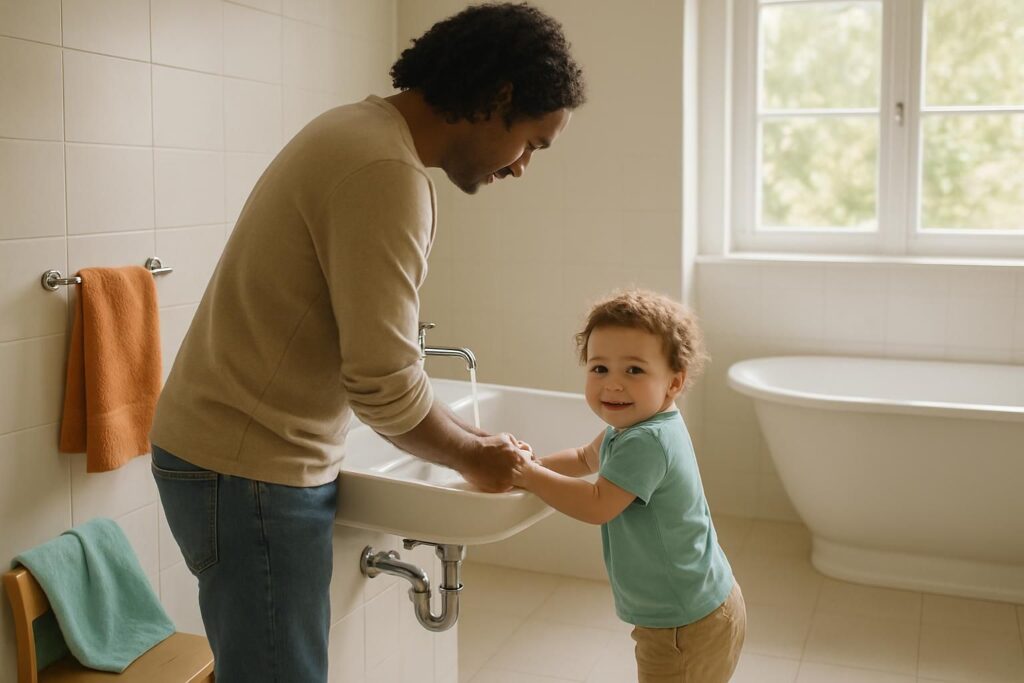
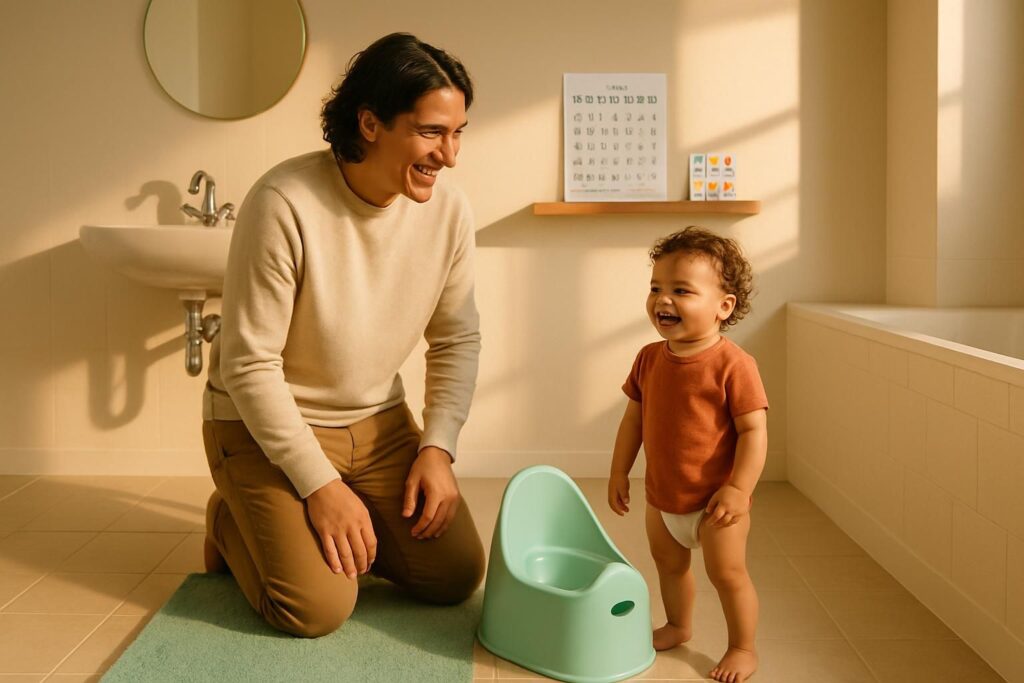
Before you start, it helps to have a potty on hand (mostly useful for the first three days), a toilet seat reducer for later, and a step stool for reaching the sink and toilet independently. These links earn this site a small commission if you buy through them, at no extra cost to you, and they do not change what we recommend.
As an Amazon Associate we earn from qualifying purchases. A simple option like the Ingenuity My Size Potty Pro covers the potty stage, a Frida Baby Drop Down Potty Training Seat works well as the toilet seat reducer once you move to the toilet, and a sturdy Dreambaby Step Stool handles the climbing part.
Beyond that: at least 15 pairs of cotton underwear, something to protect the mattress and sofa, a handful of small rewards, and pull-ups for sleeping. Clear three days on your calendar and let daycare know when you plan to start, so the approach stays consistent between home and drop-off. For the longer version of this list, the full checklist of what to have ready walks through all of it.
How rewards keep working after the first success
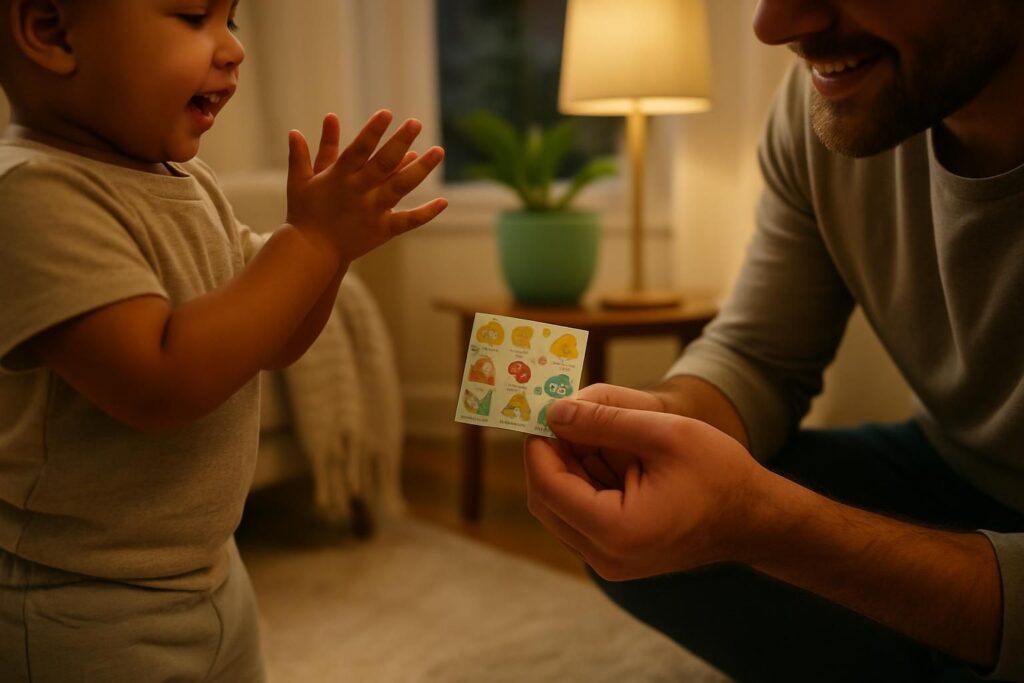
A single sticker chart often runs out of steam because the reward stays the same size while the behavior gets harder to keep up. A better setup uses cards of increasing size, for example four sizes used in order, so the reward comes quickly early on at the smallest size and then becomes rarer as your child improves.
That matters because a fast, easy win in the first days shows your child it works, while a reward that grows rarer over time means the habit, not the sticker, is what keeps the behavior going once the cards run out.
Two small certificates, one for pee and one for poop, work well as a finish line at the end of the week: a concrete, visible marker of what your child accomplished. Praise that names the specific thing your child did, "you told me you needed to go," tends to land better than a generic "good job."
What to do if three days comes and goes and nothing sticks
If three days pass with constant refusal, real distress, or no progress at all, stopping and waiting a few weeks before trying again is a legitimate part of the process, not giving up. Pushing through a failing attempt usually teaches a child to dread the bathroom rather than to use it.
Watch for fear, ongoing withholding, or visible distress as your cue to pause. Withholding stool, constipation, or pain during potty time belongs with a doctor or child health clinic rather than being worked through at home.
Children who are autistic, have Down syndrome, or are non-verbal are often trained successfully, usually over a longer stretch and by reading the child’s own signals closely rather than waiting to be told in words; the American Academy of Pediatrics covers this in more detail. If this is a second or third attempt after one that did not work, that is common and not a reason to expect a harder time this round. If an attempt stalls out, what to do if your child backslides covers the setback itself rather than starting the whole thing over as if it were new.
Where a structured program helps more than a 3-day sprint
A free article can tell you the theory, but it cannot tell you what to actually do when day four turns into a battle over sitting on the potty. That is the gap a structured plan fills.
The 7-Day Potty Training Video Course covers the same seven day structure as about forty short videos of roughly three minutes each, grouped by day, plus a digital AI coach you can ask questions of at any hour. The printable sticker cards, tracking schedule, and certificates are part of the course and are printed at home as you go.
What it adds over reading a free article is specificity: what to actually do on day one, two, and three, including the days that go badly, rather than a general idea of the approach. If you are about to start, what to actually do on day 1 is the most useful next step once you have decided to begin.
Frequently asked questions
How many accidents are normal on day 3 of potty training?
Several accidents on day three is normal and does not mean the attempt is failing. Most children are still learning to notice the feeling and connect it to action at this point, and the number of accidents usually drops noticeably over the following few days rather than stopping all at once.
At what age should my 3 year old be potty trained?
There is no single age every child should be trained by. Toilet training in the United States typically begins between 2 and 3 years of age and most children are trained by 4, according to the American Academy of Pediatrics, but readiness signs matter more than the date on the calendar.
Can you potty train with pull-ups?
Pull-ups during the day can blunt the feeling a child needs to notice in order to learn, since they absorb moisture the same way a diaper does. Cotton underwear during the daytime training itself lets a child feel wetness clearly, while pull-ups remain a reasonable choice for sleep.
Is potty training easier for boys or girls?
There is no reliable evidence that one sex trains faster or easier than the other overall; individual children vary far more than any pattern by sex. Readiness signs, temperament, and timing matter much more than whether a child is a boy or a girl.
What do you do on day 4 after 3-day potty training?
On day four, ease off asking your child whether they need to go, since repeating the same question too often tends to cause resistance right around this point. Keep a few fixed moments, like before and after sleep and before leaving the house, and let your child take more responsibility for noticing and telling you the rest of the time.
Can you really potty train in 3 days?
Three days at home can genuinely teach a child the basics of using the potty or toilet, and some children are mostly dry by the end of it. For most children, full daytime dryness takes closer to a week, with day four or five often being the hardest stretch rather than the earlier days.
Ready for the next step?
The 7-Day Potty Training Video Course walks you through this program in forty short videos, grouped per day, with a digital AI coach you can ask a question at eleven at night on day four. The full handbook comes with it as a PDF to read and print. Nothing is shipped, so you can start today.
Sources
- American Academy of Pediatrics (HealthyChildren.org) (Toilet training in the United States typically begins between 2 and 3 years of age and…)
- American Academy of Pediatrics (HealthyChildren.org) (Children who are autistic, have Down syndrome, or have other developmental differences…)
This article was written with AI assistance and checked by Dustin van de Sande.