Potty Training Day 1: What to Actually Do, Morning to Bedtime


On day 1, the diaper comes off at wake up, your child wears cotton underwear, and you stay home all day. Your child drinks a full cup in one go so you can time how long it takes before they need to pee. From hour one, you ask your child to tell you when they need to go.
This is the first day of the seven day method used in the 7-Day Potty Training Video Course, a program built around short daily videos and a printable tracking chart rather than a strict schedule. The point of day 1 is not a dry day. The point is information: how your child’s body actually works, and the first attempt at your child telling you instead of the other way around.
What happens on day 1 of potty training, in short
You stay home all day with no outings planned. The diaper comes off in the morning and does not go back on until bedtime. Your child drinks a full cup of something in one go so you can see, and write down, how long it takes before they need to pee. You ask your child to tell you when they need to go, rather than putting them on the potty by the clock, and you treat every accident as useful information rather than a setback.
What you want ready before your toddler wakes up
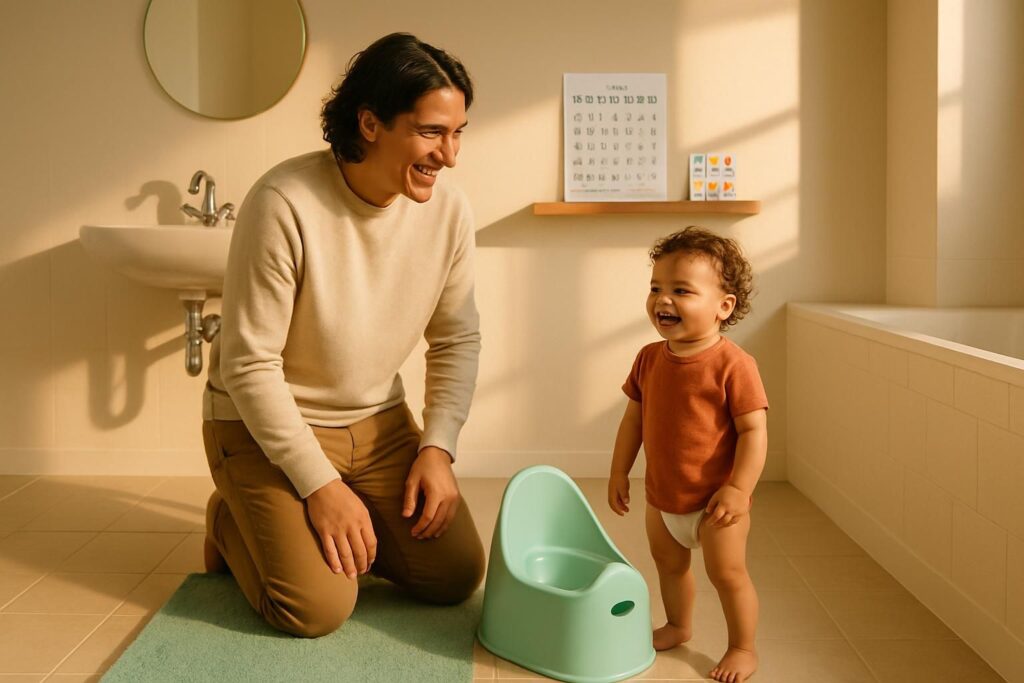
It helps to have a potty out for the first few days, along with a toilet seat reducer and step stool for when you move to the toilet a little later in the week. If you need a recommendation for any of these, a product like the Ingenuity My Size Potty Pro or a Dreambaby Step Stool works well for this. As an Amazon Associate we earn from qualifying purchases. Some links in this article are affiliate links: if you buy through them we earn a small commission, at no extra cost to you, and it does not affect what we recommend.
Beyond that, you want at least fifteen pairs of cotton underwear, something to protect the mattress and the sofa, a handful of small rewards, and pull-ups for sleeping only, since night dryness is a separate stage that comes later. Clear your calendar for three days at home. A simple picture book can help your child get used to the idea beforehand, something like Potty works well for this age group. For a complete rundown, the full checklist of what to have ready walks through everything in one place.
Is your child actually ready to start tomorrow?
A child who is ready usually stays dry for a couple of hours at a time, shows some awareness of wetting or soiling, can follow a simple instruction, shows curiosity about the bathroom, and wants to help with getting dressed and undressed. According to the American Academy of Pediatrics, these kinds of physical and behavioral signs are the ones worth watching for before starting, rather than age alone.
A child who is frightened of the potty or the toilet is not ready yet. The honest move is to build familiarity first with no pressure, and start the week later. The course keeps until then, and starting a week late costs far less than starting two weeks too early and having to stop partway through.
If you are not sure where your child stands, a short readiness check can help you decide before you commit a week to it.
Morning: the diaper comes off and does not go back on
Take the diaper off at wake up and make a small moment of it with your child, so the day feels like a change rather than a punishment. From here on it is cotton underwear, not training pants, because your child needs to actually feel wet to connect the feeling to the event.
Do one sit first thing in the morning, then stop sitting your child down by the clock for the rest of the day. Instead, introduce the sentence you will repeat all week: ‘You tell me when you need to pee.’ Then give the first full cup of water or juice, drunk in one go rather than sipped over an hour, and write down the time. Keep clothing simple for the day, underwear and a t-shirt, nothing with buttons or tight waistbands that slow your child down.
How the tracking chart works and what you write down
The tracking chart has six columns: time of drinking, time on the toilet, whether nothing happened, pee marked green for a success or red for an accident, poop marked the same way, and a notes column. Drinking the full cup in one go matters here, because it is the only way to see the real link between how much went in and how long it took before your child needed to go.
| Moment | What you do | What you write on the chart |
|---|---|---|
| Wake up | Diaper off, underwear on, first sit | Start time |
| After first full cup | Drink in one go, then wait and watch | Time of drinking |
| Mid-morning | Ask ‘you tell me when you need to pee’ | Time on toilet, result |
| Lunch | Offer a drink, watch for signals | Time of drinking |
| Afternoon | Free play, no scheduled sits | Any accidents, notes |
| Before nap | One of the fixed around-sleep sits | Result |
| Evening | Last drink, final sit before bed | Time, result |
| Bedtime | Pull-up on for sleep | Nothing written overnight |
The chart is there to record what your child actually does, not to tell your child when to go. By the end of day 1, most parents can already see a rough interval for this particular child, even if it is a messy one. The chart and sticker cards are part of the video course and are printed at home, so you are not left hunting for a separate download.
Midday: what to do when the first accident happens
Stay neutral and matter of fact when it happens, with no scolding and no big reaction either way. Say simply what happened and where pee belongs, then change together and let your child help pull up the new underwear. Mark it in red on the chart. It is data, not failure, and a full day of mostly accidents on day 1 is common, not a sign that anything is going wrong.
If this is the first accident of the day, it can help to watch something together right afterward to reset the mood before moving on.
How often should you ask, and why not every 30 minutes?
Putting your child on the potty every thirty or sixty minutes on the clock trains them to wait for you to ask, rather than noticing their own body’s signal. That is a different approach from the one built into the Potty Training Box Method, and it tends to produce a child who holds on for the next scheduled sit instead of learning to recognize the feeling themselves.
Instead, you watch for signals such as squirming, going quiet, or heading for a corner, use what the chart has already shown you about this child’s rough timing, and keep repeating ‘you tell me when you need to pee.’ The only fixed moments that stay, even after training is finished, are before and after sleep and before you leave the house. Everything else is scaffolding that comes down fast as your child starts to take the lead.
Afternoon: rewards, stickers and the first success
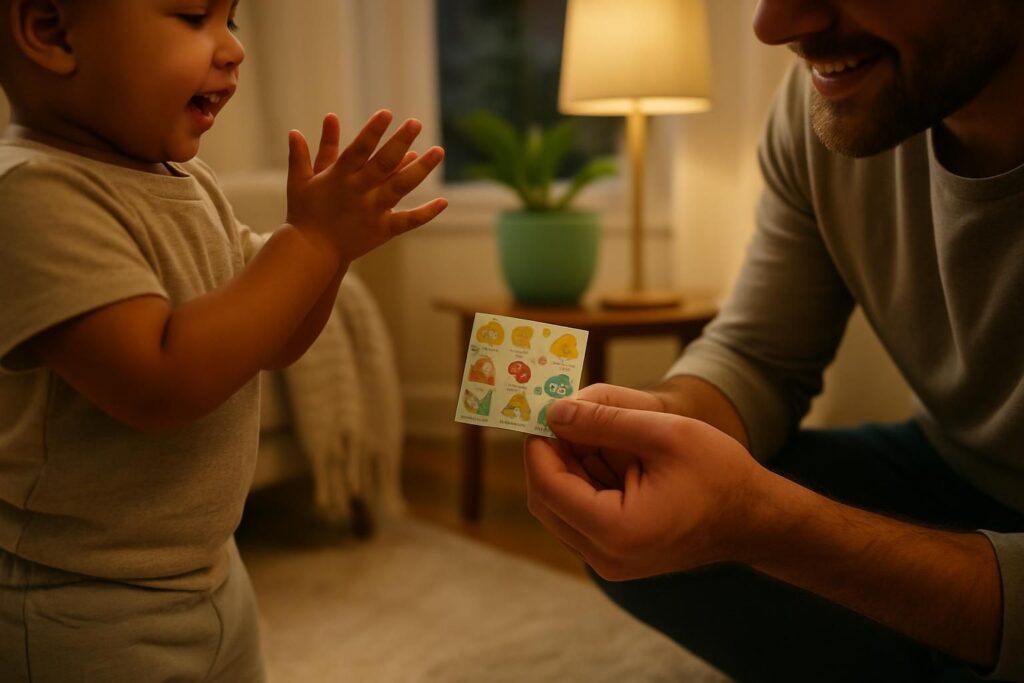
The sticker cards run in four sizes, three squares, then five, then seven, then nine, used in that order. The reward comes quickly at three squares so your child sees right away that it works, then it gets rarer as the card grows, so the habit keeps going after the stickers stop mattering as much.
Praise specifically. Say what your child did, ‘you told me you needed to go,’ rather than a general ‘good girl’ or ‘good boy.’ Keep small rewards small, a sticker or a few extra minutes of a favorite activity is plenty. The pee certificate and poop certificate arrive at the end of the week as the finish line your child is working toward, not something handed out for a single success.
Evening and bedtime on day 1
Time the last drink so there is enough room for one more sit before bed. Put a pull-up on for sleep, since night dryness is a separate stage that typically comes weeks or months after daytime training, not something day 1 is meant to achieve.
Leave the chart somewhere you will see it first thing in the morning, by the coffee maker or the front door. If your partner, a grandparent, or anyone else will be around tomorrow, give them the exact same line to use, ‘you tell me when you need to pee,’ so your child hears one consistent message rather than different rules from different people.
What a realistic day 1 looks like, and what it does not
Most children are dry in the daytime in about a week using this kind of method, some in as little as three days, others take two or three weeks, and that range is entirely normal. Day 1 often means several accidents and few or no catches, and that is still a perfectly normal first day, not a sign the method is not working.
Many parents expect day 2 to be the hardest, but it is usually day 4 or 5 that brings real resistance, once your child gets tired of being asked the same question over and over. You can read why day 4 is usually the hardest for what to do when that happens. If your child is clearly not ready on day 1, stopping and trying again in a few weeks is part of the method, not giving up on it. The same approach is also used successfully with autistic children, children with Down syndrome, and children who are non-verbal, usually over a longer stretch and by reading signals rather than waiting for words.
It is also worth asking whether three days is really enough before you set expectations around a fixed number of days.
What you do on day 2, in one paragraph
Day 2 follows the same basic shape as day 1, with one difference: you lean a little harder on your child’s own signaling and a little less on offering. You are still home, with outings starting only after the first three days are done. For the rest of the week, what each day of the week looks like lays out day by day, and the complete 7-day method is the place to start if you have not yet decided how to approach the week.
Frequently asked questions
What should I expect on day 1 of potty training?
Expect the diaper to come off at wake up and stay off all day, several accidents, and a full cup of a drink given in one go so you can time how long it takes before your child needs to pee. Staying home with no outings and writing results on a tracking chart are the two things that make the day useful even if it is messy.
How many accidents are normal on day 1 of potty training?
It is common for day 1 to include several accidents and few or no successful catches, and that is a normal first day rather than a sign the method is failing. Accidents on day 1 are how your child starts connecting the physical feeling to the act, so they are treated as information, not failure.
What is the hardest day of potty training?
Day 4 or 5 is usually the hardest, not day 2, because that is when resistance to the repeated question 'you tell me when you need to pee' tends to build. A useful adjustment at that point is to ask less often and give your child more room to take the lead on their own.
Should I put my toddler on the potty every 30 minutes on the first day?
No, putting your child on the potty every thirty or sixty minutes teaches them to wait for you to ask rather than to notice their own body's signal. Instead, watch for your child's individual signs, use what the tracking chart shows about their rough timing, and keep asking them to tell you when they need to go.
Should my child wear training pants or regular underwear on day 1?
Regular cotton underwear works better than training pants on day 1, because your child needs to actually feel wet to learn the connection between the feeling and the event. Training pants absorb too well for that feedback to register clearly.
Do we have to stay home all day on the first day of potty training?
Yes, staying home for the first day, and usually the first three days, is part of the method, since that is when your child learns the most and accidents are easiest to manage without the stress of being out. Short outings are introduced after that initial stretch at home.
Ready for the next step?
The 7-Day Potty Training Video Course walks you through this program in forty short videos, grouped per day, with a digital AI coach you can ask a question at eleven at night on day four. The full handbook comes with it as a PDF to read and print. Nothing is shipped, so you can start today.
Sources
This article was written with AI assistance and checked by Dustin van de Sande.