How Long After a Toddler Drinks Do They Pee? What the Timing Tells You

Most toddlers pee somewhere between 20 and 60 minutes after finishing a full drink, but the range is wide and depends on the child’s age, bladder size, and how much they drank. Younger toddlers go sooner and with less warning. The only timing worth planning around is the one you observe in your own child over a few days.
How long after drinking does a toddler usually pee?
A 20 to 60 minute window is the usual answer, but it is a starting point, not a schedule. A two year old who drinks a full cup of water might pee in 25 minutes one day and 45 minutes the next, depending on how active they are, how warm the room is, and how much was already in their bladder.
Younger toddlers have smaller bladders and less practice noticing the signal, so they tend to go more often and with shorter, less predictable warning. As a child gets closer to three, the bladder holds more and the gap between drinking and peeing generally stretches out. None of this is guaranteed on a fixed timeline for every child, which is exactly why a general average cannot tell you when your own child will need the potty today.
Why one full cup tells you more than sipping all morning
If you want to learn your child’s drink-to-pee timing, offer the drink all at once and let your child finish the cup in one go, rather than letting them sip on and off across the morning. That is the only way to know exactly how much went in and how long it took to come back out.
Sipping spreads the signal out so thin you cannot read it. A few sips at 9am, a few more at 9:20, a splash at 9:40, and by the time your child pees at 10am you have no idea which sip it came from or how long the gap really was. A half cup finished slowly does not give you the same information as a full cup finished in one go, so it is worth asking your child to drink it down rather than carry it around.
In practice this can be as simple as saying “let’s finish this before you go play” and sitting with them for the minute it takes. It does not need to feel like a test, just a normal part of snack or drink time.
What the tracking chart actually records (and what it is not)
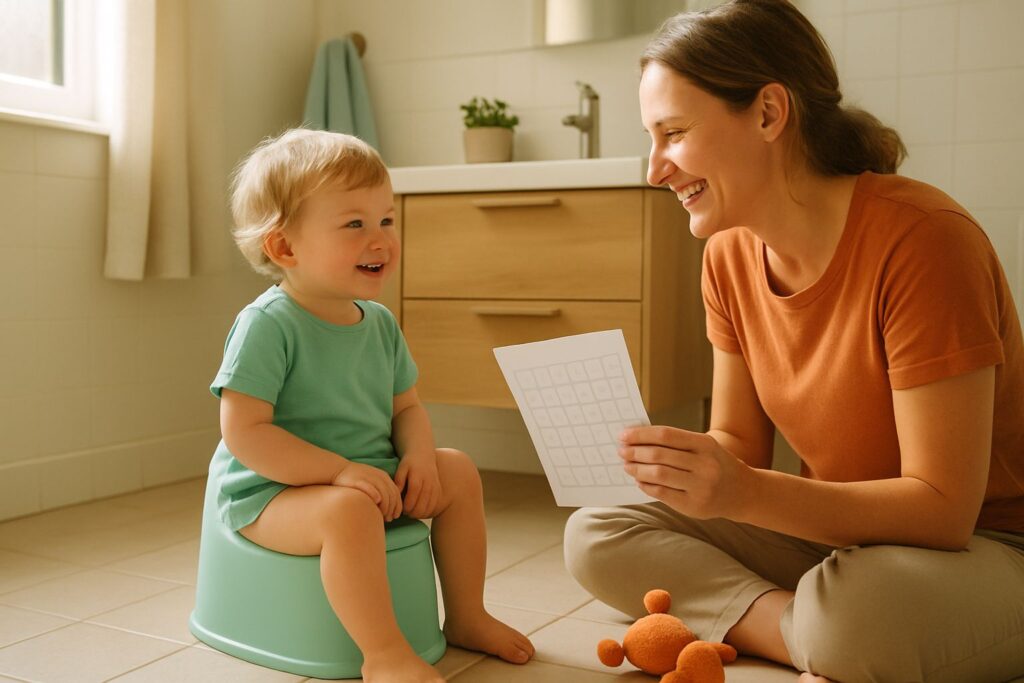
A tracking schedule is built to capture exactly this kind of pattern. Each row has a column for the time your child drank, the time they were on the toilet or potty, a yes or no column for whether nothing happened, a column for pee marked green for a success or red for an accident, a column for poop marked the same way, and a notes column for anything else worth remembering.
| Column | What you write | What it tells you |
|---|---|---|
| Time of drinking | The clock time a full cup was finished | Your starting point for the gap |
| Time on the toilet | When your child sat down | Whether the timing lined up |
| Nothing happened (yes/no) | Tick if the sit was empty | You offered too early or too often |
| Pee (green/red) | Green for a success, red for an accident | Whether the timing worked |
| Poop (green/red) | Green for a success, red for an accident | A separate pattern to track |
| Notes | Anything unusual: a big drink, a nap, a new place | Context for the other columns |
Green marks a success and red marks an accident, nothing more judgmental than that. The point of filling this in is to learn this particular child’s pattern, not to build a fixed timetable you then impose on them. Most families can see a clear pattern within about two weeks of charts, and once you see it, the chart has done its job and starts coming down rather than staying in use forever.
How often do toddlers pee in a day, and how long can they hold it?
Most toddlers pee several times across the day, and that frequency drops naturally as bladder capacity grows with age. Staying dry for about two hours is a commonly cited sign that a child’s bladder is starting to store urine rather than releasing it the moment it fills, according to the American Academy of Pediatrics.
Holding on is a skill your child builds during training, not something they need to already have before you start. A few concrete signs tend to show up around the same time: staying dry for about two hours at a stretch, telling you or showing you that a diaper is wet or soiled, showing curiosity about the potty or toilet, and being able to pull pants up and down with little help. If you are not sure whether your child is showing enough of these to start, a short readiness quiz can help you check before you dive in.
So when do you put your child on the potty after a drink?
Early in training, you offer the potty after a drink so you can gather information, not because a clock says it is time. This is scaffolding, and it comes down as your child starts to lead. Rather than scheduling sits every 20 or 30 minutes, which is a different and competing approach, the aim is to get to the point where you ask your child a simple question: will you tell me when you need to pee?
A few moments stay fixed, during training and after it: before and after sleep, and before you leave the house. Outside of those, counting out intervals on a clock tends to stall progress rather than speed it up, because it keeps the adult in charge of timing instead of the child. If you are curious why that approach can backfire, there is more on putting your toddler on the potty every 15 or 30 minutes, and on why timed sits actually slow you down.
The Potty Training Box Method is built around this shift from offering to asking. It runs over about a week, starting with three days at home, moving from potty to toilet, and working toward the moment the child signals the need on their own rather than being walked to the bathroom on a schedule.
Reading the pattern: what the numbers on your chart mean by day three
By day three, look back over your rows. If the gap between drinking and peeing is shortening, that is normal while your child is still learning to hold on, and it usually lengthens again as the week goes on. If it is lengthening already, your child may be getting the hang of holding faster than expected.
If you see more “nothing happened” rows than successes, that is a sign you are offering the potty too often rather than too rarely. The fix is simple: space the offers out and start asking your child directly instead of walking them over automatically. As the days pass, the goal is to hand the responsibility back, so your child is the one announcing the need rather than you reading it off a chart.
Day 4 or 5 is usually the hardest, and the timing question is often why
Resistance tends to show up on day four or five, not day two, and it is often connected to this exact question. By that point a child has been asked “will you tell me when you need to pee” so many times that they get tired of hearing it, and some push back by holding on or ignoring the potty altogether.
The fix is to ask less often, not more, and let your child carry more of the responsibility themselves. An accident at this stage is part of learning, not a sign that the week has failed or that you need to start over. If an accident just happened, this short video is meant to be watched together right afterward, to turn the moment into something calm rather than a scolding.
There is more detail on why day 4 is usually the hardest, and on what to do in the moment after an accident. If an attempt genuinely is not working after a real try, pausing for a while before trying again is part of the method, not a step outside it.
When the drink-to-pee timing is a question for the doctor, not a chart
A very long stretch with no pee, pain or straining when peeing, blood in the urine, a sudden strong smell, or a sudden change in a pattern that was previously predictable are all reasons to call a doctor or pediatric clinic rather than adjust your chart. These are medical questions, and no chart or training plan can answer them.
Worries about dehydration also belong with a doctor, not a potty training schedule. Night-time dryness is a separate matter that develops later than daytime dryness and on its own timeline; if bedwetting continues past age six, that is also worth discussing with a doctor, as the American Academy of Pediatrics and the National Institute of Diabetes and Digestive and Kidney Diseases both cover in more detail.
Where the tracking chart and the day-by-day plan come from
If you want the full week laid out day by day, rather than piecing the timing together on your own, the 7-Day Potty Training Video Course carries the same method across forty short videos of about three minutes each, grouped by day, with a digital AI coach you can ask questions at any hour. The tracking schedules, sticker cards, and certificates are part of the course and are printed at home as you go.
As an Amazon Associate we earn from qualifying purchases. Some links in this article are affiliate links: if you buy through them we earn a small commission, at no extra cost to you, and it does not affect what we recommend.
It is worth having a few things ready before you start, whatever plan you follow: a potty, a toilet seat reducer, a step stool, plenty of cotton underwear, something to protect the mattress and sofa, and small rewards on hand. A step stool with a wide, stable base makes it much easier for a toddler to climb up and sit independently, and a non-slip step stool search on Amazon is a reasonable place to start looking.
For the full plan from the first morning onward, see the full day-by-day plan for the first week.
Frequently asked questions
How long after drinking do toddlers pee?
Most toddlers pee somewhere between 20 and 60 minutes after finishing a full drink, but this varies a lot by age, bladder size, and how much they drank. Younger toddlers tend to go sooner and with less warning. The only reliable way to know your own child's timing is to track it for a few days rather than rely on an average.
How often should a toddler pee in a day?
Most toddlers pee several times across a day, and that frequency naturally drops as bladder capacity grows with age. There is no single correct number, and a wide range is normal. A sudden, noticeable change from your child's usual pattern is more worth noting than the raw count on any one day.
My toddler hasn't peed in 6 hours. Should I be worried?
A long stretch with no pee, especially alongside signs like discomfort, a fever, or very little fluid intake, is a question for a doctor or pediatric clinic rather than something to wait out. Dehydration and bladder concerns are medical matters, not potty training ones. When in doubt, call rather than guess.
How long can a toddler hold their pee?
This varies widely and grows with age and practice. Staying dry for about two hours is often cited as a sign a child's bladder is starting to store urine rather than release it immediately. Holding on for longer is a skill that develops during potty training, not something a child needs to already have mastered before starting.
Should I put my toddler on the potty 20 minutes after every drink?
Not as a fixed rule. Early in training, offering the potty after a drink helps you gather information about your child's pattern, but the goal is to move toward your child telling you when they need to go, not to keep them on a timed schedule indefinitely. Sitting a child down every 20 or 30 minutes by the clock tends to slow progress rather than speed it up.
At what age do children typically stay dry at night?
Night-time dryness develops later than daytime dryness and on a separate timeline for every child. Bedwetting past age six is common enough that it is worth discussing with a doctor rather than assuming something is wrong, and it is a different conversation from daytime potty training.
Ready for the next step?
The 7-Day Potty Training Video Course walks you through this program in forty short videos, grouped per day, with a digital AI coach you can ask a question at eleven at night on day four. The full handbook comes with it as a PDF to read and print. Nothing is shipped, so you can start today.
Sources
- American Academy of Pediatrics, HealthyChildren.org (Staying dry for about two hours is a commonly cited sign that a child's bladder is star…)
- American Academy of Pediatrics, HealthyChildren.org (Night-time dryness develops on a separate timeline and bedwetting past age six is worth…)
- National Institute of Diabetes and Digestive and Kidney Diseases (NIH) (Bladder control problems and bedwetting in children are medical topics worth discussing…)
This article was written with AI assistance and checked by Dustin van de Sande.