What Counts as Potty Trained? How to Know When Your Child Is Actually There

Potty trained means your child feels the urge to pee or poop, tells you or goes on their own, and stays dry through the day with only occasional accidents. It refers to daytime dryness; night-time dryness is a separate, later milestone. Most children reach this stage in about a week of focused training, though some take two to three weeks.
That is the whole definition, and it is worth saying plainly because so many parents measure their child against something stricter: zero accidents, nighttime dryness, or full bathroom independence. None of those are part of the basic milestone. A child who still has an accident now and then, still wears a pull-up to bed, and still needs help with a tricky snap on their pants is, by the ordinary meaning of the phrase, potty trained during the day.
What Counts as Potty Trained, and What Does Not
Your child counts as potty trained once they feel the urge, communicate it or act on it themselves, and can hold on for a short stretch while they get to the bathroom. Pulling pants down and up with a little help, sitting and getting off safely, and needing a reminder before a nap or before you leave the house all still fall inside the definition.
What does not have to be in place yet: wiping cleanly after a poop, staying dry all night, using an unfamiliar public bathroom without an adult nearby, or managing buttons and zippers alone. These are separate skills that usually arrive months after daytime dryness, not prerequisites for it. It also still counts if your child is using a potty rather than the toilet at this stage; moving to the toilet comes later and is its own small transition.
Where Your Child Is Right Now: the Four Levels of Potty Trained
Potty trained is not one single achievement reached all at once; it is a handful of separate skills that build on top of each other, usually in roughly this order. Daytime dryness is the first and by far the biggest jump. Wiping independently, especially after a poop, tends to lag months behind it. Nighttime dryness is a different kind of control the body develops on its own timeline, and daycare-level independence is really about clothing and speaking up rather than bladder control itself.
| Level | What your child can do | Typical timing |
|---|---|---|
| Daytime dry | Feels the urge, says it or goes, holds on briefly | Often within 1 to 3 weeks of starting |
| Wiping after poop | Cleans up with little or no adult help | Usually months after daytime dryness |
| Daycare-level independence | Manages pants, speaks up to a teacher, follows a group bathroom routine | Varies by program and child |
| Dry overnight | Bladder holds through a full night’s sleep | A separate milestone, often well after daytime training |
Toilet training depends on your child first becoming aware of their own bladder and bowel signals and coordinating that awareness with the physical steps of getting to a bathroom, according to the American Academy of Pediatrics (HealthyChildren.org). That is why pushing ahead of that awareness rarely goes well, and why two children of the same age can be at very different points on this table.
Is There a Difference Between Potty Trained and Toilet Trained?
In everyday use, the two phrases mean the same thing: your child recognizes the need and acts on it without a diaper. The wording difference is mostly about equipment and age. ‘Potty trained’ tends to describe a younger child using a freestanding potty chair, while ‘toilet trained’ is the term pediatric sources and daycare paperwork lean on more often, especially once a child has graduated to the household toilet.
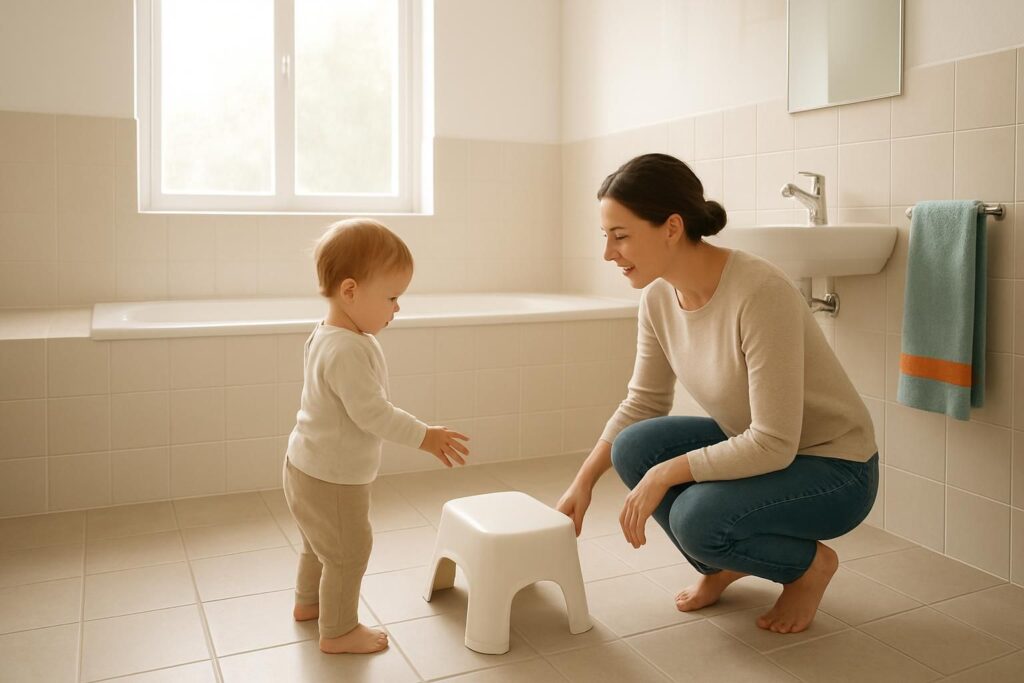
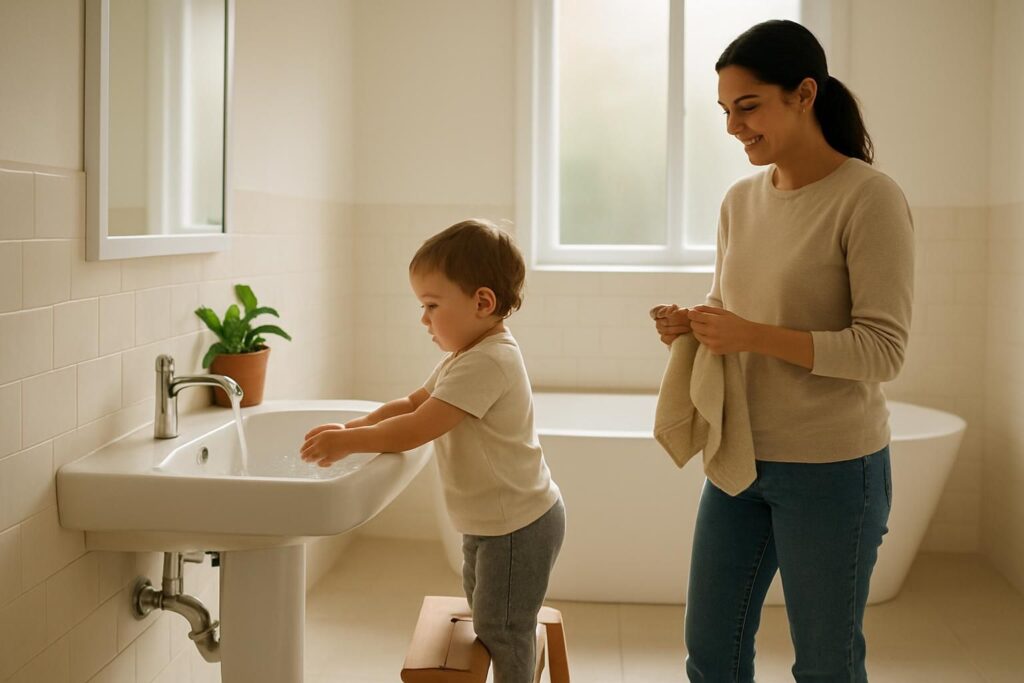
The distinction matters in practice because your child is eventually going everywhere else: a grandparent’s house, a restaurant, preschool. None of those places have the potty chair from home. Moving from potty to toilet is worth treating as its own small step rather than assuming it happens automatically. A toilet seat reducer and a step stool make that switch much less intimidating, since an adult-sized seat and a counter-height sink are built for nobody under four feet tall.
What Does Daycare or Preschool Mean When They Say “Potty Trained”?
Most programs mean something fairly specific: no diapers during the day, your child tells an adult when they need to go, they can manage pants with minimal help, and they can handle a scheduled group bathroom trip along with the rest of the class. That is a narrower bar than full independence, but a firmer one than just being mostly dry at home.
Wiping after a poop is often still assisted at this age, and policies differ widely from one center to another, so this is a question worth asking directly rather than assuming. Also ask what happens when there is an accident, since some programs call a parent immediately and others simply change the child and carry on, and ask how many changes of clothes they want you to keep on hand.
Call the specific center rather than assuming a standard policy exists across daycares or preschools; requirements vary by state, by age group, and sometimes by classroom. Building in a buffer of several weeks before the actual start date gives you room to practice without the deadline itself adding pressure. If you want a clearer sense of how much runway to leave, how much time you need before preschool starts walks through that in more detail.
How Do You Actually Know Your Child Is There? Signs to Look For
The clearest sign is your child announcing the need before you ask, on their own, for several days in a row. A second sign is holding on for a minute or two instead of going the instant the urge hits, which shows the muscle control and the awareness are both present, not just one of them.
Staying dry after a nap, after a car ride, or through a morning out without being reminded every twenty minutes are all good evidence. As a rough marker, two to three weeks of mostly dry days, with only the occasional accident, is a reasonable point to say your child has arrived rather than just having a lucky week.
If you are not sure whether what you are seeing adds up to readiness, a short readiness quiz can help you line the signs up against each other instead of guessing from memory.
Why the Child Saying It Is the Real Finish Line, Not the Clock
The goal of potty training is not a parent running a timer and placing a child on the potty every thirty minutes. The goal is the moment your child says, on their own, that they need to go. Everything leading up to that is just scaffolding that comes down once it has done its job.
In practice that means asking your child directly, ‘will you tell me when you need to pee?’ rather than repeatedly offering the potty on a fixed interval. A tracking sheet that records what your child actually drank, when they sat on the toilet, and whether it was a success or an accident is there to teach you your own child’s timing and patterns, not to hand you a schedule to enforce. It works best when your child drinks a cup in one go rather than sipping it over an hour, since that is the only way to see how much went in and how long it then takes before they need to pee. It is a record of what already happened, not a plan for what should happen next.
The standing reminders that are worth keeping, during training and well after it, are before and after sleep and before you leave the house. Outside of those two moments, the aim is to ask less often over time so your child takes on more of the responsibility themselves. This is the core idea behind the Potty Training Box Method, a seven day program that spends the first three days at home before moving to short outings, shifts the child from potty to toilet, and uses a reward system that gets harder to earn as the child improves rather than stopping abruptly. You can read what each day of the week actually looks like if you want the day by day breakdown, and why a sticker chart should get harder explains the reasoning behind the escalating rewards specifically.
How Long Does It Take to Go From “Training” to “Trained”?
Most children reach daytime dryness in about a week of focused training. Some manage it in as few as three days, and others take two to three weeks, and both are completely ordinary outcomes rather than something going wrong. Children commonly begin showing readiness signs between 18 and 24 months and are typically trained somewhere between 24 and 36 months, according to Nationwide Children’s Hospital (Nationwide Children’s Hospital).
A child who is frightened of the potty or the toilet is not ready yet, and the honest move is to build familiarity first and try again later rather than pushing through the fear. If an attempt does not work, stopping and waiting a while before trying again is part of the approach, not a failure of it.
Children who are autistic, have Down syndrome, or are non-verbal are often trained successfully too, usually over a longer stretch, by reading the child’s individual signals rather than waiting for them to say the words. Night-time dryness develops separately from daytime control and on its own schedule; it is not something training promises or speeds up (HealthyChildren.org). If you want the full picture on that half of the puzzle, night potty training covers it separately.
Does Your Child Stop Being Potty Trained After a Setback?
No. A run of accidents after a new sibling arrives, a move, an illness, or starting daycare does not undo the milestone your child already reached. Regression is common and usually temporary, and it says more about the stress of the moment than about whether your child actually learned the skill.
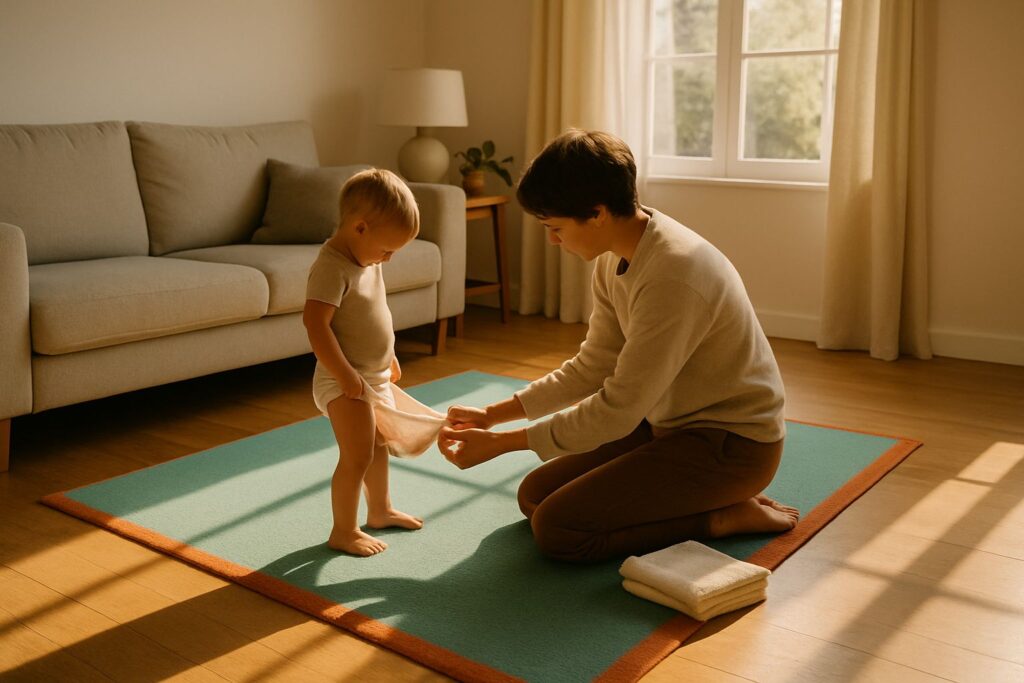
What usually helps is less pressure rather than more: fewer questions about whether they need to go, easy on and off clothing, and a calm, unbothered cleanup when an accident happens. Making a big deal of it, in either direction, tends to extend the rough patch rather than shorten it.
Right after an accident is often a good moment to watch something together rather than talk it through in the heat of the moment.
Some things are worth a call to your child’s doctor rather than waiting out: pain while peeing, holding in poop on purpose, ongoing constipation, or bedwetting that continues past age 6. Those are medical questions, not training ones, and a pediatrician or child health clinic is the right place to raise them.
What to Do if Your Child Is Not There Yet
As an Amazon Associate we earn from qualifying purchases. Some links in this article are affiliate links: if you buy through them we earn a small commission, at no extra cost to you, and it does not affect what we recommend.
Waiting is a legitimate plan, and it costs nothing. A child who is not showing the signs yet is not behind; they simply are not there yet, and starting later when they genuinely are tends to go faster than starting early and stalling repeatedly. If you are wondering whether your particular child’s age is a concern, whether it’s normal for a 2 or 3 year old not to be potty trained is worth a read. A picture book like Once Upon a Potty can keep the idea friendly and low pressure while you wait for the signs to show up.
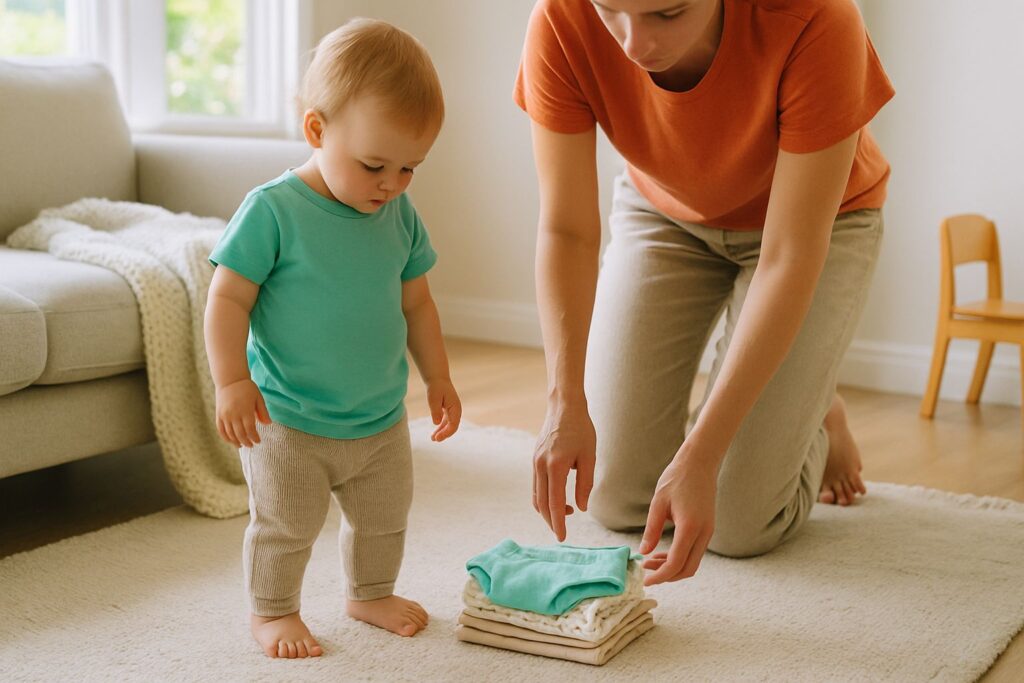
When you do decide to start, it helps to have a few things ready beforehand: a potty, a toilet seat reducer, a step stool, at least fifteen pairs of underwear, something to protect the mattress and the sofa, a handful of small rewards, and pull-ups for sleep. Plain cotton underwear works better than training pants here, since a child feels wetness through cotton in a way they do not through a padded training pant, and that feeling is part of what teaches them to notice the urge sooner next time. A fuller rundown of what you actually need to potty train walks through each item.
If you want a structured, day by day plan to follow rather than piecing one together yourself, the 7-Day Potty Training Video Course covers the same seven day approach across roughly forty short videos grouped by day, and includes a digital AI coach you can ask questions any hour, along with printable sticker cards, a tracking schedule, and a pee and poop certificate you print at home.
Frequently asked questions
What is another term for potty training?
Toilet training is the most common alternative, and pediatric sources and daycare paperwork tend to use that term more often than potty training. Both phrases describe the same thing: a child learning to recognize the need to pee or poop and act on it without a diaper.
At what age is a child usually potty trained?
Children commonly begin showing readiness signs between 18 and 24 months and are typically trained somewhere between 24 and 36 months, according to Nationwide Children's Hospital. There is a wide normal range, and readiness signs matter more than a specific birthday.
Is a child potty trained if they still wear a diaper at night?
Yes. Daytime dryness and nighttime dryness are separate milestones, and a child can be fully potty trained during the day while still needing a diaper or pull-up overnight for months or longer. Nighttime bladder control develops on its own timeline and is not something a child controls on purpose.
Does my child have to wipe themselves to count as potty trained for preschool?
Usually not. Most preschools and daycares expect a child to be out of diapers, able to tell an adult they need to go, and able to manage pants with minimal help, but assisted wiping after a poop is common and policies vary. Call the specific program to ask what they require before the start date.
How many accidents a week are normal once a child is potty trained?
A few accidents a week in the first couple of months after training is typical and does not undo the milestone. Accidents tend to drop off gradually as the child gets more practice reading their own signals, especially around naps, excitement, or new environments.
What does it mean if my 3 year old is still not potty trained?
It usually means they have not yet shown the full set of readiness signs, not that anything is wrong. Many children are not fully daytime trained until closer to age 3 or even a little after, and starting a bit later when a child is genuinely ready often goes faster than starting early and stalling.
Ready for the next step?
The 7-Day Potty Training Video Course walks you through this program in forty short videos, grouped per day, with a digital AI coach you can ask a question at eleven at night on day four. The full handbook comes with it as a PDF to read and print. Nothing is shipped, so you can start today.
Sources
- HealthyChildren.org, American Academy of Pediatrics (Toilet training depends on your child first becoming aware of their own bladder and bow…)
- Nationwide Children's Hospital (Children commonly begin showing readiness signs between 18 and 24 months and are typica…)
- HealthyChildren.org, American Academy of Pediatrics (Night-time dryness develops separately from daytime control and on its own schedule.)
This article was written with AI assistance and checked by Dustin van de Sande.