How to Night Potty Train: When to Start and What Actually Helps

Nighttime dryness is mostly a maturation process, not a skill you actively teach. Two things need to line up: the body producing less urine overnight, and the child waking or holding when the bladder is full. You can set up the right conditions and wait, but you cannot drill it the way you train daytime dryness in a week.
Daytime training is active work: a parent and child spend a focused stretch of days learning to notice the urge, signal it, and get to the toilet in time. Night training looks nothing like that. There is no week of practice that reliably produces a dry night, because the thing that changes is largely physical: the body learning to make less urine while asleep, or the bladder learning to hold more and signal strongly enough to wake a sleeping child. Most children master how daytime potty training works well before their nights follow, sometimes by a year or more.
What age should a child be dry at night?
There is no single correct age, and the normal range is wide. Many children reach night dryness somewhere between 3 and 5, and a good number take longer than that without anything being wrong. Bedwetting is still common at ages 5 and 6, and occasional wetting at 7 is not unusual either.
Night dryness typically lags behind daytime dryness, often by many months and sometimes by a couple of years. Night dryness also tends to run in families, and boys often take somewhat longer on average than girls, both patterns noted by Mayo Clinic. None of that reflects anything the child or the parent is doing wrong, and a child who is still wetting the bed at 5 or 6 is not behind. Why timing beats age applies here just as much as it does to daytime training: readiness, not the calendar, is what decides when a child’s body is ready.
| What it is | Daytime dryness | Nighttime dryness |
|---|---|---|
| What drives it | Active learning: noticing, signaling, holding | Maturation: bladder capacity and vasopressin, the hormone that reduces overnight urine |
| Typical age range | 18 months to 3.5 years | 3 to 5 years, sometimes later |
| What the parent does | Runs a focused week of training | Sets up conditions, waits, tracks dry mornings |
| How long it takes | Often about a week | Months to years, unpredictable |
How do you know your child is ready for underwear at night?
The clearest sign is mostly dry mornings over a week or two, not a single lucky night. Pull-ups that come off dry or barely damp most mornings for a stretch are a much better signal than one dry night followed by a wet one.
Other signs to watch for: your child wakes up on their own and asks to use the toilet, stays dry through naps, or can get out of bed, manage their pants, and get to the toilet with only a little help. A child who brings it up themselves, saying they do not want to wear pull-ups anymore, is often more ready than a parent expects. These line up closely with the broader readiness signs for daytime training, just shifted later on the clock.
If you are not sure where your child stands, a quick readiness check can help you see the pattern more clearly than guessing night to night.
Should you wake your child at night to pee?
Waking a child to pee, sometimes called a dream pee or lifting, can keep the bed dry that night, but it does not teach the child anything about noticing their own bladder. It trains the parent’s internal clock, not the child’s. The child is carried or walked to the toilet half asleep and rarely remembers it in the morning.
It can also fragment sleep for both of you without moving the actual goal forward, which is the child waking themselves because they feel the need. If you use lifting during a stressful stretch, such as travel or a new sibling, treat it as a short-term way to manage laundry rather than a training step. The same logic that runs through daytime training applies here: the goal is always the child noticing the urge and acting on it themselves, not a parent managing it for them on a schedule.
What do you actually set up before the first underwear night?
A few practical things make the first underwear nights far less stressful, whichever way they go. A waterproof mattress protector is worth having regardless. Layer two protectors with a sheet in between each one, so a 3am change takes a minute instead of ten.
- Spare pajamas and underwear within easy reach, even in the dark
- A small night light and a clear, obstacle-free path to the bathroom
- A potty in the bedroom if the bathroom is down a hallway or on another floor
- Peeing before bed as a fixed part of the bedtime routine, a habit worth keeping even after training is done, along with checking in before naps and before leaving the house
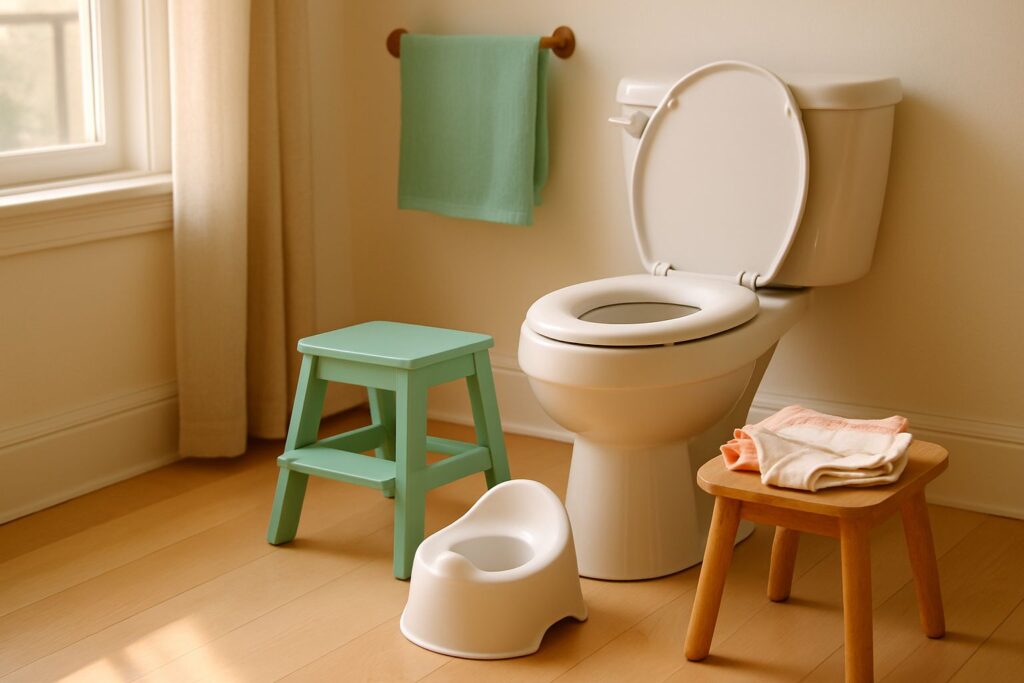
As an Amazon Associate we earn from qualifying purchases. Some links in this article are affiliate links: if you buy through them we earn a small commission, at no extra cost to you, and it does not affect what we recommend. Goodnites disposable bed mats are a simple extra layer of protection under the sheet for the first few weeks. If your household already has a step stool and toilet seat reducer in place from daytime training, keep them exactly where they are, since a dark, half-asleep trip to the bathroom is not the moment to go hunting for either. For a fuller rundown of the basics, what you actually need to potty train covers the same setup in more detail.
It also helps to agree on a calm script for wet nights before they happen, so nobody is improvising at three in the morning. Something as simple as: change clothes, change sheets if needed, back to bed, lights stay low, no questions asked until morning. A short bedtime story about using the potty, such as Time to Pee!, can also make the whole bedtime-to-bathroom routine feel more familiar rather than like a test.
Do you have to cut off drinks before bed?
Normal drinking through the day matters more than a strict cutoff right before bed. A child who drinks enough during the day and evening is not more likely to wet the bed because of a glass of water at dinner.
Tapering large drinks in the last hour before bed is reasonable, but thirst should never be denied as a way to prevent accidents. Restricting fluids as a discipline measure does not work and is not fair to a child whose body has not caught up yet. If your child suddenly starts drinking and peeing far more than usual, day or night, that is a question for a doctor, not something to solve with a training approach.
What do the first few wet nights look like, and what do you say?
Expect wet nights, including after dry stretches. A wet night does not mean the attempt failed or that your child is not ready; bladders mature unevenly and a dry week can be followed by two wet ones for no obvious reason.
Keep the change quick, quiet, and low-drama. Lights stay low, voices stay soft, and the goal is simply to get back to sleep. Say something neutral like, ‘You’re okay, let’s get you dry,’ rather than asking why it happened or pointing out that they did so well last night. No shame, no interrogation, no comparing to the night before.
If it helps, watch this together with your child the morning after a wet night, since it covers an accident without making it a big deal.
If every single night is wet for two to three weeks straight with no dry mornings at all, it is reasonable to go back to pull-ups for a while without framing it as a setback. The method behind daytime training treats a pause and a later retry as part of the plan rather than a defeat, and the same logic holds for nights: stepping back for a few months and trying again later is a normal part of how this goes, not a sign anything went wrong.
Should you use pull-ups at night, and how do you get off them?
Pull-ups at night are completely fine and are not the same thing as going back to diapers during the day. Daytime training works best with regular cotton underwear, because a child needs to actually feel wetness to learn from it. Nights are different: the child is asleep, so that same feedback loop does not apply, and a dry, comfortable night matters more than teaching a lesson while unconscious.
Use the streak of dry mornings as your real data rather than a gut feeling. Once a child has woken up dry, or close to it, for most mornings over roughly two weeks, that is a reasonable point to try underwear at night with the mattress protector in place. If you want a step between daytime underwear and night pull-ups, Ninjamas bedwetting underwear hold more without feeling like a bulky diaper. Pick one approach and stick with it for a couple of weeks rather than flipping back and forth between pull-ups and underwear night to night, which makes it harder to read what is actually happening.
When should you talk to your doctor about bedwetting?
Ongoing bedwetting past roughly age 6 or 7 is worth bringing up with a pediatrician, not because it is automatically a medical problem, but because a doctor can rule out anything physical and talk through options if it is affecting your child’s confidence, according to Mayo Clinic. A child who was reliably dry for six months or more and suddenly starts wetting the bed again should also be seen, since that pattern sometimes points to something worth checking.
Other signs worth a doctor’s visit sooner rather than later: pain or burning when urinating, a sudden big increase in thirst or how often your child urinates, or daytime wetting returning after it had stopped. Constipation and stool withholding can also affect nighttime bladder control and are worth mentioning at a checkup. This article cannot diagnose any of these, and all of them belong with a doctor or your child’s health clinic rather than with a training approach.
How night training connects to the 7-day daytime method
The 7-Day Potty Training Video Course is built around daytime dryness, and it does not promise dry nights, because nights depend on a different, slower process the course cannot speed up. What it does teach is the same awareness that nights eventually need: noticing the urge, naming it, and holding on for a few minutes, which is exactly the skill a child is drawing on months or years later when they wake themselves up at night.
The course is the same seven-day method delivered as about 40 short videos, roughly three minutes each, grouped by day, plus a digital AI coach that answers questions any time you have one. Sticker cards, a tracking schedule, and certificates are included and printed at home as part of the course. What each day of the week looks like walks through the structure in detail if you are deciding whether to tackle daytime training first.
It is worth saying plainly: this course is not a fix for bedwetting or for a regression at night. It is a daytime method, and nights are their own separate milestone that follows in their own time.
Frequently asked questions
At what age should a child be night potty trained?
There is no fixed age, but many children reach night dryness somewhere between 3 and 5 years old, and some take longer than that. Bedwetting is still common at 5 and 6 and is not a sign of a problem or a parenting mistake. Night dryness usually follows daytime dryness by months or even a couple of years.
Is it possible to nighttime potty train, or do you just wait?
You cannot train nighttime dryness the way you actively train daytime dryness in a week, because it depends mostly on the body's own maturation: making less urine overnight and the bladder signaling strongly enough to wake the child. What you can do is set up the right conditions, such as a consistent bedtime pee and a mattress protector, and watch for dry mornings as a sign of readiness. It is more a watch-and-wait process than a taught skill.
Should I wake my toddler up at night to pee?
Waking a child to pee, sometimes called lifting or a dream pee, can keep the bed dry that night but does not teach the child to notice their own bladder. It trains your schedule rather than your child's awareness, and it can disrupt sleep for both of you. If you use it, treat it as a short-term way to manage laundry rather than a training method.
How long after daytime potty training does night training usually happen?
Night dryness commonly follows daytime dryness by several months, and for some children by a year or more. This gap is normal and does not mean anything is wrong with how daytime training went. The two are genuinely separate milestones driven by different things.
Should I stop giving drinks before bed to prevent bedwetting?
No, normal drinking throughout the day matters more than a strict cutoff right before bed, and thirst should never be denied. Tapering large drinks in the last hour before sleep is reasonable, but restricting fluids as a way to prevent or punish accidents does not work and is not fair to a child whose body has not caught up yet. A sudden, large increase in thirst or urination is worth mentioning to a doctor rather than managing with fluid restriction.
When is bedwetting something to see a doctor about?
Bedwetting that continues past roughly age 6 or 7, or that returns suddenly after six months or more of consistent dryness, is worth discussing with a pediatrician. Pain when urinating, a sudden big increase in thirst or urination, and daytime wetting that returns are also reasons to check in sooner. This article cannot diagnose any of these, and they belong with a doctor or child health clinic.
Ready for the next step?
The 7-Day Potty Training Video Course walks you through this program in forty short videos, grouped per day, with a digital AI coach you can ask a question at eleven at night on day four. The full handbook comes with it as a PDF to read and print. Nothing is shipped, so you can start today.
Sources
This article was written with AI assistance and checked by Dustin van de Sande.