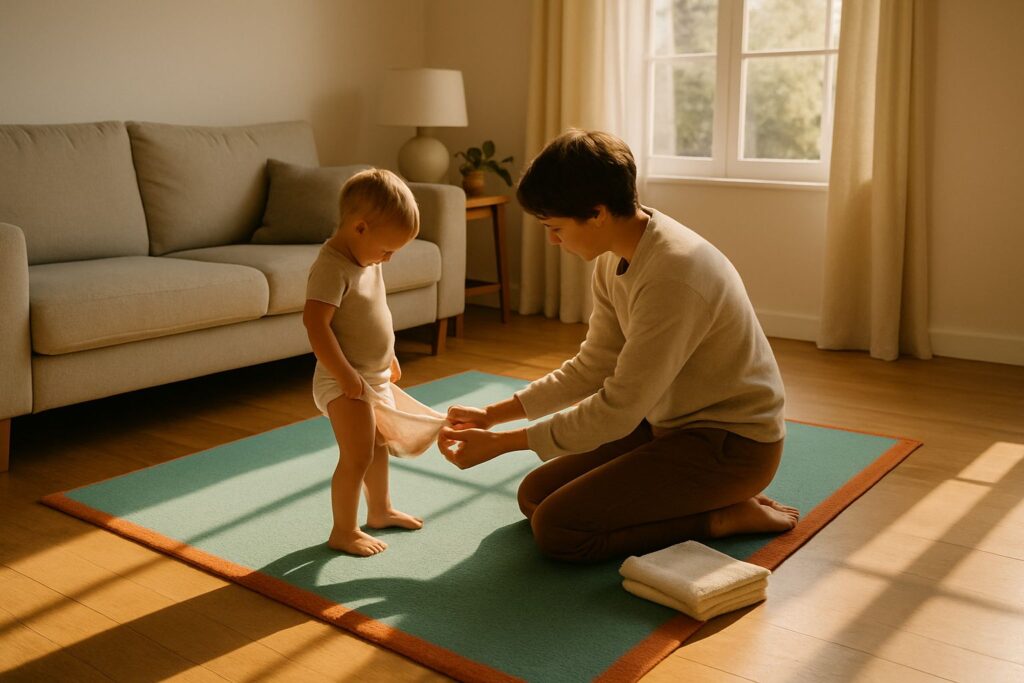
Potty Training Underwear: What to Buy, How Many, and When to Switch


Use regular cotton briefs or boxer briefs in a snug fit, not thick padded training pants. Buy at least 15 pairs so you are never caught without a dry pair during the first week. Switch from diapers to underwear all at once, during the day, once your child shows real readiness signs, and save pull-ups for sleep only.
What underwear should you buy for potty training?
Plain cotton underwear is the whole point, not a style preference. It feels wet almost instantly, and that uncomfortable feeling is what teaches a child to notice the sensation of needing to go before it happens again. Look for a label that says cotton or a cotton blend, a soft waistband with no stiff elastic digging in, and flat seams so nothing chafes when your child squats or sits.
Skip anything marketed as absorbent or leak proof for daytime use. The idea behind a structured, day by day potty training method is simple on this point: diaper off, cotton on, from day one, so the child’s own body gives the feedback instead of a layer of padding doing it for them. You do not need a particular brand, just plain cotton that fits snugly and that your child can manage alone.
Why does plain cotton work better than padded training pants?
Padded training pants are built to pull on and off like a diaper, and that is exactly the problem. They hold pee away from the skin with several absorbent layers, so a child who has an accident barely feels it. If the child does not feel wet, there is nothing to connect the sensation of needing to go with the act of saying so.
That feeling of wet cotton against skin is the actual lesson. It is mildly uncomfortable, it is noticed within seconds, and it gives the child a reason to tell you next time before it happens rather than after. A thick pull-style pant short circuits that, which is why many families find that switching to them midweek slows progress rather than speeding it up.
Pull-ups do have a legitimate place in this process, just not during the day. They work well for sleep, when you are not expecting a child to wake themselves up and walk to the bathroom yet, and nighttime dryness is a separate skill that develops on its own timeline anyway.
How many pairs do you need for the first week?
Plan on at least 15 pairs of underwear for the first week, more if your laundry turns around slowly or you do not have a dryer. Accidents cluster heavily in the first three days, which is also why most structured programs keep the child home for those days rather than heading straight out.
Count pants and socks in the same pile, since both tend to get caught in the splash zone along with the underwear itself. Keep a stack within arm’s reach in whichever room you are spending the day in, rather than stored away in a dresser down the hall, so a change takes ten seconds and not a scramble.
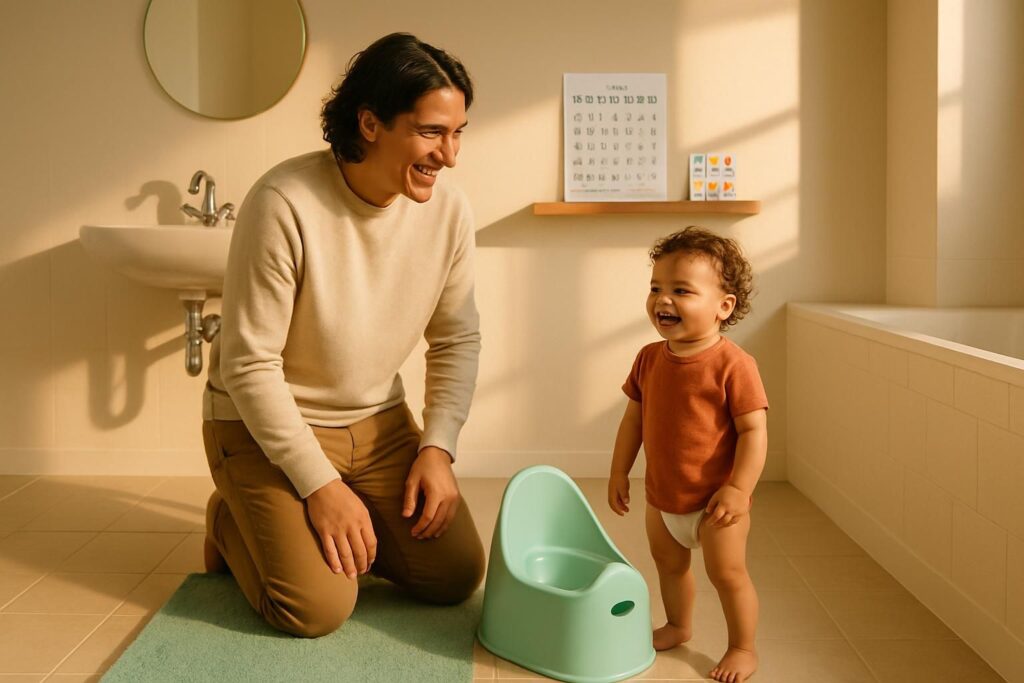
As an Amazon Associate we earn from qualifying purchases. Some links in this article are affiliate links: if you buy through them we earn a small commission, at no extra cost to you, and it does not affect what we recommend. Alongside the underwear, it helps to have a few other things ready in general terms: a potty for the first few days, such as the BabyBjörn Potty Chair, a toilet seat reducer like the Munchkin Sturdy Potty Training Seat and a step stool such as the Dreambaby Step Stool once you move toward the toilet, something to protect the mattress and the sofa, a handful of small rewards, and pull-ups for overnight.
What your child feels in each type, and when it belongs in the rotation
| Item | What the child feels | When to use it |
|---|---|---|
| Cotton underwear | Wet almost immediately | Daytime, from day one |
| Padded training pants | Barely noticeable, like a diaper | Sleep only, not for daytime |
| Pull-ups, such as Pull-Ups Boys’ Night-Time | Dry feel, absorbs fully | Sleep only |
What size and fabric actually matter?
Fit matters more than the pattern on the front. A snug fit, not loose and not a size up for room to grow, lets your child pull the waistband down and back up without help, which is a skill they need dozens of times a day during training week.
Breathable cotton with flat seams and a soft, non-stiff waistband beats anything synthetic or heavily printed with plastic graphics, which tend to run warmer and chafe at the leg openings. Buying a size larger than your child currently wears, with the idea that they will grow into it, usually backfires: loose underwear slips down mid-squat and makes independent dressing harder, right when independence is the whole goal.
Let your child pick the pattern or the character on the pants if the store or the pack offers a choice. It sounds small, but ownership over the underwear tends to carry over into ownership over the whole process. A simple picture book about using the potty, such as Potty, read together a few times before you start, can build the same kind of familiarity and make the underwear feel like part of something your child chose rather than something that happened to them.
When do you switch from diapers to underwear?
Switch once your child shows real signs of readiness, not on a schedule you have set for yourself. Common signs include staying dry for a couple of hours at a stretch, showing interest in the bathroom or in watching others use it, telling you during or right after they have gone, and being able to pull pants up and down with little help.
If you are not sure where your child stands, a short readiness check can help you see the pattern more clearly than guessing in the moment.
Once you decide to start, go cold turkey on daytime diapers rather than switching back and forth between diapers and underwear depending on the plan for the day. Moving in and out of diapers sends a mixed signal about what is expected, and most children settle into the new habit faster when the change is clean and consistent.
A child who is genuinely frightened of the potty or the toilet is not ready yet, whatever the calendar says. In that case it is worth building familiarity first, through books, through watching a parent or sibling, through sitting on the potty fully clothed with no pressure to perform, and starting the real switch a few weeks later.
Does going straight to underwear really work, or is it too fast?
Going straight to underwear, with no padded transition stage in between, is the approach behind most structured programs, and most children are dry in the daytime within about a week of starting this way. Some manage it in three days, others need two or three weeks, and that range is normal rather than a sign anything has gone wrong.
Switching back to diapers partway through a hard day feels kind in the moment, but it tends to undo the lesson the underwear is teaching, since the child goes from feeling every accident to feeling none at all and back again. If a particular attempt genuinely is not working after a few days, the better move is to stop training altogether for a while and try again later, rather than keep pushing through a stretch that is not landing.
Accidents themselves are part of learning, not a sign of failure or a reason to delay the next attempt. A calm change and a brief reminder of what to do next time teaches more than a reaction that makes the child feel like they did something wrong.
How do you handle accidents outside the house?
Spend the first three days at home, where accidents are easiest to manage and where your child learns the most, and only start short outings once the first stretch of daytime dryness is established. Trying to combine the earliest days of training with errands or daycare drop off usually creates more stress than progress for everyone involved.
Pack a small bag before you head out: at least one full spare outfit including underwear and socks, a wet bag for the soiled clothes, wipes, and a towel to sit on in the car seat or stroller just in case. A waterproof cover under the regular seat cover keeps the upholstery dry without feeling like a diaper underneath.
Two moments are always worth a prompt, even once your child is mostly signaling on their own: right before sleep, and right before you walk out the door. Outside of those two moments, the aim is for your child to tell you, not for you to keep asking.
An accident in public rattles parents more than it rattles the child, so a calm, matter of fact response, change and move on, keeps the moment small instead of turning it into something to dread next time. If your child has just had an accident and needs a gentle reset, this short video is made to watch together right afterward.
What do you watch for instead of putting your child on the potty by the clock?
The goal is your child telling you they need to go, not a timer deciding for them. Rather than offering the potty every thirty minutes on a fixed interval, ask directly, “Will you tell me when you need to pee?” That question, repeated gently at a few key moments, teaches your child to notice the signal and speak up, which is the actual destination of the Potty Training Box Method. The exceptions are before and after sleep and before you head out the door, moments worth a regular prompt both during training and for a good while after.
This is exactly what the tracking schedule is for: not a timetable to impose on your child, but a record of when your particular child actually goes, so you learn their pattern instead of guessing. A typical schedule has columns for the time your child drank, the time they sat on the toilet, whether nothing happened, whether they peed, marked green for a success or red for an accident, whether they pooped, marked the same way, and a notes column for anything else worth remembering.
When you fill it in, it helps to have your child drink a full cup in one go rather than sipping it across the afternoon. A single full cup lets you see how much went in and how long it then takes before your child needs to pee, and that relationship between amount and timing is exactly what the schedule is meant to reveal. A few sips here and there over an hour will not give you a clean picture to work from.
Many parents brace for the second day to be the hardest, but it is usually day four or five that tests everyone’s patience most. By then the child is often tired of being asked “will you tell me when you need to pee?” over and over, and some real resistance shows up right when progress seemed steady. The fix is not to push harder, it is to ask less often and hand more of the responsibility back to your child, trusting the groundwork from the first days to hold.
Daytime underwear versus nighttime: what is the difference?
Daytime dryness and nighttime dryness are two different skills, and cotton underwear during the day has nothing to do with staying dry overnight. Nighttime dryness depends on a child’s bladder maturing enough to hold urine for a full night’s sleep, and it typically comes along on its own timeline, sometimes months after daytime training is solid.
Pull-ups for sleep are a normal and sensible part of potty training, not a step backward or a sign that daytime progress has not stuck. Keep something to protect the mattress underneath the fitted sheet regardless of what your child wears to bed, such as a Goodnites disposable bed mat, since even a child who is dry most nights will have the occasional wet one for a while yet.
If bedwetting continues well past age six, that is worth raising with a doctor or your child’s health clinic rather than something to solve with a different kind of underwear. It is a common and usually temporary issue, but a persistent pattern at that age deserves a professional’s eyes, not a guess from an article.
Where underwear fits into the seven-day method
Plain cotton underwear is one piece of a seven-day, day-by-day, reward-based method that moves a child from potty to toilet and works toward the child signaling the need themselves, rather than being asked on a schedule. The method treats the first three days at home as the foundation, followed by short outings, and treats accidents as information rather than failure.
The 7-Day Potty Training Video Course carries that same program as about forty short videos of roughly three minutes each, grouped by day, along with a digital AI coach you can ask questions at any hour. The sticker cards, the tracking schedule and the pee and poop certificates are included in the course as printables, so you are not starting from a blank page or sketching your own system.
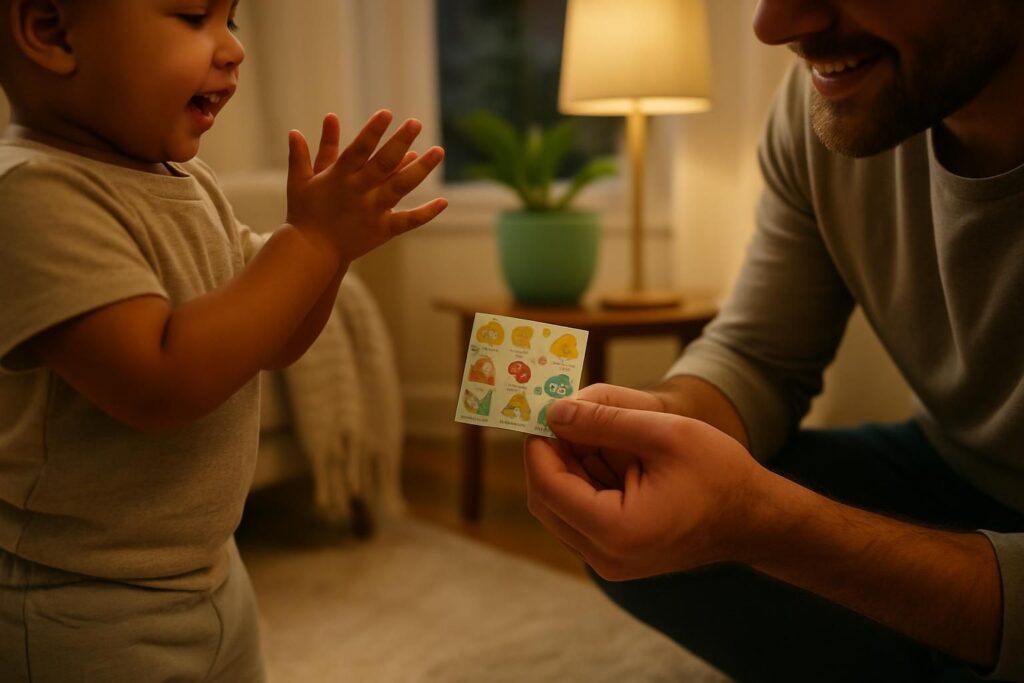
The sticker cards themselves build in stages, from three squares up to five, seven and then nine, so the reward comes quickly at the start, when your child most needs to see that this is working, and grows rarer as the habit takes hold, so it outlasts the stickers instead of stopping abruptly the day they run out.
The same approach is also used successfully with children who are autistic, have Down syndrome, or are non-verbal, usually over a longer stretch and by reading the child’s own signals rather than waiting for them to say it out loud. Once your child is solidly out of diapers during the day, the next step is usually making the switch from the potty to the toilet, and if you are still deciding how much structure and support you want along the way, it is worth taking a moment to compare the program options.
Frequently asked questions
Do potty training underwear actually work?
Yes, plain cotton underwear works because it lets a child feel wet almost immediately, which teaches them to notice the sensation of needing to go and link it to telling you. Padded training pants that function like diapers blunt that feedback and can slow progress down rather than speed it up. Most children make real daytime progress within about a week once they switch to regular cotton underwear.
What kind of underwear is best for potty training?
Plain cotton briefs or boxer briefs in a snug, well-fitting size work best, since cotton feels wet quickly and a snug fit lets your child pull them up and down alone. Avoid thick absorbent training pants for daytime use, since they are designed to behave like a diaper rather than like underwear. Letting your child pick the pattern or color can help them feel ownership over the process.
Should you potty train with underwear or pull-ups?
Underwear during the day and pull-ups at night work best together, rather than using pull-ups as a daytime in-between step. Daytime pull-ups absorb too well for a child to notice an accident, which undoes the main lesson that cotton underwear is meant to teach. Save pull-ups for sleep, when nighttime dryness is a separate and later skill.
How many pairs of underwear do you need for potty training?
Plan on at least 15 pairs for the first week, more if laundry runs slowly or you do not have a dryer handy. Accidents cluster heavily in the first three days, so having enough dry pairs within reach matters more than most parents expect going in.
Should your child wear underwear at night during potty training?
Not necessarily, and there is no need to push it. Nighttime dryness develops on its own timeline, separate from daytime training, and pull-ups for sleep are a normal part of the process rather than a step backward.
Is it okay to put a diaper back on if the day is going badly?
Switching back to a diaper mid-day sends a mixed signal and tends to undo the lesson the underwear is teaching, so it is better avoided once you have started. If an attempt genuinely is not working after a few days, the better move is to stop training altogether for a while and try again later, rather than mixing diapers and underwear within the same stretch of days.
Ready for the next step?
The 7-Day Potty Training Video Course walks you through this program in forty short videos, grouped per day, with a digital AI coach you can ask a question at eleven at night on day four. The full handbook comes with it as a PDF to read and print. Nothing is shipped, so you can start today.
This article was written with AI assistance and checked by Dustin van de Sande.