Elimination Communication vs Potty Training a Toddler: What’s the Real Difference?

Elimination communication is a practice where a caregiver reads a baby’s cues, timing and signals to catch pees and poops in a potty or sink instead of relying on a diaper, usually starting in the first months of life. Toddler potty training aims at the same goal, a child who signals their own need, but starts later and moves faster.
You may also see elimination communication called infant potty training, natural infant hygiene, or diaper free baby care. These are all names for the same idea: instead of leaving a baby in diapers full time, a caregiver watches for signs that a pee or poop is coming and offers a potty, sink, or toilet at that moment. Most families who try it start somewhere between birth and about six months, and most do it part time rather than all day every day.
This is not toddler potty training in disguise. With elimination communication, the adult does almost all the reading, timing and deciding. With toddler potty training, the point is to shift that job to the child, so the child is the one who notices the urge and says something about it. Both aim at the same finish line, a child who can recognize and signal their own need, they just start from very different places and move at very different speeds.
How does elimination communication actually work day to day?
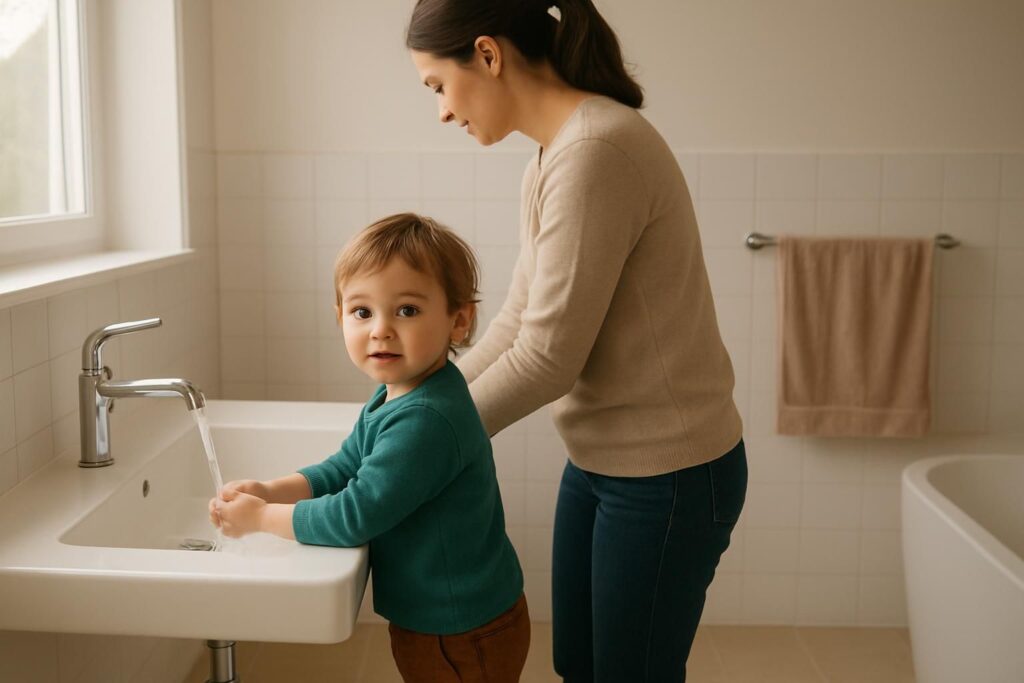
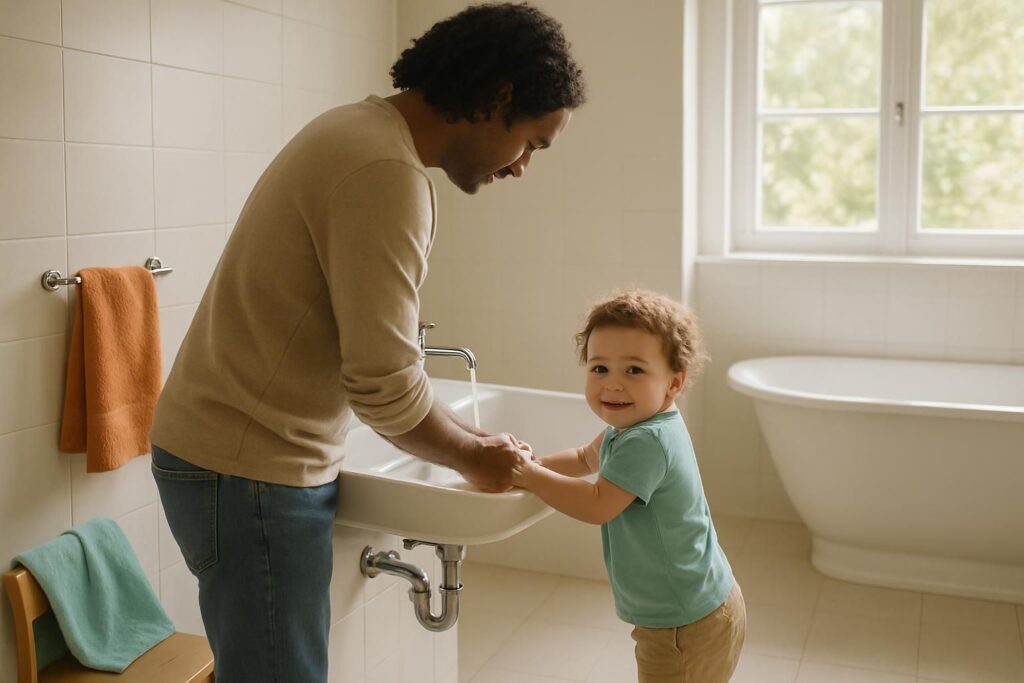
In practice, elimination communication means watching a baby closely for physical cues, such as squirming, a sudden pause in activity, a particular grunt or cry, or a moment of stillness, and offering the potty or sink right then. Many caregivers also lean on natural timing windows that tend to produce a catch: right after waking from a nap, shortly after a feed, or right after being carried in a sling or carrier for a while.
A common technique is to pair the offering with a cue sound, often a soft sssss, made while holding the baby in position over the potty or sink. Over time the baby starts to associate that sound with the act itself, the same way some babies learn to associate running water with the urge to go.
You’ll sometimes see this summarized as a handful of easy catches, usually meaning the moments right after waking, right after a feed, and right before and right after leaving the house. These are simply the times a baby is statistically more likely to need to go, not a fixed schedule to enforce. According to the Wikipedia entry on elimination communication, the practice relies on timing, signals, cues and intuition rather than on training the child to a routine.
Part time elimination communication is the norm, not the exception. Most families who try it still use diapers overnight, at daycare, and whenever a consistent caregiver isn’t available to watch closely. Expect a learning curve and more laundry while you figure out your own baby’s patterns, and expect misses, especially in the first weeks. Nobody should ever hold or push a baby into position against resistance; if a baby squirms away or cries at being held over the potty, that’s a stop signal, not a hurdle to push through.
At what age do you start elimination communication, and what if you missed that window?
Elimination communication is typically started in the early months, with many families beginning before their baby is around six months old, often because a very young baby has less ability to resist being held in position and the timing windows are more predictable. You can still introduce a potty to an older baby, but once a child is mobile, opinionated and able to say no, the dynamic changes considerably.
If you didn’t start elimination communication as an infant, you haven’t lost anything that matters for toddler potty training. The signs that count from here are the readiness signs that typically show up starting around 18 months, not whatever happened in the newborn months. According to the American Academy of Pediatrics’ page on the right age to toilet train, signs of bladder and bowel control tend to appear between 18 and 24 months, and toilet training in the United States most commonly begins between ages 2 and 3.
Look for these signs rather than a specific age:
- Staying dry for an hour or two at a time
- Telling you, in words or gestures, about a wet or dirty diaper
- Showing curiosity about the bathroom or wanting to watch others go
- Able to pull pants up and down with little help
- Can follow a simple two-step instruction
- Shows some physical sign of the urge, like pausing, squatting or grunting
If you want a clearer picture of where your own child stands, the readiness quiz walks through this in a few minutes.
For a fuller look at the age question, when to start toilet training a toddler covers it in more detail.
Does elimination communication work, and what does it realistically get you?
Elimination communication can work well for families with the time and a consistent caregiver at home to watch closely and respond quickly, and many parents report fewer diapers used and an earlier sense of their baby’s patterns. What it usually does not mean is a baby who is independently toilet trained as an infant, because independence requires skills a baby simply doesn’t have yet, like walking to the bathroom, pulling down pants and recognizing the urge without an adult’s help.
Families commonly stop or scale back elimination communication for ordinary reasons: a return to work, a daycare that can’t support the close watching it requires, or what’s sometimes called a potty strike around the time a baby becomes mobile and starts resisting being held still. None of this is a failure on the family’s part. Diapers are not a shortcoming and elimination communication is not a superior form of parenting, they’re just two different approaches with different tradeoffs, and what parents report varies a lot from one baby and one household to the next.
Elimination communication vs potty training a toddler: what is the real difference?
The clearest way to see the difference is side by side.
| Elimination communication | Toddler potty training |
|---|---|
| Starts in infancy, often before 6 months | Starts around 18 months to 3 years, when readiness signs show up |
| Caregiver reads cues and times offers | Child learns to notice and announce the need |
| Gradual, often part time, for months or years | Concentrated, often about a week |
| Baby learns to associate a cue with the act | Child learns to signal the need themselves |
Despite looking very different, both approaches share the same core idea: learning this particular child’s own signals and timing, rather than training to a fixed clock. That’s exactly why neither one should be run by the clock, sitting a baby or a toddler down every thirty minutes because a schedule says so.
This is the idea behind the Potty Training Box Method, a seven-day program that starts with three days at home, moves the child from potty to toilet, uses a tracking schedule to learn this particular child’s own pattern of drinking and going, and builds toward the moment the child announces the need on their own. A tracking schedule is there to record when a child actually goes, so a parent learns that child’s rhythm. It is not a timetable to impose on the child, which is an easy thing to get backwards when so much of what’s written about elimination communication reads as timing-driven.
Families drawn to elimination communication because it’s about reading a baby rather than waiting for words often find the same philosophy useful later with a toddler who isn’t talking much yet; reading signals instead of waiting for words covers that in more depth. And if the idea of a rigid, clock-based system put you off elimination communication in the first place, why timed sits slow you down explains why the same objection applies to potty training by the clock.
If you did EC, how do you move your toddler into full potty training?
Many babies who did elimination communication as infants still need a dedicated week of toddler potty training later, because catching a pee in infancy and being independently potty trained are two different skills. The second one requires walking to the bathroom, undressing, sitting down and getting back up, none of which a baby could do on their own.
What usually does carry over is familiarity: a child who spent time on a potty as a baby often has less fear of it and less resistance to the whole idea, which can shorten the adjustment period considerably.
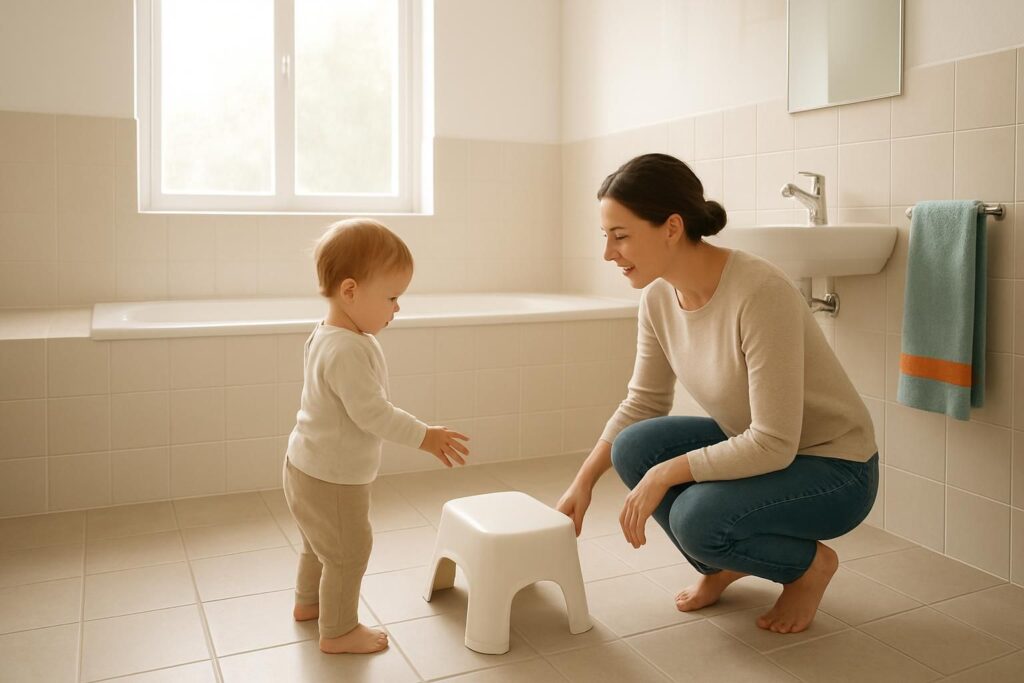
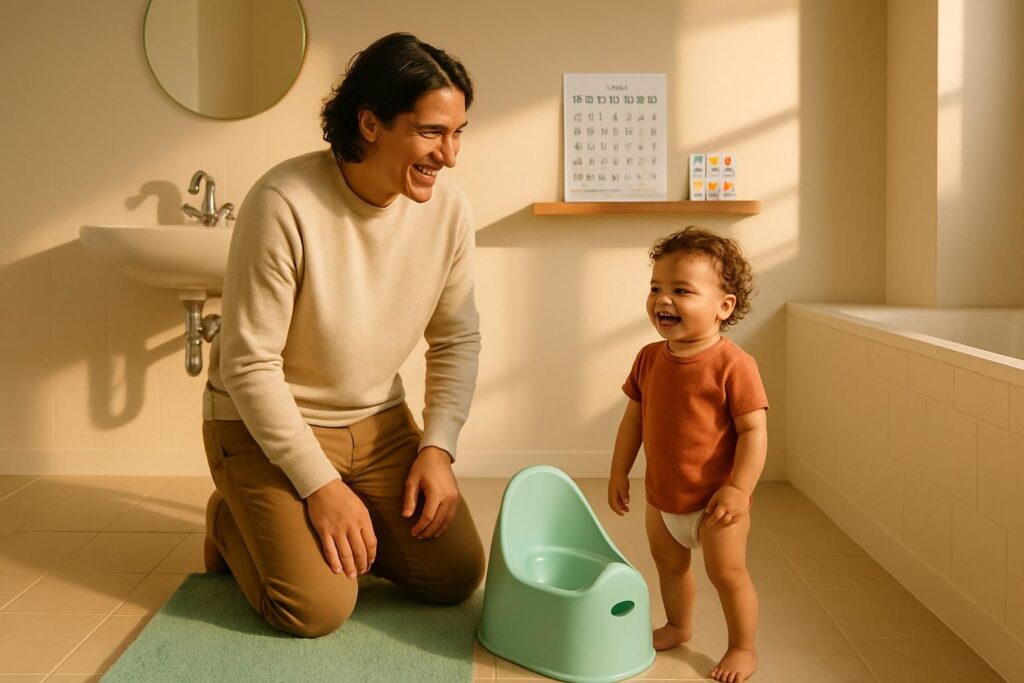
Whichever path got you here, the mechanics of toddler potty training stay the same. Diaper comes off and regular cotton underwear goes on, not training pants, because a child feels a wet training pant less than a wet cotton pair and that sensation is part of how they learn. A tracking schedule records the time a cup is drunk (ideally in one full go rather than sipped slowly, so you can see how long it takes before your child needs to go), the time spent on the toilet, whether nothing happened, and whether a pee or poop was a success (marked green) or an accident (marked red), with a notes column for anything else worth remembering. Alongside the schedule, it also helps to have a potty, a toilet seat reducer and a step stool ready before you start, so your child can get up to the toilet and sit comfortably without you having to lift them each time.
Rather than offering the potty on a schedule, the core habit to build is asking your child directly, will you tell me when you need to pee, so the responsibility for noticing shifts to them. The exceptions worth keeping as fixed moments, during training and afterward, are before and after sleep and before leaving the house.
If you’d rather follow a full day-by-day plan instead of piecing one together, the day-by-day plan for the first week lays out what to do each day, including the days that don’t go well. For families who prefer a gentler, fully child-led pace, the child-oriented potty training method is worth a look too.
The 7-Day Potty Training Video Course runs the same seven-day program as about forty short videos, roughly three minutes each and grouped by day, and it includes a digital AI coach you can ask questions of at any hour. The sticker cards, tracking schedule and certificates are included as printables you print at home. For a story to read with your child about the process itself, Noa’s Potty Training Journey (Ebook) is written for exactly that moment.
What about rewards, accidents and the day it all goes sideways?
Accidents are part of learning to potty train, never a sign of failure, and treating them that way is part of what keeps a child willing to keep trying. The reward system built into the Potty Training Box Method uses sticker cards that grow from 3 squares, to 5, to 7, then 9, so the reward comes fast in the beginning when a child most needs to see that it’s working, and then gets rarer as the child improves, so the habit outlasts the stickers instead of stopping the moment they do.
Watch this together if your child has just had a first success and you want to mark the moment.
Contrary to what you might expect, day 2 usually isn’t the hardest day. Why day 4 is usually the hardest explains that resistance more often shows up on day 4 or 5, once a child gets tired of being asked will you tell me when you need to go. The fix isn’t to push harder, it’s to ask less often and hand more of the responsibility back to your child.
As an Amazon Associate we earn from qualifying purchases. Some links in this article are affiliate links: if you buy through them we earn a small commission, at no extra cost to you, and it does not affect what we recommend.
A child who’s genuinely scared of the potty or the toilet isn’t ready yet, and the honest move is to back off, build familiarity at a slower pace, and try again later. Reading a simple picture book together, like Potty, can help take the fear out of it before you try again. If a full attempt stalls out, stopping and leaving it alone for a few weeks is part of the plan, not a sign you’ve failed at it. Night dryness is a separate skill that comes later and isn’t something any daytime method promises.
Ongoing issues like constipation, a child who seems to be withholding stool, repeated urinary infections or bedwetting past age 6 are medical questions, not potty training questions, and belong with your child’s doctor or a child health clinic rather than with any article or program. The American Academy of Pediatrics has more on bedwetting if that’s what you’re dealing with.
Frequently asked questions
At what age do you start elimination communication?
Most families who try elimination communication start in the first few months of life, often before their baby is around six months old. There's no official starting age, but babies tend to be easier to hold in position for this before they become mobile and start resisting it on their own terms.
Is elimination communication good for babies?
Elimination communication isn't harmful when it's done without forcing or holding a baby against resistance, and many families who try it report fewer diapers used over time. It isn't a requirement for later potty training success, and babies who never do it are not at any disadvantage once they reach toddler readiness.
Does elimination communication really work?
It can work well for families with a consistent caregiver and the time to watch closely, but it rarely means a baby is independently toilet trained in infancy. Independence, meaning a child who can walk to the bathroom, undress and recognize the urge on their own, is a separate skill that develops later, usually in toddlerhood.
What are the 4 easy catches in elimination communication?
The commonly cited easy catches are the moments right after waking up, shortly after a feed, and right before and right after leaving the house. These are simply times a baby is more likely to need to go, not a fixed schedule, and they're meant to guide when you offer the potty, not to replace watching for your own baby's actual cues.
If I did elimination communication, will my toddler potty train faster?
A toddler who spent time on a potty as a baby often shows less fear of it, which can shorten the adjustment period when full toddler potty training starts. It doesn't skip the process entirely though, because independence skills like undressing, walking to the bathroom and announcing the need still have to be learned separately, usually around 18 months to 3 years.
Is elimination communication better than waiting to potty train a toddler?
Neither is objectively better, they're different approaches suited to different family situations and both aim at the same outcome, a child who can recognize and signal their own need. Elimination communication asks more of the caregiver early on, while toddler potty training asks more of the child and works best once the usual readiness signs show up.
Ready for the next step?
The 7-Day Potty Training Video Course walks you through this program in forty short videos, grouped per day, with a digital AI coach you can ask a question at eleven at night on day four. The full handbook comes with it as a PDF to read and print. Nothing is shipped, so you can start today.
Sources
- Wikipedia (Elimination communication relies on timing, signals, cues and intuition rather than a f…)
- American Academy of Pediatrics (HealthyChildren.org) (Signs of bladder and bowel control tend to appear between 18 and 24 months, and toilet…)
- American Academy of Pediatrics (HealthyChildren.org) (Information on bedwetting as a separate medical topic from daytime potty training)
This article was written with AI assistance and checked by Dustin van de Sande.