Potty Training an Autistic or Non-Verbal Toddler: Reading Signals Instead of Waiting for Words


You potty train a child who cannot tell you by watching what they actually do, learning their pattern, and teaching them one clear signal, such as a sign, a picture card, or walking to the bathroom. The same structure used with speaking toddlers works here too, usually spread over a longer stretch, since a reliable signal matters more than speech.
The same seven day approach that works for most toddlers is also used successfully with autistic children, children with Down syndrome, and children who are not yet talking. It usually takes longer, often spread across two or three weeks instead of one, and the plan leans harder on observation than on asking the child to explain anything. You are not waiting for your child to say the word pee. You are waiting for them to show you, reliably, in their own way.
A longer timeline is not a sign that something has gone wrong. Some children are dry in a week, some need three weeks, and a child who is not ready yet should simply wait and try again later. None of that is failure. It is just where that particular child is right now.
Is it harder to potty train an autistic toddler?
Often, yes, in the sense that it typically takes longer, not that it is impossible. According to SPARK for Autism, among 4 to 5 year olds, 49 percent of autistic children were not yet toilet trained, compared with 24 percent of children with a developmental delay who were not autistic.
A few reasons show up again and again. Interoception, the sense of noticing a full bladder from the inside, can be less reliable, so the physical cue that most children rely on arrives late or not at all. The bathroom itself can be a lot to process at once: hard surfaces, echo, flushing, bright light. Communication is part of it too, and so is a dislike of breaking from a familiar routine to do something new and unfamiliar.
If you suspect constipation, stool withholding, or any other medical concern, that belongs with your pediatrician, not with an article. The same goes for ongoing bedwetting well past the toddler years. Those are medical questions, and a doctor who knows your child is the right person to answer them.
Why ‘every 30 minutes on the toilet’ backfires, and what to do instead
The advice you will see most often is timed sits: put your child on the toilet every 30 minutes, timer running, whether or not they show any sign of needing to go. It is easy to follow and it feels proactive, which is probably why it spreads.
The problem is what it teaches. A child sat down on a schedule learns to wait to be taken, not to notice the feeling and act on it. You can read more on why timed sits slow you down in general, and the same logic applies here, only more so, because the whole aim with a non-verbal child is to build a signal they generate themselves.
What replaces the timer is a short burst of offering early on, purely to gather information about this child’s actual pattern, and then stepping back as fast as that pattern lets you. A handful of moments stay fixed for good: before and after sleep, and before you leave the house. Everything else fades as your child starts to show you.
Even the words you use shift. Instead of announcing potty time, you invite the signal: ‘you tell me when you need to pee.’ For a child who is not speaking yet, ‘tell me’ might mean a sign, a tug, or walking toward the bathroom door, and you build that meaning deliberately, which the next sections cover.
What readiness actually looks like when your child isn’t talking yet
Readiness is something you observe, not something your child announces. Watch for a dry diaper after a one to two hour stretch, a dry diaper after naps, pausing or hiding somewhere while peeing or pooping, curiosity about the bathroom, being able to sit for a minute or two, and being able to help pull pants down and up.
Being able to tell you in words that they need to go is not on that list, and it does not need to be. A child can be entirely ready by every observable measure above and still have no spoken way to say so yet.
If your child is frightened of the potty or the toilet itself, that is its own answer: not ready yet. Build familiarity first, in small unpressured visits, and start the actual training later. There is no clock running against you here. A calm picture book that walks through using the potty step by step, such as Time to Go Potty!, can help your child get comfortable with the idea before you expect them to actually do anything on it.
There is also no single correct age. Readiness is about what a particular child does, not what the calendar says, and that is doubly true for an autistic or non-verbal toddler, where the usual age ranges often do not apply cleanly.
A short readiness check can help you see where your child actually stands before you start.
See where your child stands right now
How to read your child’s signals: the tracking chart does the work
A tracking chart records what actually happened so you learn this particular child’s timing. It is not a timetable to impose on them, and that distinction matters more here than almost anywhere else in the method.
The chart itself has specific columns: time of drinking, time on the toilet, whether nothing happened (yes or no), pee marked green for a success or red for an accident, poop marked the same way, and a notes column. Nothing fancy, just a record.
Give your child the full cup in one go rather than small sips spread across the hour. That is the only way to see how much went in and how long it takes before they need to pee, and that gap between drinking and going is exactly what the chart is built to reveal.
The notes column is where this adapts for a child who is not telling you in words. Write down the exact behavior you saw right before: going quiet, pressing on the belly, pacing, a particular sound, heading for a specific corner of the room. After two or three days, a pattern usually starts to show, and that pattern becomes the thing you start naming out loud, consistently, every time you see it.
| What you might see | What it often means | What to write in the chart |
|---|---|---|
| Goes quiet or still | About to pee or poop | Time and the exact behavior in notes |
| Hides behind furniture | Already going, or about to | Green or red, plus the hiding spot |
| Presses on the belly | Noticing the full feeling | Time seen, green or red after |
| Tugs at pants | Needs to go soon | Note the tug, time it against result |
| Sudden stimming or pacing | Rising need, or discomfort | Describe it exactly, not just ‘fussy’ |
Giving your child one clear way to say ‘I need to go’
Pick a single signal and keep it exactly the same every time: a sign, a picture card, a specific sound, a tap on your leg, or walking to the bathroom door. Changing it partway through undoes the learning you have already built.
Model it yourself, every single time, before and after you offer the potty or toilet. Then pause and wait a beat before you act, so your child has a chance to produce it rather than being swept along by you.
Honor the signal immediately whenever it appears, even when your chart suggests it is too soon, and even when nothing comes out that time. If your child taps your leg and you sit them down and nothing happens, say the same short phrase anyway, something like ‘good telling me,’ so the signal itself gets the response, not the result. A false alarm is not a setback, it is practice.
Keep your own language short and identical each time rather than varied or elaborate. Autism Speaks notes that using less language, not more, tends to work better when toilet training non-verbal autistic children, since a flood of words can bury the one cue you actually want your child to latch onto.
What the seven days look like when they take three weeks
The first three days still happen at home, diaper off, in regular cotton underwear rather than training pants, because your child feels wetness less clearly with training pants on and that feedback is part of the learning. What the first week looks like day by day covers the general shape in more detail.
Repeating a day instead of moving to the next one is entirely normal here and is part of the plan rather than a sign of falling behind. Short outings only start once your child is signaling reliably at home, and the potty comes first before you ever move to the toilet with a seat reducer and step stool.
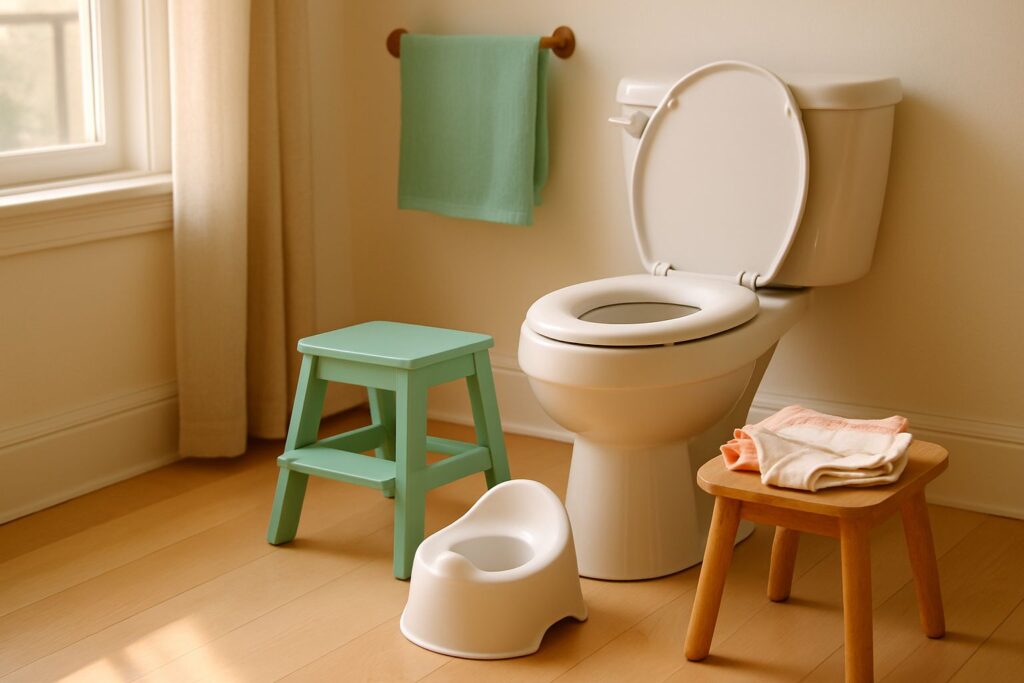
It helps to have a few things ready beforehand: a potty for the early days, a toilet seat reducer, a step stool, at least 15 pairs of cotton underwear, something to protect the mattress and sofa, a handful of small rewards, and pull-ups for sleep.
As an Amazon Associate we earn from qualifying purchases. Some links in this article are affiliate links: if you buy through them we earn a small commission, at no extra cost to you, and it does not affect what we recommend.
| What | What you could use |
|---|---|
| Potty for the early days | Ingenuity My Size Potty Pro |
| Toilet seat reducer | Frida Baby Drop Down Potty Training Seat |
| Step stool | Dreambaby Step Stool |
Night dryness is a separate matter that tends to come later, and the method here does not promise it. Daytime dryness and nighttime dryness are addressed on their own timelines.
Why day 4 or 5 is usually the hard one, and what to do about it
Resistance typically shows up on day 4 or 5, not day 2, and it is usually because your child has grown bored or irritated at being asked constantly. Why day 4 is the hardest day goes into this in more depth.
The fix is to ask less often, not more, and hand more of the responsibility to your child rather than tightening your grip on the schedule. For an autistic child, that resistance may not look like a clear no. It can show up as a shutdown, increased stimming, or bolting away from the bathroom entirely.
If an attempt genuinely is not working after a real try, the method’s own advice is to stop and leave it for a few weeks before trying again, rather than pushing through. That pause is part of the plan, not an admission of defeat.
Accidents are data for the chart, nothing more. They tell you something true about timing, and they are never a reason to tell a child off.
Rewards that keep working past the first week
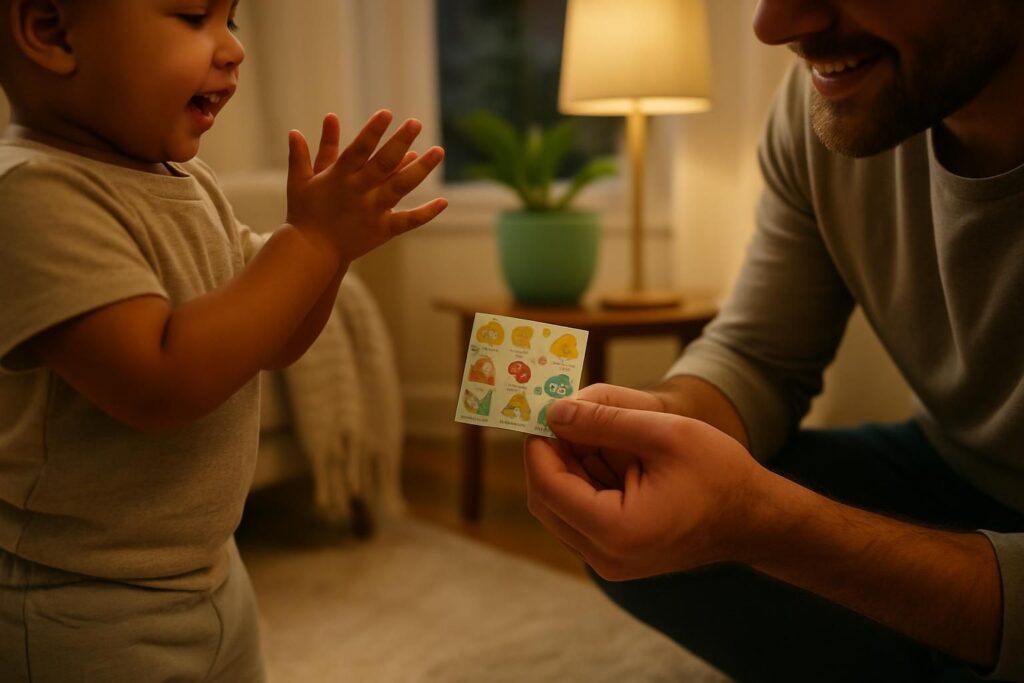
Sticker cards run through four sizes in order, 3 squares, then 5, then 7, then 9. The first reward arrives quickly at just three squares so your child sees right away that the system works, then rewards get rarer as the card grows, so the habit outlasts the stickers rather than stopping the moment they do.
That early fast payoff matters even more for a child who needs concrete proof that something works before they will invest effort in it. Pair every sticker with the exact same short phrase of praise, so the words themselves become part of the cue your child learns to expect and respond to.
A pee certificate and a poop certificate mark the end of the stretch, something concrete to show for the work on both sides. Watch this short clip together with your child right when that first success happens, so the moment itself becomes part of the celebration.
Potty training a child with Down syndrome: what changes
Often the start is later and the process runs longer, built on the same structure of watching signals and recording them rather than waiting to be told. Low muscle tone is common, and a step stool with firm foot support matters more here, particularly for pooping, where good foot bracing makes a real physical difference.
Constipation shows up often enough in children with Down syndrome that it is worth raising directly with your doctor rather than managing it from general advice. A visual routine helps, as does using the exact same words and the exact same sequence of steps every single time, since predictability itself is doing part of the work.
Where the video course fits if you want the day-by-day plan
If you want the structure laid out for you rather than assembling it yourself, The 7-Day Potty Training Video Course covers the same seven day method across around 40 short videos, each about three minutes, grouped by day. It includes a digital AI coach that answers questions at any hour, which matters a lot when day 5 falls apart at seven in the evening and you need an answer right then.
The sticker cards, the tracking chart, and the certificates are part of the course and are printed at home as you go. The method can also be followed without the course, for a family that prefers to work through it on their own. For the full picture of the approach this article adapts, the complete 7-day method is the place to start.
Frequently asked questions
Is it harder to potty train an autistic toddler?
Often, yes, in that it typically takes longer rather than being impossible. SPARK for Autism reports that among 4 to 5 year olds, 49 percent of autistic children were not yet toilet trained, compared with 24 percent of children with a developmental delay. Interoception, sensory sensitivity in the bathroom, and communication differences are common reasons it stretches out.
At what age should an autistic child be potty trained?
There is no single right age, and the usual toddler age ranges often do not apply cleanly here. Readiness is better judged by what your child actually does, such as staying dry for a stretch or showing curiosity about the bathroom, rather than by a birthday. Some children start later and take longer, and that is not a problem to fix, just the shape the process takes for that child.
Can you potty train a non-verbal child who can't ask to go?
Yes. You teach one clear non-verbal signal, such as a sign, a picture card, or walking to the bathroom door, and honor it immediately every time it appears. Speech was never the actual requirement. A reliable signal of any kind does the job.
How long does potty training take for a child with autism or Down syndrome?
Most children finish in about a week, but for autistic children or children with Down syndrome it commonly stretches to two or three weeks, sometimes longer, following the same seven day structure spread out. A longer timeline is normal and is not a sign that anything has gone wrong.
Should I use a timer and take my child every 30 minutes?
No, that approach tends to teach a child to wait to be taken rather than to notice the feeling and signal it themselves. A better approach offers the potty a handful of times early on purely to gather information, then fades that scaffolding quickly while a few fixed moments, like before and after sleep and before leaving the house, stay in place long term.
What if my child is scared of the toilet or the potty?
That fear is the honest sign that your child is not ready yet. Build familiarity first through calm, low pressure visits and simple books about the bathroom, and start the actual training later once the fear has settled. There is no benefit to pushing through it on a schedule.
Ready for the next step?
The 7-Day Potty Training Video Course walks you through this program in forty short videos, grouped per day, with a digital AI coach you can ask a question at eleven at night on day four. The full handbook comes with it as a PDF to read and print. Nothing is shipped, so you can start today.
Sources
- SPARK for Autism (Among 4 to 5 year olds, 49 percent of autistic children were not yet toilet trained, co…)
- Autism Speaks (Using less language tends to work better when toilet training non-verbal autistic child…)
This article was written with AI assistance and checked by Dustin van de Sande.