Toilet Training: The Complete Guide to Getting Your Toddler Out of Diapers

Toilet training means teaching your toddler to notice the physical urge, hold on briefly, say so, and use the potty or toilet instead of a diaper. Most children reach daytime dryness in about a week, though some take three days and others two or three weeks. Night dryness comes later, as a separate skill.
What does toilet training actually mean?
At its core, toilet training is teaching a child four things in sequence: notice the physical sensation of needing to go, hold on for a short while, say so out loud or signal it, and then use the potty or toilet instead of a diaper. None of that happens overnight, which is why the first week of training is really about building that chain of skills one link at a time.
Daytime dryness and night dryness are two different skills that arrive on two different timelines. A child can be reliably dry all day and still wet the bed at night for months or even years afterward, because staying dry overnight depends on a sleeping body recognizing a full bladder, which develops separately from daytime bladder control. Most children reach daytime dryness in about a week of focused training, though some manage it in as little as three days and others need two or three weeks, and neither end of that range means anything went wrong.
A schedule that sits a child down every fifteen or thirty minutes regardless of what they actually need teaches them that going happens when a timer says so, not when their own body tells them to. The approach that holds up over time works the other way around: you watch and record what your particular child does, and you hand the decision over to them as fast as you reasonably can.
When should you start toilet training your toddler?
There is no single correct age. According to the American Academy of Pediatrics, signs of bladder and bowel control typically appear between 18 and 24 months, and most families in the United States begin toilet training somewhere between age 2 and 3, with most children trained by age 4. Readiness matters far more than the number on the calendar.
Look for these signs rather than a birthday:
- Staying dry for two hours or more during the day
- Showing interest in the bathroom or in watching others go
- Telling you, in words or gestures, that a diaper is wet or dirty
- Pulling pants up and down mostly on their own
- Following a simple two step instruction, like “bring me the cup and sit down”
Want a clearer answer than a checklist can give you? Answer a few quick questions in the readiness quiz and see where your child actually stands.
A child who is genuinely frightened of the potty or the toilet is not ready yet, whatever their age. The honest move there is to build familiarity first, in no particular hurry, and start the real training later. Reading a picture book about using the potty together, with no pressure attached, can help a nervous child get comfortable with the idea before you try anything else. Once Upon a Potty is a well known choice for exactly that kind of gentle introduction. A 2.5 year old who is still in diapers is common and not a sign anything is wrong.
How does toilet training work, step by step?
The Potty Training Box Method is a structured seven day program built around the child’s own initiative rather than a fixed schedule: the diaper comes off, the child wears regular cotton underwear, the first three days are spent at home so the parent can learn the child’s actual patterns, and short outings follow once the basics are steady. Rewards start generous and get rarer as the days go on, so the habit outlasts the stickers instead of stopping the moment they do.
Instead of offering the potty every so often, you ask your child directly: will you tell me when you need to pee? That question, asked over and over, is what teaches a toddler to notice the feeling themselves instead of waiting for a prompt. The only moments you keep fixed, both during training and afterward, are before and after sleep and before you leave the house.
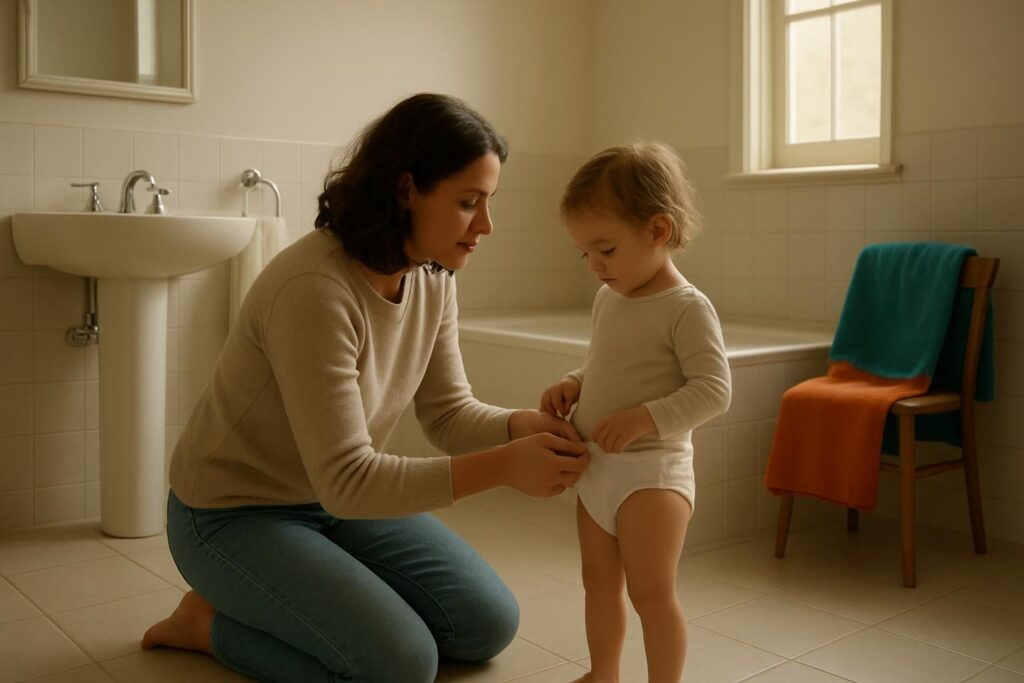
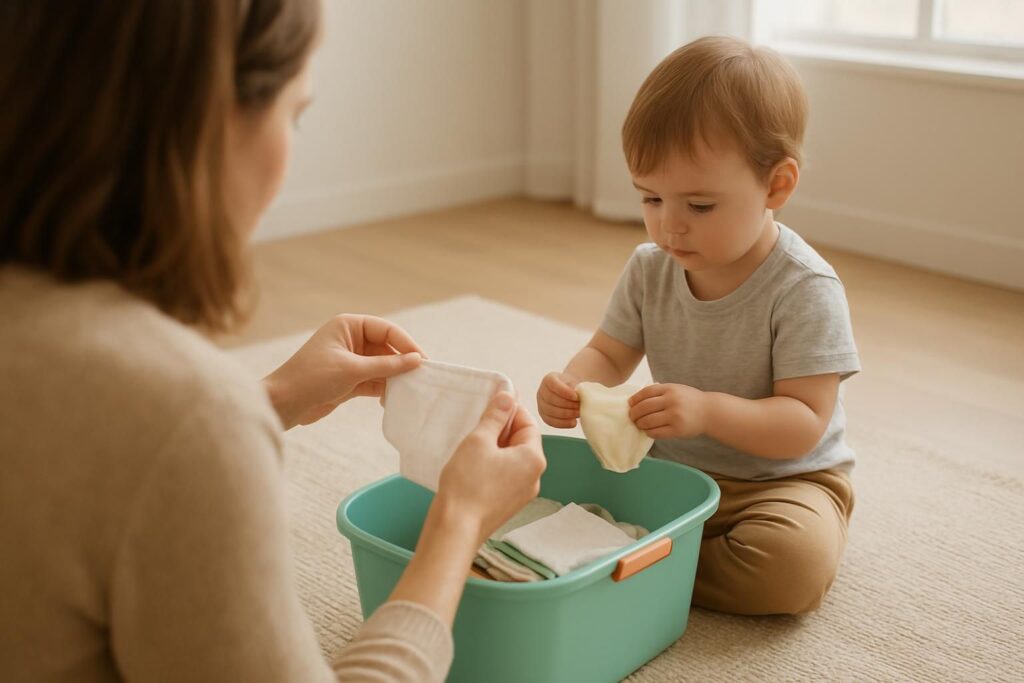
Regular cotton underwear matters more than it sounds like it should. A child feels a wet pull up far less than wet cotton against their skin, and that sensation is part of what teaches them to notice and act before it happens again. An accident in cotton underwear is uncomfortable in a way that actually carries information, both for the child and for you.
For the full breakdown of what each day looks like in practice, how toilet training works day by day walks through it in more detail than a single guide can.
What do you need to have ready before day one?
Have a potty on hand, mostly for the first three days, along with a toilet seat reducer and a step stool for once your child starts using the regular toilet. Stock at least fifteen pairs of cotton underwear, something to protect the mattress and the sofa, a handful of small rewards, and pull ups for sleeping. Clear three days off your calendar where you can stay close to home.
As an Amazon Associate we earn from qualifying purchases. Some links in this article are affiliate links: if you buy through them we earn a small commission, at no extra cost to you, and it does not affect what we recommend.
For a simple option, the BabyBjörn Potty Chair is low to the ground and easy for a toddler to climb on and off unassisted. For the toilet itself, the Frida Baby Drop Down Potty Training Seat folds flat against the lid between uses, and a sturdy option like the Dreambaby Step Stool gives small feet something solid to push against while they go.
For the complete list with nothing missing, see the complete checklist of what you need.
What happens on each day of the week?
The table below is a short version of the week. It is not a timetable to follow to the minute, it is a shape to expect.
| Day | What you do | What you are watching for |
|---|---|---|
| Day 1 to 3 | Diaper off, cotton underwear on, stay home. Drink a full cup in one go, record the time, record when the toilet happens. | Patterns: how long after drinking, how often, any signs before an accident. |
| Day 4 to 5 | Ask less often, hand over more responsibility. Expect pushback. | Whether your child starts telling you unprompted, even once. |
| Day 6 to 7 | Short outings, longer stretches between check ins. | How your child manages a new place, a car ride, a public bathroom. |
Day four or five is usually the hardest day of the week, not day two. By then most children are bored and a little irritated at being asked “will you tell me when you need to pee?” so often, and that irritation shows up as resistance. The fix is not to push harder, it is to ask less and let your child carry more of it themselves. There is more on handling that specific slump in why day 4 is usually the hardest.
If a week goes badly from the start, rather than pushing through, the method’s own advice is to stop, put the underwear away, and try again in a few weeks. That pause is a normal part of the process, not a sign the approach has failed.
How do you know when your child needs to go? Tracking instead of timing
A tracking schedule works better than a fixed interval because it records what your particular child actually does instead of imposing a routine on them. A typical card has columns for the time your child drank, the time they used the toilet, whether nothing happened, whether a pee was a success or an accident, whether a poop was a success or an accident, and a notes column.
The cup is drunk in one go rather than sipped across the afternoon, because that is the only way to see the real gap between drinking and needing to go. A half finished cup sipped over an hour tells you nothing useful about timing. A full cup, drunk at a recorded moment, shows the link between amount and timing clearly enough to act on.
As the pattern becomes clear and your child starts signaling on their own, you prompt less, not more. Sitting a child down every fifteen or thirty minutes regardless of what the schedule shows works against the one thing that actually matters here, which is the child’s own initiative. For a longer look at why fixed intervals work against this, see putting your toddler on the potty every 15 or 30 minutes.
How do rewards and the sticker cards keep a child going?
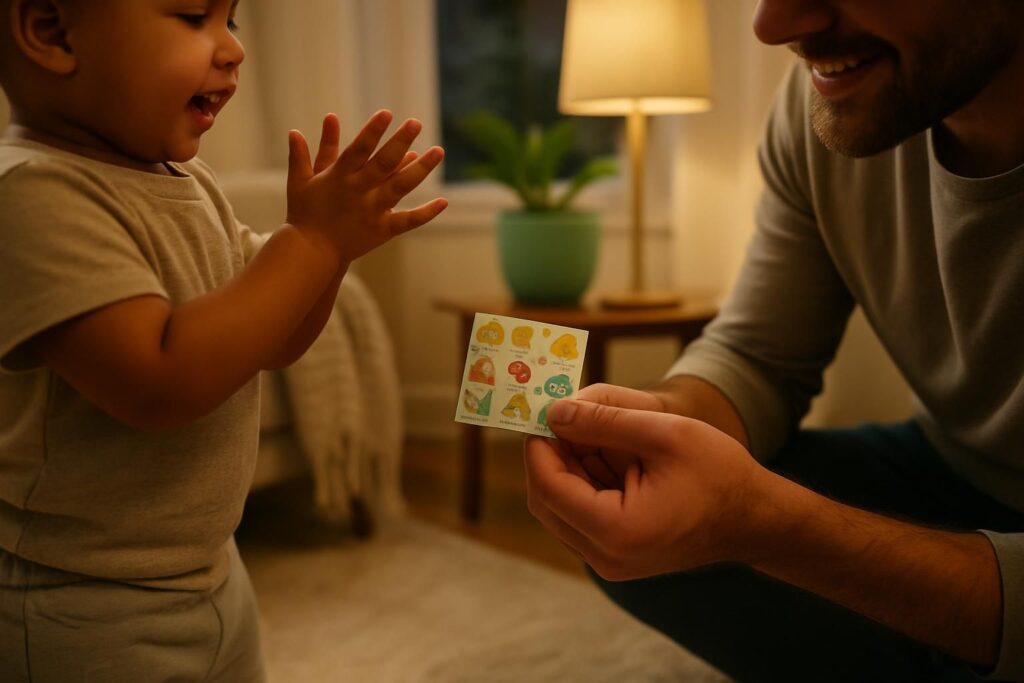
Sticker cards come in four sizes, with 3, 5, 7 and then 9 squares, used in that order rather than as one fixed card. The reward arrives quickly at three squares so a child sees right away that it works, then gets rarer as the squares increase, so the habit outlasts the stickers instead of stopping the moment they run out.
Animal stickers and poop stickers give the child something small and immediate to earn, and a pee certificate and a poop certificate mark the bigger milestones. Praise works best when it names exactly what happened: “you told me you needed to go, that’s exactly it” lands better than a generic “good job”.
Watching the moment land can help both of you. Here’s a short video to watch together the first time it clicks.
How do you move from the potty to the toilet?
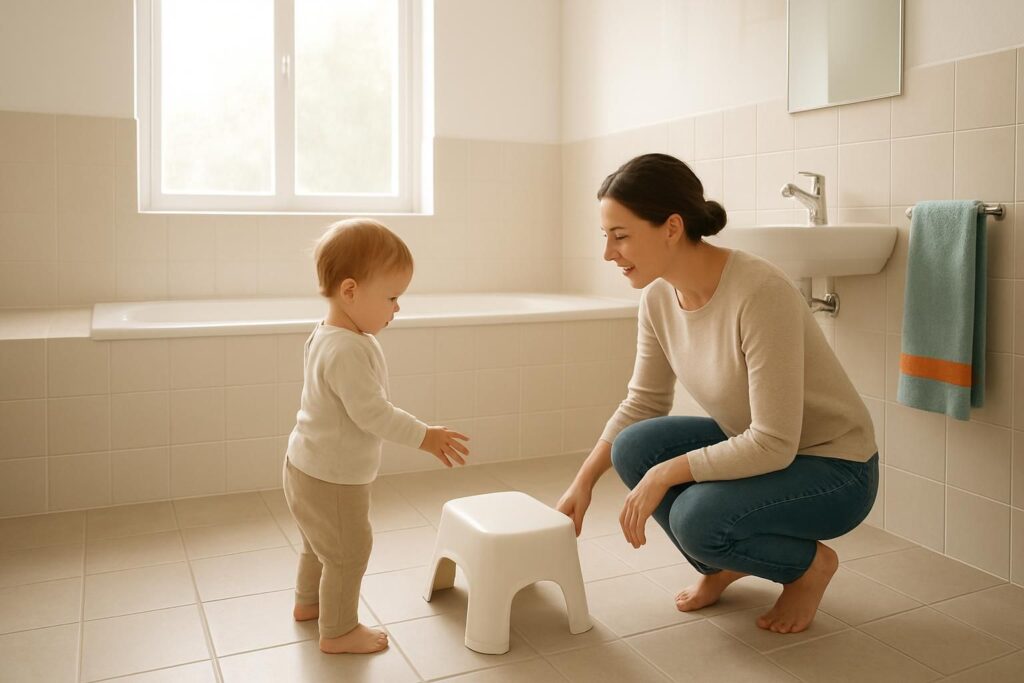
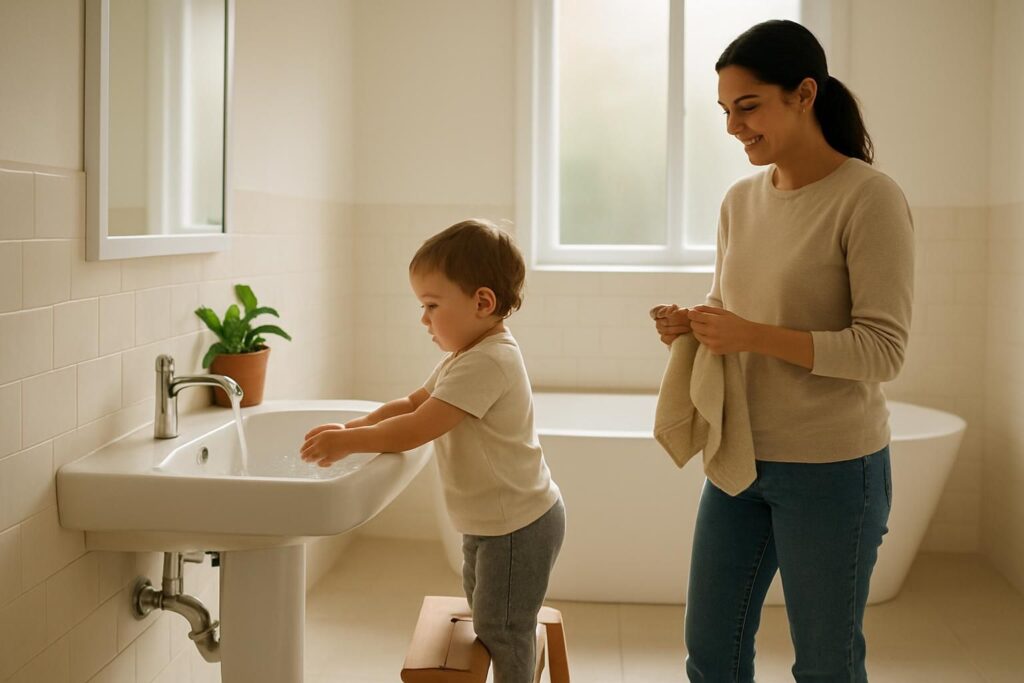
Think of the potty as a first three days tool and the toilet as the destination. A seat reducer and a step stool let your child climb up, feel stable with their feet supported, and manage the whole thing, flush included, with less help from you over time.
If your child refuses the big toilet after being comfortable on the potty, keep the potty in the bathroom rather than turning it into a standoff. Let them use it a while longer and reintroduce the toilet without pressure. Public bathrooms bring their own obstacles, loud automatic flushes and hand dryers chief among them, and it is reasonable to cover your child’s ears or flush after they have stepped away until they get used to it. For more on timing this switch well, see making the switch from potty to toilet.
What about accidents, setbacks and daycare?
Respond to an accident the same calm way every time: “that happens, let’s get you changed,” and let your child help with the cleanup rather than treating it as something that needs fixing on them. Setbacks after a new sibling, a move, or an illness are common and usually pass within a week or two once the disruption settles.
Keep daycare or preschool using the same words and the same cotton underwear during the day, with no diaper as backup, so your child is not getting two different messages in two different places. Night dryness comes later and on its own timeline, separate from how quickly daytime training goes.
Some things belong with a doctor rather than a potty training plan: ongoing constipation, a child who seems to be holding stool on purpose, pain while peeing, or bedwetting that continues past roughly age 6. The American Academy of Pediatrics notes that bedwetting beyond that age is worth raising with your child’s doctor, and the National Institute of Diabetes and Digestive and Kidney Diseases covers bladder control concerns in more depth.
Can you really toilet train in a week?
Most children reach daytime dryness in about a week of focused training. Some manage it in three days, others take two or three weeks, and a child who shows no readiness signs yet is better off waiting a little longer rather than starting on a deadline. Toilet training asks a toddler to coordinate several physical and cognitive skills at once, noticing a sensation, holding on, communicating it, and acting on it, which is exactly why the timeline varies so much from one child to the next.
What a structured week adds over a free article is specifics: what to do on day one, day two, and day three, including what to do on the day that goes badly, plus somewhere to ask when it does. The 7-Day Potty Training Video Course delivers this same seven day plan as forty short videos of about three minutes each, grouped by day, with a digital AI coach available any hour for the questions that come up at 9pm on day four. The sticker cards, tracking schedule and certificate come as printables included in the course that you put together at home, rather than physical pieces shipped to you.
The same approach is also used successfully with children who are autistic, have Down syndrome, or are non-verbal, usually stretched over a longer period and built around reading the child’s own signals rather than waiting for them to say the words. For that version of the plan, see potty training an autistic or non-verbal toddler.
Frequently asked questions
What is the proper age for toilet training?
There is no single proper age. Signs of bladder and bowel control typically show up between 18 and 24 months, and most children in the United States start toilet training between ages 2 and 3, with most trained by age 4, according to the American Academy of Pediatrics. Readiness signs matter more than any specific birthday.
What is the best method for toilet training?
An approach that is positive, reward based, and built around the child's own initiative tends to work well for most families. The Potty Training Box Method follows this shape: diaper off and cotton underwear on, three days at home to learn the child's patterns, then short outings, with the goal of reaching the moment the child tells you themselves.
Is it normal for a 2.5 year old to not be potty trained?
Yes, this is completely common. Many children are not ready to start until closer to 3, and readiness, not age, is what determines whether training will go smoothly. There is no reason to compare against other toddlers who started earlier.
How often should I put my toddler on the potty?
Rather than a fixed interval like every fifteen or thirty minutes, use a tracking schedule to record when your particular child actually drinks and goes, then let that pattern guide you. As your child starts signaling on their own, you prompt less, not more, since the goal is the child's own initiative rather than a timed routine.
How long does toilet training take?
Most children reach daytime dryness in about a week of focused training. Some manage it in as little as three days, while others take two or three weeks, and a child who is not showing readiness signs is better off starting later rather than on a deadline.
When should my child move from the potty to the toilet?
The potty is mostly useful during the first three days of training, and the toilet, with a seat reducer and a step stool, is the long term destination. Once your child is reliably telling you they need to go, introducing the toilet with those supports in place usually goes smoothly, though some children need the potty kept nearby a little longer.
Ready for the next step?
The 7-Day Potty Training Video Course walks you through this program in forty short videos, grouped per day, with a digital AI coach you can ask a question at eleven at night on day four. The full handbook comes with it as a PDF to read and print. Nothing is shipped, so you can start today.
Sources
- American Academy of Pediatrics, HealthyChildren.org (Signs of bladder and bowel control typically appear between 18 and 24 months and most c…)
- American Academy of Pediatrics, HealthyChildren.org (Bedwetting that continues past roughly age 6 is worth discussing with a doctor)
- National Institute of Diabetes and Digestive and Kidney Diseases (Bladder control problems and bedwetting in children are covered in more depth by a nati…)
This article was written with AI assistance and checked by Dustin van de Sande.