The Stages of Potty Training: What Each One Looks Like and How Long It Takes


Potty training has five stages: getting ready, diaper off at home for three days, a day 4 or 5 dip, moving from potty to toilet, and your child telling you without being asked. Most children reach daytime dryness in about a week, some in three days, others in two to three weeks. Night dryness is a separate, later stage.
These stages overlap, and your child will not move through them in a straight line. You might see three dry days, then a slide back for an afternoon, and that is not a sign anything has gone wrong. It is just what this particular skill looks like while it is being built.
What are the stages of potty training?
In order, the stages are: readiness in the weeks before you start, three days at home with the diaper off, a dip in motivation around day 4 or 5, the move from potty to toilet with short trips out, and finally your child telling you they need to go before you ask. Night-time dryness sits outside this list entirely, as its own, later stage.
Each stage has a rough timeline, but they are ranges, not deadlines. Most children are dry in the daytime in about a week. Some get there in three days. Others take two to three weeks, and if your child is clearly not ready yet, you are better off waiting a few weeks and trying again.
Stage 1: Is your child actually ready? (the weeks before day one)
Readiness shows up as a cluster of small things, not one big sign. Here is what to look for:
- Stays dry for a couple of hours at a stretch
- Tells you during or right after they have gone
- Can pull pants up and down mostly on their own
- Follows a simple two-step instruction
- Shows some curiosity about the bathroom
According to the American Academy of Pediatrics, signs of bladder and bowel control typically appear between 18 and 24 months, and families in the United States most commonly begin toilet training somewhere between age 2 and 3, with most children trained by age 4 (healthychildren.org).
As an Amazon Associate we earn from qualifying purchases. Some links in this article are affiliate links: if you buy through them we earn a small commission, at no extra cost to you, and it does not affect what we recommend.
If your child is genuinely frightened of the potty or the toilet, they are not ready yet, no matter their age. The honest move is to build familiarity first, maybe with a picture book like Potty, or a few minutes of sitting on it fully clothed, and start the real training later.
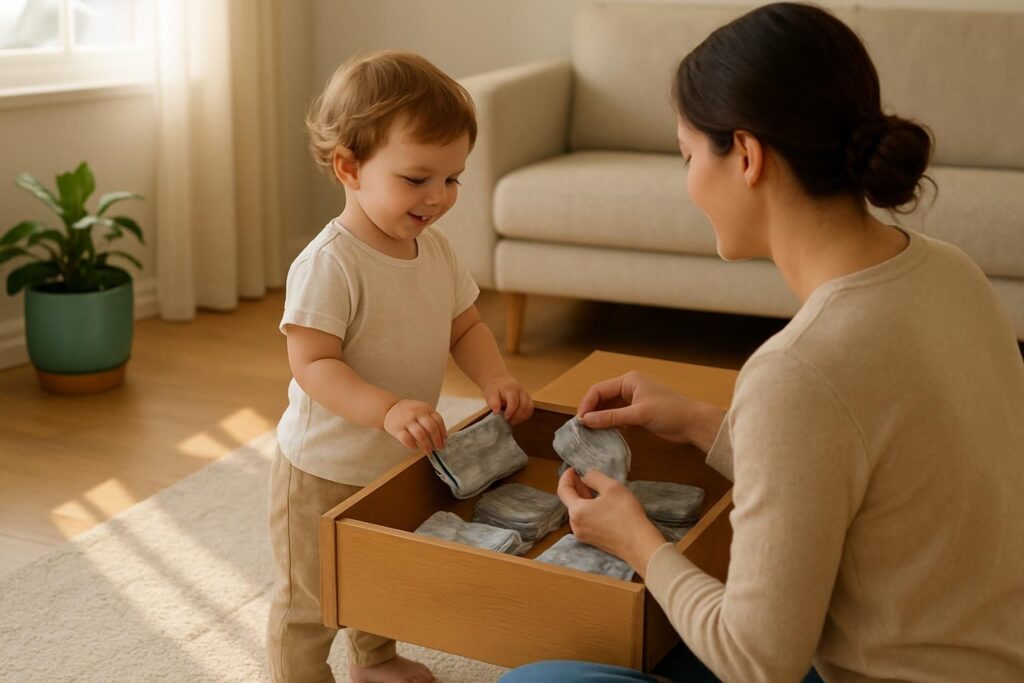
- Have ready before day one: a potty, a toilet seat reducer, a step stool, at least 15 pairs of cotton underwear, something to protect the mattress and sofa, and a handful of small rewards
- Use pull-ups for sleep, not for the day
The training works with regular cotton underwear rather than training pants, because your child feels a cotton pair get wet much more clearly than a padded one, and that sensation is part of what teaches them to notice and hold on.
Not sure where your child stands? Take the readiness quiz to get a clearer read on it.
If your child is still uneasy about the whole idea, reading something together first can help. Noa’s Potty Training Journey is a story written for exactly that moment, to read together before you start.
Stage 2: The first three days at home, diaper off
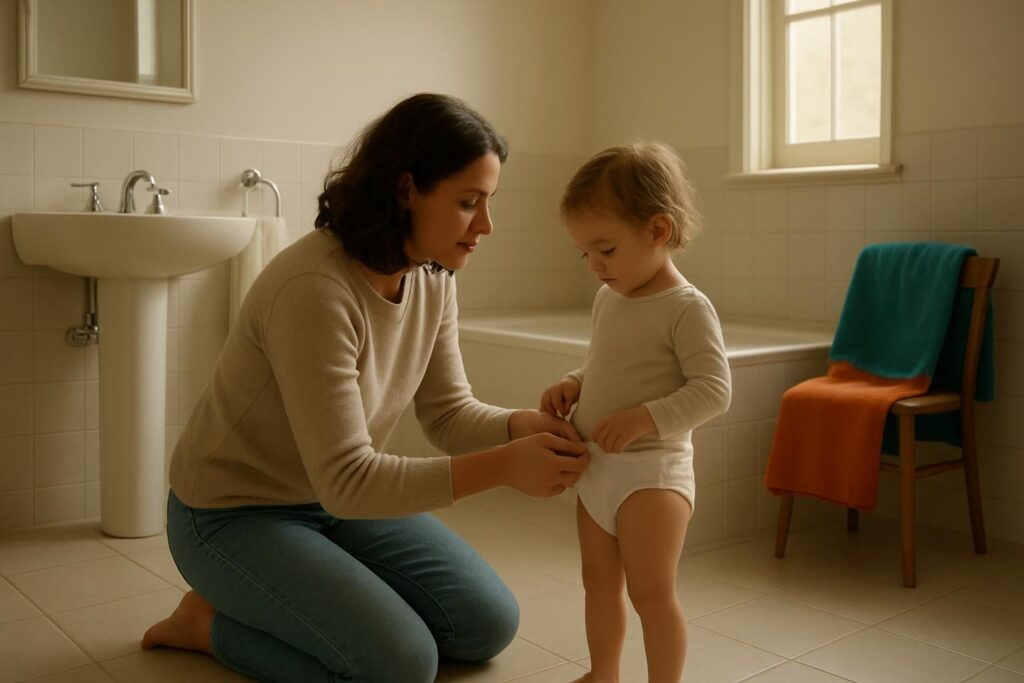
The first three days are spent entirely at home, because this is when your child learns the most and accidents matter the least. Day one means the diaper comes off, cotton underwear goes on, you offer plenty to drink, and you ask your child to tell you when they need to pee rather than putting them on the potty on a schedule.
Day two usually brings the first real successes alongside continued accidents, which is normal and expected rather than a setback. Day three tends to show more hits than misses, and the gap between your child signaling and getting to the potty starts to shrink.
This structure is what the 7-Day Potty Training Video Course walks you through: the same seven-day program as roughly forty short videos of about three minutes each, grouped by day, plus a digital AI coach you can ask questions of at any hour, and printable tracking schedules, sticker cards and certificates you print at home.
The Potty Training Box Method is a seven-day program that starts with three days at home, moves from potty to toilet, uses a tracking schedule to learn your child’s own timing, and pairs that with an escalating sticker reward, all aimed at your child eventually saying it themselves.
An accident on day two is information about your child’s timing, not a verdict on the plan. If you want the day-by-day detail of what to actually do and say, what each day of the week actually looks like goes through it in order.
Stage 3: Why day 4 or day 5 is usually the hardest, not day 2
Day 4 or day 5 is typically the hardest day, not day 2. By then, most children are simply tired of being asked “will you tell me when you need to pee?” over and over, and that fatigue often shows up as refusal or a sudden run of accidents.
The fix is to ask less, not more. Instead of prompting every twenty minutes, back off and let longer stretches of normal play happen without a question, so your child has room to notice the feeling and act on it themselves.
In practice that means a day with far fewer check-ins than day one or two had, with your child largely left to their own signals during play. The moments that stay fixed throughout training, and afterward, are before and after sleep and right before you leave the house.
A dip around this point is normal and is not a reason to go back to diapers. It usually passes within a day once the pressure eases.
Stage 4: From the potty to the toilet, and first trips out
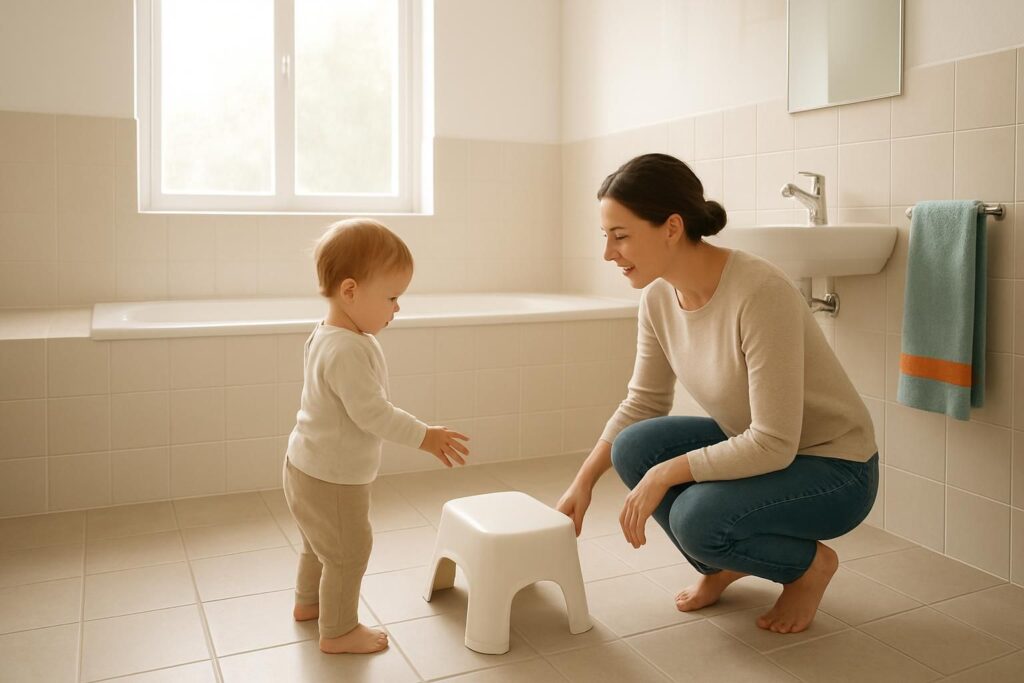
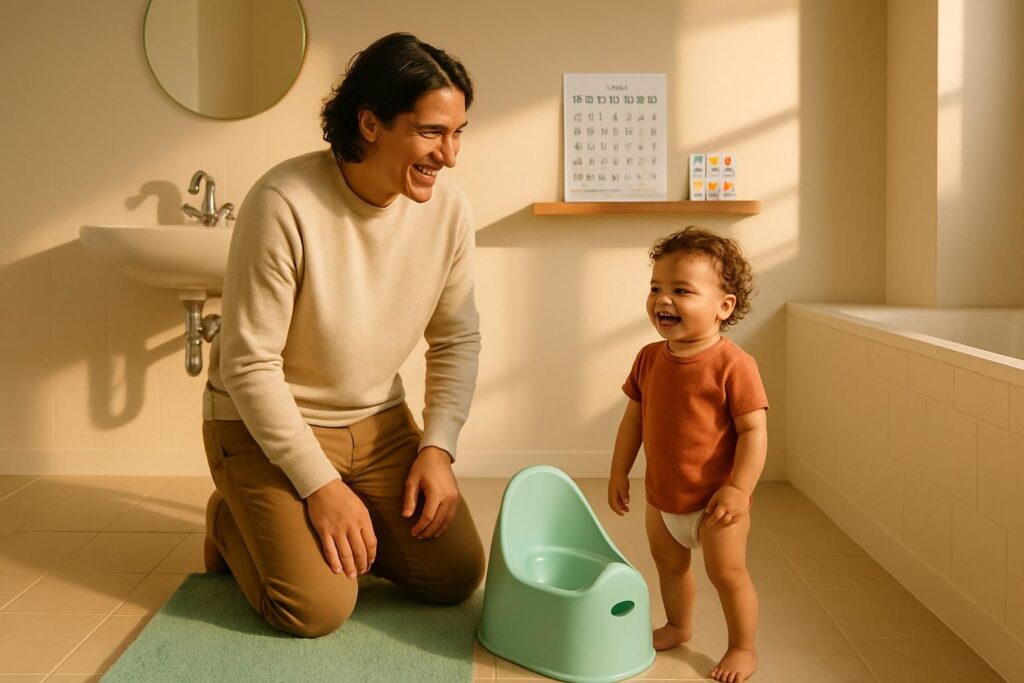
The potty is mainly useful for the first three days at home. After that, most families move to the regular toilet, using a seat reducer and a step stool so your child’s feet are supported and they can climb up and down on their own.
Outings start short, ten to twenty minutes at first, then get longer as confidence builds. Bring spare underwear, a spare pair of pants, and a bag for wet clothes, and use the toilet right before you leave rather than mid-outing if you can.
Poop often lags behind pee by days or even a couple of weeks, and that gap is ordinary rather than a sign of a problem. Bowel control tends to develop on its own separate timeline from bladder control.
Stage 5: Your child tells you, without being asked
The actual goal of the whole process is a child who says they need to go before anyone asks, not a parent running a toilet schedule. Putting your child on the toilet every thirty minutes by the clock is a different approach entirely, and it tends to work against your child learning to notice their own body.
The moments that stay routine, both during training and long after, are before and after sleep and before leaving the house. Outside of those, the asking fades as your child takes over.
You will know you are close when your child stays dry through a whole morning out, asks for the bathroom in an unfamiliar place like a store or a relative’s house, and manages fine at daycare without reminders from staff.
How do you know your child is making progress? Using a tracking schedule
A tracking schedule is a record of when your child actually goes, not a timetable you impose. The columns are: time of drinking, time on the toilet, whether nothing happened, pee marked green for success or red for an accident, poop marked the same way, and a notes column.
| Stage | What you see | Roughly how long |
|---|---|---|
| Getting ready | Readiness signs appear, prep gathered | Weeks before day one |
| First three days at home | Diaper off, frequent accidents then first successes | 3 days |
| Day 4 to 5 dip | Resistance, boredom with being asked | 1 to 2 days |
| Potty to toilet, outings | Toilet use, short trips out, poop still catching up | Days to a couple of weeks |
| Child takes the lead | Child tells you first, manages new places | Ongoing from about week 1 to 3 |
| Night dryness | Separate skill, pull-ups still used for sleep | Months after daytime, on its own clock |
When you fill in the schedule, have your child drink a full cup in one go rather than sipping it across the afternoon. That is the only way to see how much went in and how long it then takes before they need to pee, and that gap is exactly what the schedule is meant to reveal.
Over a few days, a pattern usually emerges, such as needing to go about forty minutes after a full cup. That pattern is what lets you offer the toilet at the right moments less and less, as your child starts doing it on their own.
How the reward stage works, and how it ends without a cliff
The sticker reward grows rather than staying fixed. Cards come in four sizes, 3, 5, 7 and then 9 squares, used in that order, so the first reward lands fast at just three squares and your child sees quickly that this works.
As squares increase, the reward gets rarer relative to how often your child succeeds, which matters because it means the habit keeps going once the stickers stop rather than collapsing the day you run out of them. The stage ends with a pee certificate and a poop certificate, marking the two skills separately.
Watching a moment of success together can be a nice way to mark the milestone with your child once they’ve had a few good days in a row, and this short video is made for exactly that.
What if your child gets stuck in a stage, or slides back?
Regression is common and usually has a trigger: a new sibling, starting daycare, an illness, a move, or a scare after a painful poop. The first response is to ease off, ask fewer questions, drop the pressure, and spend more time at home for a day or two if you can.
If an attempt clearly is not working, the method’s own guidance is to stop and leave it alone for a few weeks before trying again, rather than pushing through. Starting the training over from scratch is not the fix for an occasional accident weeks or months later; that kind of slip is better handled by talking it through calmly than by restarting the whole program.
Constipation, stool withholding, pain while peeing, or a suspected urinary infection are matters for a doctor or your child’s health clinic, not something to work through on your own at home.
Night-time dryness: a separate stage on its own clock
Daytime dryness and night-time dryness are two different skills, and this program does not promise night dryness as part of daytime training. Using pull-ups for sleep while your child is dry all day is completely normal and not a step backward.
Night dryness tends to arrive once a child’s body produces less urine overnight or wakes more easily to a full bladder, which can be months after daytime training finishes, and sometimes longer. The American Academy of Pediatrics covers this timeline and what is typical in more detail (healthychildren.org).
Bedwetting that continues past age 6 is worth mentioning to a doctor or pediatric clinic rather than managing alone, since it can have a few different causes worth checking (niddk.nih.gov).
How long does the whole thing take, start to finish?
Most children reach daytime dryness in about a week. Some manage it in three days, and others need two to three weeks, with no real difference in how well it eventually sticks.
If your child shows no readiness signs yet, you are usually better off waiting a few weeks rather than pushing through a stalled attempt. This program and other structured programs are also used successfully with children who are autistic, have Down syndrome, or are non-verbal, usually over a longer stretch, with you reading your child’s own signals rather than waiting to be told in words. The American Academy of Pediatrics has guidance specific to toilet training a child with a disability or developmental delay (healthychildren.org).
No plan can guarantee a date. A good one tells you what to do on the days that go well and the ones that do not, and then lets your child set the actual pace.
Frequently asked questions
What should day 3 of potty training look like?
By day 3, most children are having more successes than accidents, and the time between your child signaling and getting to the potty has usually shortened. It's still normal to have an accident or two, and the diaper generally stays off during the day throughout, with a pull-up only reintroduced for sleep.
What does day 4 of potty training look like, and why is it harder?
Day 4, or sometimes day 5, is often the hardest day because your child is tired of being asked whether they need to go. The practical fix is to ask less often and let your child take more responsibility for noticing on their own, which usually eases the resistance within a day.
At what age should a kid be fully potty trained?
There is no single correct age. The American Academy of Pediatrics notes that families in the United States commonly start between age 2 and 3, with most children trained by age 4, though the right time depends on individual readiness rather than a fixed birthday.
How do you potty train a stubborn child who refuses to sit?
Refusal is often a sign your child is not quite ready yet, or feels pressured by too many prompts. Backing off, building familiarity with the bathroom without pressure, and trying again in a few weeks usually works better than insisting in the moment.
How often should I put my child on the potty?
The goal isn't a fixed interval, it's learning when your particular child actually needs to go. A tracking schedule that records drink times and bathroom times shows you your child's own pattern, and offering the potty gradually gives way to your child telling you themselves, except around sleep and leaving the house, which stay routine moments.
How long after daytime potty training does night dryness come?
Night dryness is a separate skill that can take months longer than daytime training, since it depends on your child's body producing less urine overnight or waking more easily to a full bladder. Pull-ups for sleep during and after daytime training are completely normal in the meantime.
Ready for the next step?
The 7-Day Potty Training Video Course walks you through this program in forty short videos, grouped per day, with a digital AI coach you can ask a question at eleven at night on day four. The full handbook comes with it as a PDF to read and print. Nothing is shipped, so you can start today.
Sources
- American Academy of Pediatrics (healthychildren.org) (Signs of bladder and bowel control typically appear between 18 and 24 months, and most…)
- American Academy of Pediatrics (healthychildren.org) (Night-time dryness develops on its own timeline, separate from daytime training.)
- American Academy of Pediatrics (healthychildren.org) (Toilet training a child with a disability or developmental delay often takes a differen…)
- National Institute of Diabetes and Digestive and Kidney Diseases (NIH) (Bedwetting that continues past age 6 is worth discussing with a doctor.)
This article was written with AI assistance and checked by Dustin van de Sande.