
For a child-led, book-length explanation, Oh Crap! Potty Training is the most thorough choice. For a fast, blunt weekend plan, 3 Day Potty Training or Potty Training in 3 Days work well. Toilet Training in Less Than a Day is the original research-based approach. A structured day-by-day program adds tracking, rewards, and support a book cannot.
All four books are paperbacks (or short ebooks) you read once, then apply on your own, with no one to call when day four goes sideways. That is not a knock on any of them, it is just what a book is. What is missing from most comparisons online is an honest look at what you actually get for your money with each one, set next to what a structured day-by-day program adds on top.
Oh Crap! Potty Training by Jamie Glowacki: what you actually get
Oh Crap! Potty Training is built around child-led signals, naked time at home, and a block system that walks you through roughly the first two weeks. (As an Amazon Associate we earn from qualifying purchases. Some links in this article are affiliate links: if you buy through them we earn a small commission, at no extra cost to you, and it does not affect what we recommend.)
Its real strength is depth. Jamie Glowacki writes conversationally and spends real pages on the problems other guides skip, like poop refusal, regression, and a toddler who holds it on purpose. Parents who like to understand the reasoning behind a method, not just follow steps, tend to get the most out of it. If poop refusal is a sticking point for you, a simple read-aloud picture book like Everyone Poops can help take some of the pressure off the subject before you start.
The limit is that you have to build your own plan from the material. There are no tracking sheets to record when your particular child actually goes, no built-in reward structure, and nobody to ask on the morning things fall apart. You are reading a method, then designing your own week around it.
3 Day Potty Training by Lora Jensen: fast, blunt, and who it works for
3 Day Potty Training is a short, ebook-style guide built around one all-in weekend at home: diapers off, no going back once you start.
It is simple and decisive, which is exactly its appeal for a parent who wants a short, no-nonsense read rather than a long one. There is very little filler.
The tradeoff is that it leaves little room for a child who needs longer than three days, and it gets thin past day three, which is often when questions actually pile up. It is worth being honest here: most children take about a week to be reliably dry in the daytime, some manage it in three days, and others need two to three weeks. A guide built entirely around the three-day case can leave a parent feeling like week two means something went wrong, when it usually just means this particular child needed more time. If you are weighing that promise specifically, whether three days is really enough is worth reading before you commit a whole weekend to it.
Potty Training in 3 Days by Brandi Brucks: the scripted weekend
Potty Training in 3 Days by Brandi Brucks gives you prep checklists and an hour-by-hour script for the weekend itself, plus a troubleshooting chapter for common snags.
It suits a parent who wants to be told exactly what to do and when, with less interpreting required than Oh Crap!. The checklists genuinely help the night before you start.
It is still a one-way book. Once the weekend is over, there is nothing recording how this particular child’s timing actually works, no visible record of progress to show them, and no way to ask a follow-up question when the script does not quite match what is happening at your house.
Toilet Training in Less Than a Day (Azrin and Foxx): the original, and why it reads dated
Toilet Training in Less Than a Day is the 1970s behavioral research book that most later guides, including the three above, borrow pieces from. It built its method around a doll demonstration, heavy practice runs, and large amounts of drinking in a single sitting to create frequent chances to succeed.
Parts of it read uncomfortably today, the doll role-play and the sheer intensity of the original schedule feel out of step with how most families parent now, and few readers attempt it exactly as written.
What still holds up is the underlying idea that giving a child a larger drink and then watching closely teaches you something real about their timing. That insight, stripped of the dated delivery, is one reason structured tracking still works decades later.
Side-by-side: how the main potty training guides compare
| Guide | Core approach | Best for |
|---|---|---|
| Oh Crap! Potty Training | Child-led, blocks, naked time | Parents who want depth |
| 3 Day Potty Training | All-in weekend, no going back | A short, no-nonsense read |
| Potty Training in 3 Days | Scripted hour-by-hour weekend | Parents who want to be told what to do |
| Toilet Training in Less Than a Day | Intensive practice, big drinks | Understanding where it all started |
| A day-by-day video program | Tracked timing, built-in rewards | Daily guidance plus support |
The pattern across every book here is the same: a book gives you knowledge about potty training in general. A structured program gives you a sequence for your own days ahead, a place to record your own child’s timing, and somewhere to go when something does not match the page. For a broader look at how the main approaches stack up, an honest comparison of potty training methods covers more ground than books alone.
What a day-by-day program adds that a paperback cannot
The Potty Training Box Method is a seven-day, day-by-day plan that spends the first three days at home before moving into short outings, shifts the child from potty to toilet over the week, and is built around the child learning to say it themselves rather than being asked on a schedule.
Instead of a book you interpret, you get tracking schedules that record when this specific child actually drinks and goes, including giving them a full cup to drink in one sitting rather than sips spread out, because that is what lets you actually see the link between how much they drank and how long it takes before they need to go.
The reward side works on sticker cards that come in four sizes, used in that order: 3, 5, 7, and then 9 squares. The reward lands fast at three squares, so a toddler sees quickly that it works, then grows rarer as the stickers go up, so the habit outlasts the stickers instead of stopping the moment they do. There is a pee certificate and a poop certificate at the end, something no paperback can hand your child.
The 7-Day Potty Training Video Course carries this same plan as forty short videos of about three minutes each, grouped by day, plus a digital AI coach that answers questions at any hour, including the 7am question that a book simply cannot. If you are still deciding whether a paid program earns its keep over a free plan, whether a paid program is worth it or you can DIY it walks through that tradeoff honestly. The sticker cards, tracking schedule, and certificates in the video course are printed at home by you once you have the course, which is part of what makes it work, not a workaround to arrange yourself ahead of time.
Do not potty train by the clock, whatever the book says
Putting a child on the potty every thirty minutes by a fixed interval teaches them to wait to be asked, not to notice the feeling themselves, which is the opposite of the goal.
The better habit is to ask, in plain words, ‘you tell me when you need to pee,’ and then actually wait for the answer rather than offering the potty on a timer.
A few fixed moments are the exception and stay useful even after training: before and after sleep, and before leaving the house. Outside of those, the tracking schedule is there to help you read this child’s pattern, not to hand you a timetable to impose on them.
Day 4 or 5 is the hardest day, and no paperback prepares you for it
Resistance usually shows up on day four or five, not day two, because by then the child is simply tired of being asked ‘do you need to go?’ over and over.
The fix is to ask less often, not more, and to hand the child more of the responsibility for noticing it themselves. For a fuller look at what that day looks like and how to get through it, why day 4 is usually the hardest covers it in more detail.
Having someone to ask on that specific morning matters more than any amount of extra reading done in advance. An accident on day four is part of learning the pattern, never a sign that training has failed.
Which books are worth buying for your child, not for you
A picture book read together before you start can make the potty or toilet familiar rather than strange, which matters more than any script a parent reads alone. Time to Go Potty! and Daniel Tiger’s Potty Time! are both short, simple, and made for reading together rather than for a parent to study alone.
If your child is genuinely frightened of the potty or the toilet, that is a sign to build familiarity first and start the actual training later, not to push through anyway. The course keeps until they are ready.
Watching that together, with no pressure to perform afterward, does more for a nervous child than another chapter of a parenting book.
Is your child actually ready, before you buy anything?
Readiness shows up in behavior more than in age: your child stays dry for a couple of hours at a time, tells you (even after the fact) that they have gone, can follow a simple two-step instruction, and shows some interest in the bathroom or in big-kid underwear.
A short test can make this clearer than a checklist you read on your own.
Waiting a few more weeks if the signs are not there yet is a completely legitimate choice, and nothing is lost by it. For more on timing specifically, when to start potty training goes into the signs in more depth.
What to have ready before day one
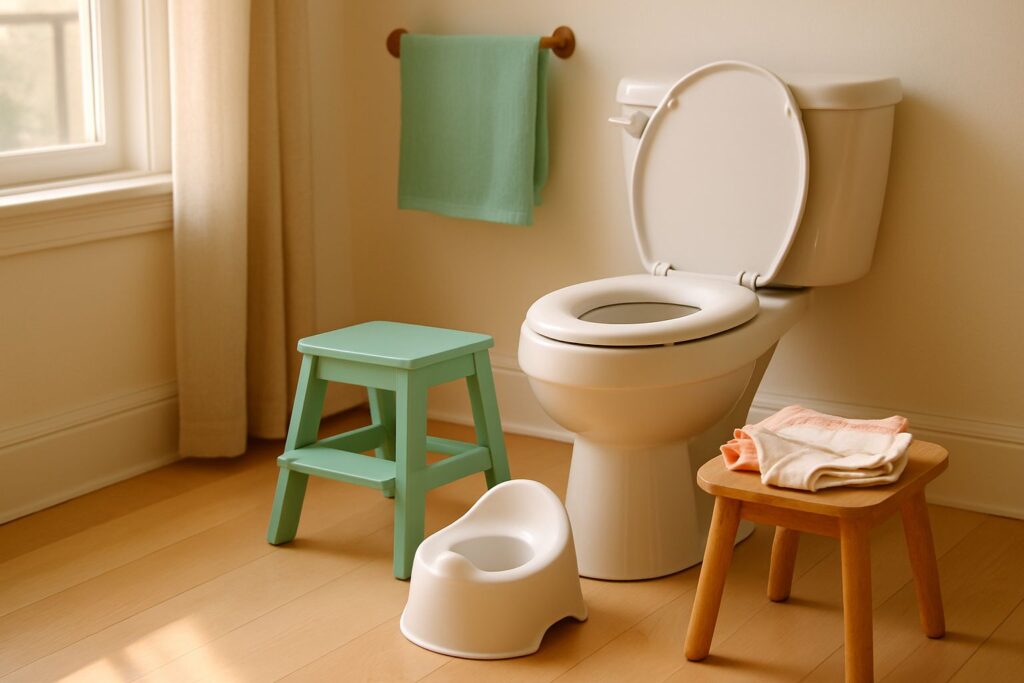
Whichever book or program you follow, the same short list of things helps on the day itself: a potty for the first few days, a toilet seat reducer once you move to the big toilet, a step stool, at least fifteen pairs of cotton underwear, something to protect the mattress and the sofa, a handful of small rewards, and pull-ups for sleeping.
Cotton underwear works better than training pants for this week specifically, because a child feels it immediately when it is wet, and that feeling is part of what teaches them to notice in time. A potty like the Ingenuity My Size Potty Pro, a reducer such as the Frida Baby Drop Down Potty Training Seat, and a sturdy step stool like the Dreambaby Step Stool cover the basics without overthinking it.
If you want the whole method laid out for free before deciding on a book or a paid course, the complete 7-day method is a good place to start.
Frequently asked questions
What do pediatricians recommend for potty training?
The advice you will see repeated most often is to watch for signs of readiness, such as staying dry for stretches of time, showing interest in the toilet, and being able to follow simple instructions, rather than starting at a fixed age. A child who shows these signs is usually in a better position to succeed quickly than one started by the calendar alone.
What is the most successful potty training method?
There is no single method proven to work for every child, but approaches that are child-led, positive, and reward-based tend to see fewer setbacks than approaches built around strict schedules or punishment. The Potty Training Box Method follows this pattern: three days at home first, then short outings, moving from potty to toilet as the child learns to signal on their own.
Is Oh Crap! Potty Training worth reading?
Yes, if you want a long, conversational explanation of the reasoning behind child-led potty training, including how to handle resistance and poop refusal in detail. It does not include tracking sheets, a reward system, or ongoing support, so you will need to build the actual week-by-week plan yourself.
Can you really potty train in 3 days?
Some children are dry in the daytime within three days, but most take about a week, and some need two to three weeks. A book built entirely around the three-day case can leave a parent feeling behind in week two when the child simply needed more time, which is a timing difference, not a failure.
What is the hardest age to potty train?
There is no single hardest age, but resistance often shows up partway through training regardless of age, typically around day four or five, because the child is tired of being asked repeatedly whether they need to go. Easing off the frequency of asking and giving the child more responsibility usually helps more than waiting for an easier age.
Do I need a book and a program, or is one enough?
A book can be useful background reading before you start, especially a short picture book for the child, but it is not required alongside a structured program since the program already includes the daily plan, tracking, and rewards a book would otherwise leave you to build yourself.
Ready for the next step?
The 7-Day Potty Training Video Course walks you through this program in forty short videos, grouped per day, with a digital AI coach you can ask a question at eleven at night on day four. The full handbook comes with it as a PDF to read and print. Nothing is shipped, so you can start today.
This article was written with AI assistance and checked by Dustin van de Sande.