

A paid potty training program is worth it when you want a day-by-day plan and someone to ask when a day goes badly. Free advice is often enough for a clearly ready child and a parent with a flexible week. Most children reach daytime dryness in about a week using a consistent, reward-based method, though timing varies and nights come later.
Some children get there in three days. Others need two or three weeks, and that is completely normal rather than a sign anything went wrong. No method, paid or free, can promise an exact timeline or a specific date, and none of them cover night dryness, which tends to follow separately and later.
The method behind the 7-Day Potty Training Video Course is a seven-day, reward-based approach built around the child learning to say it themselves, rather than being put on a schedule. That distinction matters more than most articles let on, and it is worth understanding before you decide whether to pay for structure or go it alone.
What free potty training advice actually gives you (and where it stops)
Free articles and pediatric guidance are genuinely good at one thing: telling you whether your child is ready. Signs like staying dry for longer stretches, showing interest in the bathroom, and being able to follow simple instructions are well covered by sources like the American Academy of Pediatrics, and that groundwork is worth reading regardless of what you decide to buy.
Where free advice runs out is the middle of the week. A general article can tell you that positive reinforcement works, but it rarely tells you what to actually do on day one versus day four, or what to say to a child who has started refusing the potty out of nowhere. It also cannot answer a question at nine at night when your child has had five accidents in a row and you are wondering if you have broken something.
Popular three-day promises are especially risky here. A slogan about being done in three days without a plan for what happens on day four or five sets parents up to feel like they failed when, in fact, the method just never covered the hard part. Parents who have tried once already usually do not need more theory. They need the missing middle: what to do differently, not more reasons to try again.
What a structured potty training plan adds over a free guide
A structured plan spells out what happens hour by hour for the first three days at home, before moving to short outings once the child is signaling reliably. That structure is the main thing a free article cannot replicate, because it depends on sequencing, not just principles.
A tracking schedule is part of this: a simple sheet recording drink times, bathroom times, and whether the result was a success or an accident, in green and red respectively, with a notes column. Its purpose is to reveal this particular child’s own timing and signals, not to impose a routine on them.
The reward system steps up through four sticker card sizes, used in this order: three squares, then five, then seven, then nine. The payoff comes fast at the start, at just three squares, when a child most needs to see that something changed, and it becomes rarer as the sizes grow, so the habit outlasts the stickers instead of stopping abruptly. Regular cotton underwear, rather than training pants, is part of the same logic: a child feels wetness in cotton underwear in a way training pants are designed to prevent, and that feeling is what teaches the connection.
A completion certificate and a set of ready-made compliment prompts round it out, useful on the day you have simply run out of new ways to say you did it.
| What you need | DIY with free advice | With a structured 7-day program |
|---|---|---|
| Day-by-day instructions | General principles only | Specific steps for each day |
| Reading your child’s timing | No system, you go on memory | A tracking schedule built for this |
| Reward system | No set structure | Stepped sticker system included |
| Help on a bad day | None built in | An AI coach answers any time |
| Reusable for a sibling | Depends what you kept | Yes, same plan again |
Does a paid program mean putting my child on the potty by the clock?
No. The goal of the Potty Training Box Method is the moment your child tells you they need to go, not a schedule you enforce. Instead of offering the potty on a timer, you ask your child directly: will you tell me when you need to pee?
There are two fixed exceptions that stay in place even after training ends: before and after sleep, and before you leave the house. Outside those two moments, the aim is always for the child to initiate.
The tracking schedule records what actually happened, drink time, bathroom time, success or accident, so you learn this child’s pattern. It is not a timetable you impose on them. Fill it in properly by letting your child drink a full cup in one go rather than in sips throughout the day, since that is the only way to see how long it takes between drinking and needing to go.
Which day is actually the hardest, and why most programs skip it
Day four or five is usually the hardest day, not day two as many articles claim. By that point, resistance often shows up because the child is simply tired of being asked will you tell me when you need to pee over and over.
The fix is not to push harder. It is to ask less often and hand more responsibility back to the child, letting them carry more of the initiative themselves. Accidents at this stage are part of learning, not a sign of failure or a reason to start over.
If a day truly is not working, no matter what you try, the method’s own advice is to stop and leave it a while before trying again, rather than pushing through a bad stretch. That pause is built into the approach, not a sign it has failed.
Do you need a potty training consultant, or is a course enough?
A one-to-one potty training consultant offers live, tailored advice, which can genuinely help families after several failed attempts where something specific keeps going wrong. That kind of personal troubleshooting has real value for a family stuck in a particular pattern.
A structured course offers a different kind of support: the same plan, available on demand and rewatchable whenever you need it, plus a digital AI coach built into the 7-Day Potty Training Video Course that answers questions at any hour, including nine at night on day five. Neither a consultant nor a course replaces a doctor, and any medical concern, like ongoing constipation, withholding, or a possible urinary infection, belongs with your pediatrician, not with a potty training program of any kind.
Who does not need to buy anything right now
A child who is frightened of the potty or the toilet is not ready, and pushing ahead usually backfires. The honest move is to build familiarity first, with no pressure, then give it a few weeks and check again before starting the actual training.
A child who already tells you they need to go on their own, and stays dry for a couple of hours at a stretch, may only need underwear and a free week rather than any paid structure at all. If you are mid-move, expecting a new baby imminently, or cannot see three clear days at home on the calendar, it is worth waiting for a calmer stretch instead of starting now.
Night-time dryness is a separate skill that develops later and on its own timeline, and no daytime method, paid or free, claims to produce it. The same reward-based, child-led method has also been used successfully with autistic children, children with Down syndrome, and non-verbal children, usually over a longer stretch and by reading the child’s own signals rather than waiting for them to say it out loud.
What to have ready before you start, whichever route you take
Whichever way you go, a few things are worth having ready in general: a potty, mostly useful for the first three days, a toilet seat reducer, and a step stool for the sink and toilet. At least fifteen pairs of cotton underwear make a real difference, since accidents are frequent early on and you do not want laundry to become the bottleneck.
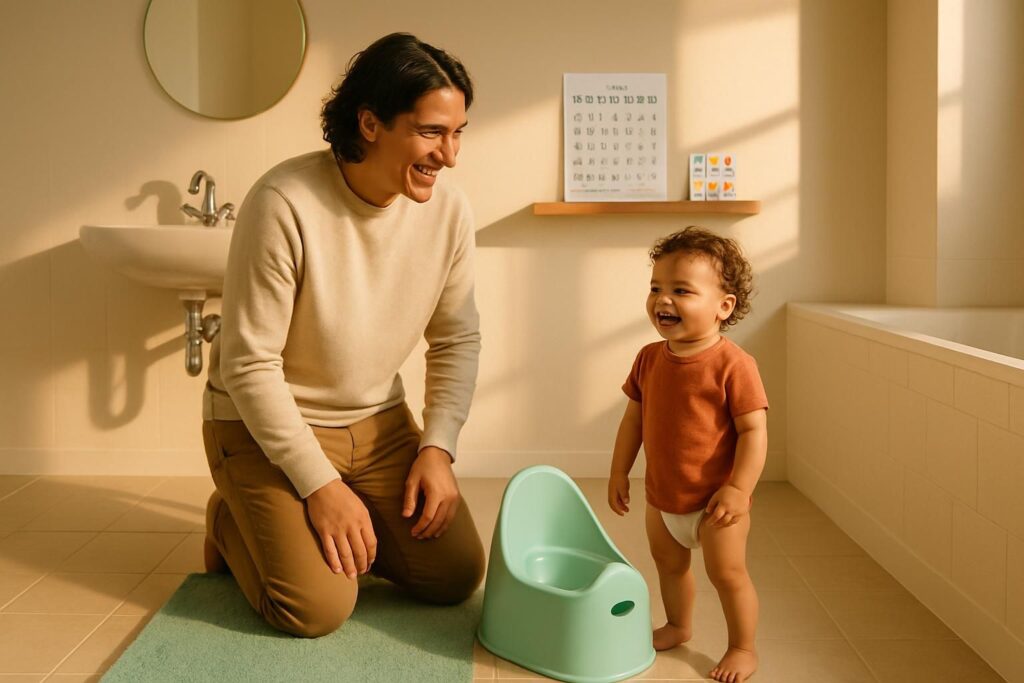
For those first three days at home, look for a sturdy potty with a removable inner bowl so cleanup takes seconds, like this one:
As an Amazon Associate we earn from qualifying purchases. Some links in this article are affiliate links: if you buy through them we earn a small commission, at no extra cost to you, and it does not affect what we recommend.
Add something to protect the mattress and sofa, a handful of small rewards, and pull-ups for sleeping only, since daytime training and night dryness are handled separately. Clear three days on the calendar without big outings or visitors, since the first three days at home are when a child learns the most.
How to decide in five minutes
You can likely do this yourself if your child already shows clear readiness signs, you have three flexible days ahead, and you are comfortable troubleshooting a bad day without outside input.
A structured plan will likely save you a second failed attempt if you have already tried once, or you want a specific answer for day four rather than general encouragement. The 7-Day Potty Training Video Course delivers the same seven-day method as roughly forty short videos of about three minutes each, grouped by day, with printable sticker cards, a tracking schedule, and a certificate included, plus the AI coach for questions at any hour. It is also reusable later for a younger sibling, since the same plan applies whenever that child is ready.
Frequently asked questions
Can I pay someone to potty train my toddler?
Yes, potty training consultants exist and offer live, tailored coaching, which can help after a few failed attempts with a specific sticking point. Most families do not need one-to-one coaching, though, and a structured day-by-day program with on-demand support covers the same ground for most cases.
What do pediatricians say about potty training?
The American Academy of Pediatrics recommends following the child's own readiness signs rather than a fixed age or a strict schedule, and starting when the child shows signs like staying dry longer and showing interest in the bathroom. Pediatric guidance generally favors positive, child-led approaches over pressure or punishment.
Is age 3 too late to start potty training?
No, age 3 is a common and normal age to start, and plenty of children begin successfully at this age or later. Readiness varies by child, and starting when a child shows clear readiness signs matters more than hitting a particular age.
Are potty training courses worth the money if we already tried once and it failed?
Often yes, because a failed first attempt is usually a sign the family needed more structure or a plan for the harder middle days, not that the child cannot be trained. A day-by-day program with support for bad days addresses exactly the gap that caused the first attempt to stall.
How often should I put my child on the potty during training?
The method does not use a fixed interval. Instead of offering the potty on a schedule, you ask your child directly whether they will tell you when they need to go, with two standing exceptions: before and after sleep, and before leaving the house. A tracking schedule records what actually happens so you learn your child's own timing rather than imposing one.
Do I need training pants or regular underwear?
Regular cotton underwear works better than training pants for this method, because a child feels wetness clearly in cotton underwear, and that feeling is what teaches the connection between the sensation and the need to go. Training pants are designed to reduce that feeling, which works against the learning process.
Ready for the next step?
The 7-Day Potty Training Video Course walks you through this program in forty short videos, grouped per day, with a digital AI coach you can ask a question at eleven at night on day four. The full handbook comes with it as a PDF to read and print. Nothing is shipped, so you can start today.
Sources
This article was written with AI assistance and checked by Dustin van de Sande.