

Pediatricians generally recommend waiting for clear readiness signs, usually after 18 months, then using a child-led, low-pressure approach with praise and small rewards, never punishment. This guidance covers principles, not a day-by-day plan, which is why many parents pair it with a structured method once their child is ready.
The American Academy of Pediatrics and the Canadian Paediatric Society are both described in the pediatric literature as favoring what is often called a child-oriented approach, built on watching for readiness and following the child’s pace rather than a fixed calendar date. A widely cited review of toilet training methods lays this out in detail (Kiddoo, 2012, Canadian Medical Association Journal). Family medicine guidance points to a similar starting window, generally after 18 months, once a child shows real signs of being ready (Choby and George, 2008, American Family Physician).
None of that guidance hands a parent a script for Monday morning. It tells you what good potty training looks like in principle: patient, positive, unhurried. It does not tell you what to do when your toddler refuses the potty on day two, or how to read the difference between a stalling tactic and a genuine need. That gap is where most parents get stuck, and it is worth naming plainly before we go further.
Which readiness signs do doctors actually look for?
Doctors look for a cluster of physical and behavioral signs together, not a single one, and not a birthday. HealthyChildren.org, the parent site of the American Academy of Pediatrics, lists signs such as staying dry for two hours or more, waking up dry from a nap, and showing awareness of the need to go, sometimes by hiding, freezing, or telling a parent afterward (HealthyChildren.org, toilet training guidance).
- Dry stretches of a couple of hours, or a dry diaper after a nap
- Clear discomfort with a wet or soiled diaper
- Physical readiness: can walk to the bathroom, help pull pants down, follow a simple two-step instruction
- Curiosity about the toilet, or interest in copying a parent or older sibling
As an Amazon Associate we earn from qualifying purchases. Some links in this article are affiliate links: if you buy through them we earn a small commission, at no extra cost to you, and it does not affect what we recommend.
A child who is genuinely frightened of the potty or the toilet is not showing readiness signs, whatever their age. The honest response in that case is to build familiarity gently, maybe just sitting near it clothed for a few days, and try again later rather than push through fear. A picture book that many parents use to make the toilet feel ordinary rather than scary is Once Upon a Potty, read together with no pressure to act on it right away. Being physically and behaviorally ready matters far more than hitting a particular age.
What does “child-led” really mean, and what does it not mean?
Child-led potty training means the goal is the moment the child says they need to go, on their own, not that the parent waits passively for that to happen out of nowhere. Those are two very different things, and the phrase gets misread constantly.
In practice, a parent creates opportunities from the first days of training and asks the child directly, will you tell me when you need to pee, right alongside offering the potty, rather than waiting for the child to have full familiarity first. Both happen together in the early days: the parent offers chances and asks the question, and as the child starts to recognize their own body’s signals, the offering fades while the question and the child’s own answer to it stay. What child-led guidance explicitly rules out is potty training by the clock: sitting a child down every thirty minutes because a schedule says so, or running fixed toilet times regardless of what the child is actually signaling. That is a different, more rigid method, and it works against the goal of the child learning to notice and say it themselves.
The exceptions that stay in place, both during training and afterward, are a handful of fixed moments: before and after sleeping, and before leaving the house. Outside of those, the aim is always to hand initiative back to the child as fast as the child can carry it.
Where pediatric guidance stops and a plan has to start
Pediatric resources such as the Mayo Clinic’s potty training guide and HealthyChildren.org both cover readiness and general principles well: recognizing signs, choosing simple bathroom words, staying calm about accidents (Mayo Clinic, potty training basics). What none of this literature offers is a structured day one, day two, day three plan, including what to do when a day goes badly.
Day one, day two and day three are usually left to the parent to improvise, often mid-week, often tired, often comparing notes with other parents who had a completely different experience. Many families report that the hardest part is not deciding to start but knowing exactly what to do at 4pm on the second or third day when nothing seems to be working. The 7-Day Potty Training Video Course exists to close that specific gap: the same child-led principles pediatricians describe, laid out as a seven-day program of roughly forty short videos grouped by day, with a digital AI coach on hand for questions at any hour.
How pediatric advice lines up with a seven-day, child-led method
The overlap between mainstream pediatric guidance and a structured method is closer than it looks, once you set them side by side.
| Pediatric guidance says | Seven-day method does this |
|---|---|
| Wait for readiness signs | Checklist before day one, start delayed if not ready |
| Child should signal need themselves | Parent asks, then steps back as child takes over |
| Praise, not punishment | Ready-made praise language and a growing sticker reward system, printed at home as part of the course |
| Accidents are normal, not failure | Tracking sheet logs accidents as data, not blame |
| Night dryness comes later, separately | Pull-ups for sleep, daytime dryness the only goal |
The video course follows this same child-led principle: the first three days at home, where most of the learning happens, followed by short outings once the child is more confident. It moves from potty to toilet over the week, and it uses regular cotton underwear rather than training pants, because a child feels a wet training pant less clearly than plain cotton, which slows down the very awareness the method is trying to build.
How often should I put my child on the potty? Answering it the useful way
The better question is not how often to put a child on the potty, but how to learn when this particular child actually needs to go, and hand that job to the child as soon as possible. Instead of offering the potty on a fixed interval, the method asks the child directly: will you tell me when you need to pee? Outside the fixed moments of before and after sleep and before leaving the house, that question replaces the clock.
A tracking schedule is the tool for learning the pattern, not a timetable to impose. A typical schedule records the time the child drank something, the time they sat on the toilet, whether nothing happened, whether peeing was a success (marked green) or an accident (marked red), the same for pooping, and a notes column for anything else worth remembering.
It helps to have the child drink a full cup in one go rather than in sips spread across the afternoon. That way a parent can actually see the link between how much a child drank and how long it takes before they need to go, which is the whole point of the sheet.
Why rewards work, and why they should get harder to earn
Pediatricians commonly endorse praise and small rewards over any form of punishment when it comes to potty training, and that lines up directly with how sticker-based reward systems are built. In one structured system, sticker cards come in four increasing sizes, three, five, seven, and nine squares, used in that exact order.
The first card fills up fast, at just three squares, so a child sees quickly that the system works. After that, the squares needed for a full card grow, so rewards become rarer as the child improves. The idea is that the habit outlasts the stickers instead of stopping the moment the rewards do. Plain praise matters just as much as the stickers themselves, and running out of new ways to say well done is a normal, common complaint among parents mid-week, not a sign anything is going wrong.
What if it does not work? What pediatricians and the method both say
If an attempt is not working, the advice from both sides is the same: stop, wait a few weeks, and try again later, rather than pushing through a bad stretch. That pause is not giving up, it is part of the Potty Training Box Method.
Day four or five of a training week is often the hardest day, more so than day two. By then a child can get bored or mildly resistant to being asked so often whether they need to go, and the fix is usually to ask less, not more, and hand more of that responsibility back to the child.
Most children who are ready become dry in the daytime in about a week using a structured, child-led approach. Some manage it in three days, others take two to three weeks, and there is no shame in either end of that range. Night-time dryness is a separate developmental milestone that typically comes later and is not something any potty training product promises.
When to stop reading articles and call your pediatrician
Some situations need a doctor, not another article. Constipation, or a child who seems to be withholding stool and finds pooping painful, is worth a call to the pediatrician rather than more potty training tips. The same goes for any signs of a urinary tract infection, such as pain when urinating or a sudden change in how often a child goes.
A child who suddenly loses a skill they already had, whether that is a previously reliable dry stretch or another developmental milestone, is also worth mentioning to a doctor. HealthyChildren.org notes that ongoing bedwetting beyond around age 6 is generally the point at which it is worth discussing with a pediatrician, since involuntary nighttime wetting up to that age is common and not usually a medical concern on its own (HealthyChildren.org, bedwetting guidance).
The same child-led approach has also been used successfully with children who are autistic, have Down syndrome, or are non-verbal, usually over a longer stretch of time and by reading a child’s individual signals rather than waiting for them to ask in words. In these cases it is especially worth involving the child’s existing care team alongside any potty training plan.
What you need before you start
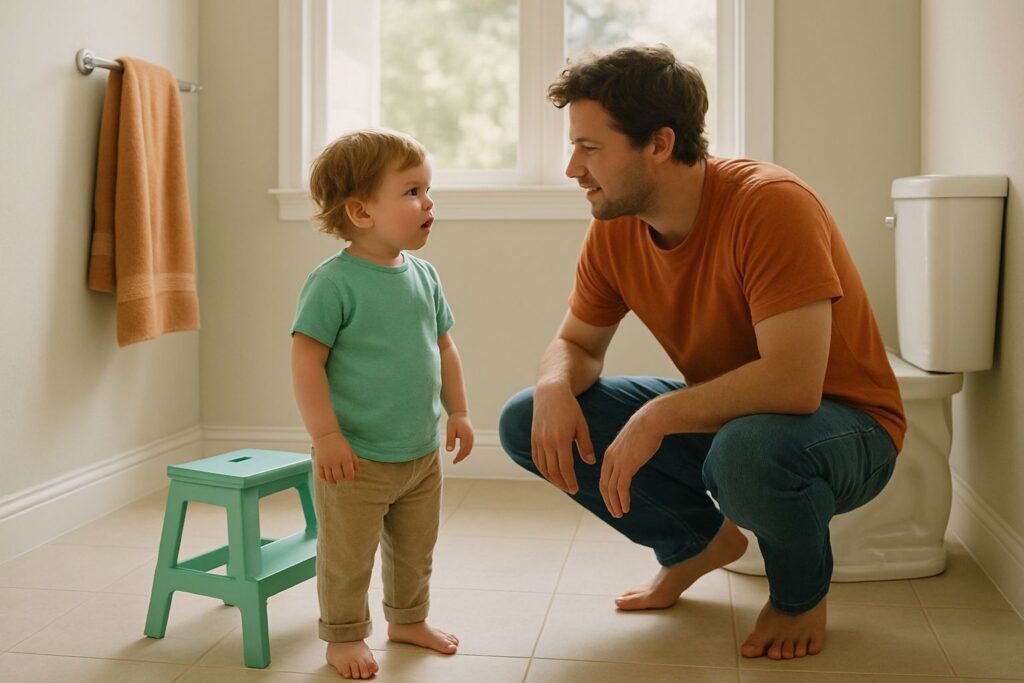
A few basics make the first days go more smoothly, whatever method a family follows. A potty, mostly useful for the first few days, a toilet seat reducer, and a step stool for reaching the sink and toilet independently are worth having on hand before day one, not halfway through it.
For those first days at home, a sturdy potty that a toddler can sit down on and get up from without help makes the whole thing easier, like this one:
Beyond that, plan on at least fifteen pairs of regular cotton underwear, something to protect the mattress and the sofa, a handful of small rewards, and pull-ups reserved for sleep only. Clearing three days at home before starting matters more than any single product, since the first three days are when most of the learning happens.
The method itself can be followed without buying anything. For parents who want the day-by-day structure written out, the video course covers the same seven-day plan across roughly forty short videos grouped by day, with a digital AI coach for questions at any hour, plus sticker cards, a tracking schedule and a certificate that are printed at home as part of the course.
Frequently asked questions
What do pediatricians say about potty training?
Pediatricians generally recommend waiting for clear readiness signs before starting, then using a positive, child-led approach with praise rather than punishment. This is described in pediatric literature as a child-oriented approach, favored by both the American Academy of Pediatrics and the Canadian Paediatric Society, and it focuses on principles rather than a specific day-by-day schedule.
At what age do pediatricians say to start potty training?
There is no single required age, but readiness signs commonly appear after 18 months according to family medicine guidance, and many children are not ready until closer to age two or later. Physical and behavioral readiness matters far more than a specific birthday, so two children of the same age can be at very different starting points.
Is child-led potty training better than a three-day method?
They are not opposites. A structured seven-day, child-led method still waits for readiness and still aims for the child to signal their own need, it simply adds a concrete day-by-day plan on top of the same principles pediatric guidance describes. The difference is structure, not philosophy.
What is the most successful potty training method?
There is no single method proven to work for every child, and any honest source will say so. What is consistently recommended is a positive, low-pressure, child-led approach that starts once readiness signs are present, treats accidents as normal, and uses praise and small rewards rather than punishment.
How often should I put my toddler on the potty?
Rather than offering on a fixed interval, ask your child directly whether they will tell you when they need to go, and keep only a few fixed moments such as before and after sleep and before leaving the house. A tracking schedule that records drinking times, toilet times, and outcomes helps a parent learn this specific child's pattern instead of guessing.
What is the latest age a child should be potty trained?
There is no fixed cutoff age, and children who are not developmentally ready should not be pushed to meet one. Ongoing bedwetting past around age six is generally the point at which pediatric guidance suggests bringing it up at a checkup, but persistent daytime training struggles are also worth mentioning to a pediatrician rather than waiting it out alone.
Ready for the next step?
The 7-Day Potty Training Video Course walks you through this program in forty short videos, grouped per day, with a digital AI coach you can ask a question at eleven at night on day four. The full handbook comes with it as a PDF to read and print. Nothing is shipped, so you can start today.
Sources
- Kiddoo, 2012, Canadian Medical Association Journal (PMC3307553)
- Choby and George, 2008, American Family Physician
- HealthyChildren.org, toilet training guidance
- HealthyChildren.org, bedwetting guidance
- Mayo Clinic, potty training basics
This article was written with AI assistance and checked by Dustin van de Sande.