What Is the 10-10-10 Rule for Potty Training? An Honest Look at Timed Sits

The 10-10-10 rule is a puppy house-training guideline, not a toddler potty training method. For toddlers, putting a child on the potty every 15 or 30 minutes is not the goal either. The aim is to learn your own child’s timing through short observation, then hand the initiative to your child, so they eventually tell you when they need to go.
What the 10-10-10 rule actually is (and why most results are about puppies)
If you searched for the 10-10-10 rule and landed here, there is a good chance the results you scrolled past were about dogs, not children. The 10-10-10 rule is a house-training framework used for puppies: roughly 10 minutes outside, staying within about 10 feet of the door, within about 10 minutes of eating, drinking, waking up or playing. Kennel and veterinary guidance, including the American Kennel Club, describes catching a puppy right after eating, drinking, waking or playing as the useful window, which is a dog-training idea, not a child-development one.
No pediatric body promotes a 10-10-10 rule for toddlers. Parents find the term anyway because search results mix dog training and child potty training so freely that the confusion is understandable. What people usually mean when they ask about it for a child is some version of a timed sit: put the child on the potty for a set number of minutes, at a set interval, all day. This article answers that version of the question honestly, including why it is not what the method behind this site teaches.
Why parents ask about the 10-10-10 rule in the first place
Wanting a simple, countable rule makes total sense when you are exhausted and this might be your second attempt at potty training. A number feels like something you can hold onto when nothing else about the process feels predictable.
There is also real anxiety behind the question: accidents on the couch, in the car seat, at daycare pickup, in front of a grandparent who potty trained differently. Pressure from other parents who seem to have cracked it in three days does not help.
Wanting a rule is not the problem. The problem is a rule built around the clock instead of around your child. The fix is not to drop structure, it is to build the right kind: one based on watching your child, not on a timer.
Is it better to potty train every 15 or 30 minutes?
Neither interval is the goal, because both put the parent in charge of timing instead of the child. Fifteen minutes and thirty minutes are both arbitrary numbers picked to make the parent feel like they are doing something, not numbers that reflect anything about the individual child sitting on the potty.
Interval sitting tends to produce a child who goes when told to, on schedule, but who never learns to notice or announce the need themselves. It also tends to produce power struggles: a toddler asked to sit every fifteen minutes, whether or not anything is happening, often starts resisting the potty altogether.
Offering the potty early in training is fine and useful, it is scaffolding for gathering information about this child’s patterns. It is not the method itself, and it is meant to come down as the child starts signaling on their own. If you want the fuller argument for why frequent forced sits actually backfire on speed, why timed sits actually slow potty training down covers that in depth.
How long should a toddler actually sit on the potty?
A minute or two is plenty for most sits, not ten minutes and not until a show ends. A toddler who is bored, restless or made to sit past the point of comfort tends to associate the potty with being trapped, which works against you.
Never restrain a child on the potty, never treat sitting as a punishment, and never stretch a sit out because you are hoping something will happen if you just wait long enough. If a child is genuinely frightened of the potty or the toilet, that fear is the signal to stop pushing sits altogether, build familiarity at a slower pace, and try the actual training later.
What replaces a timed schedule: reading your own child’s timing
Instead of asking your child to sit on a schedule, the question you actually ask is simple: will you tell me when you need to pee? That single shift, from offering on a timer to asking the child to initiate, is the core difference between clock-based sitting and a method built around the child’s own signals.
A few fixed moments stay in place regardless: before and after sleep, and before leaving the house. Those hold during training and afterward, because they are practical routines, not a schedule imposed all day.
To learn this particular child’s timing, the tracking schedule used in this method has the child drink a cup in one go, rather than in sips spread across an hour. Drinking it all at once is what lets a parent see how much went in and how long it takes before that child needs to pee, which is the pattern the whole schedule is built to reveal.
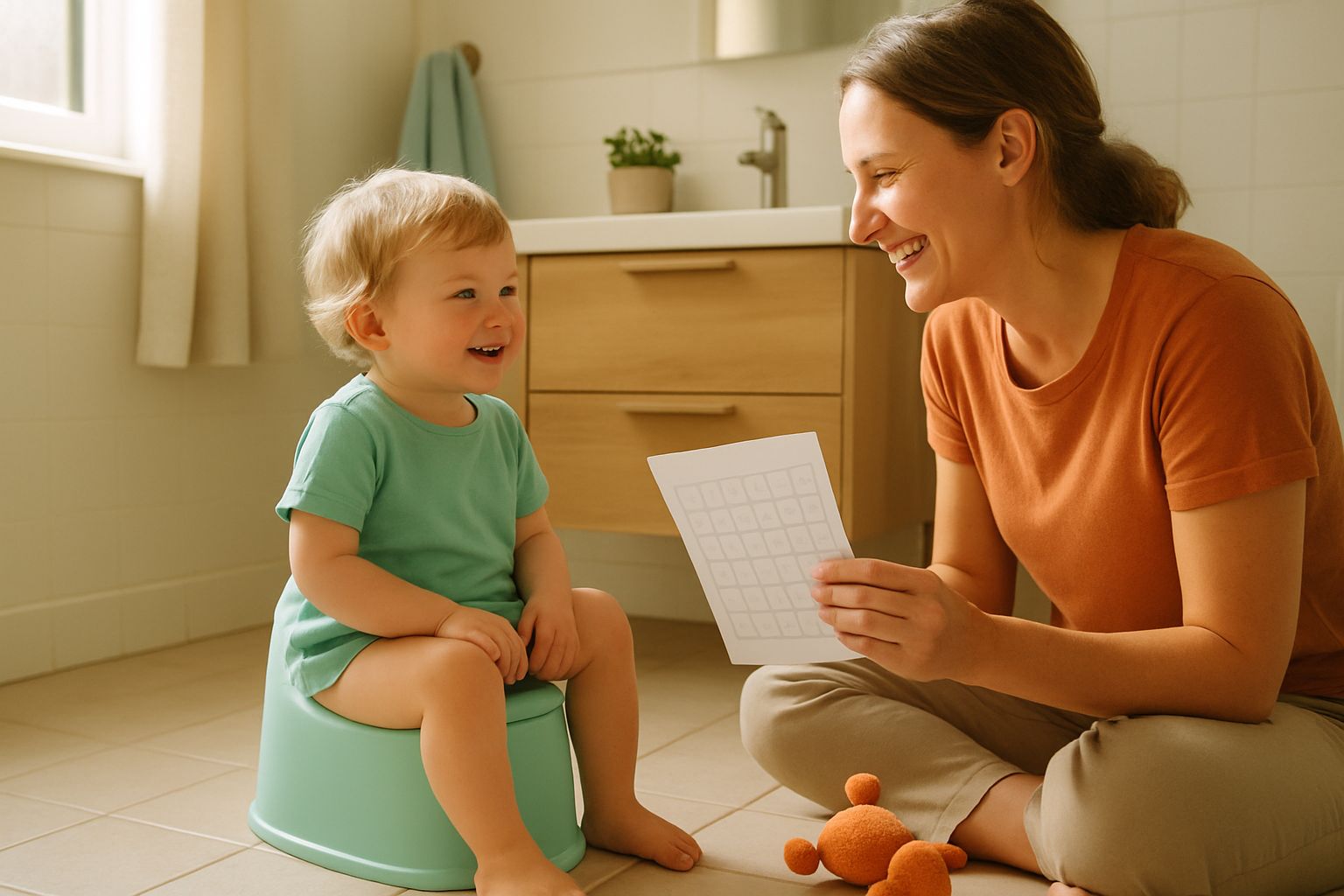
The schedule itself has specific columns: time of drinking, time on the toilet, whether nothing happened, pee marked green for a success or red for an accident, poop marked the same way, and a notes column for anything worth remembering. Green and red are not there to grade the day. They are there to build a picture of this one child’s timing, and that picture usually becomes clear within a couple of days. An accident recorded in red is data about timing, not evidence of failure.
What the tracking schedule looks like in practice
| Column | Example entry | What it tells you |
|---|---|---|
| Time of drinking | 9:15 am, full cup | How much fluid went in and when the clock on this attempt started |
| Time on toilet / pee | 9:50 am, green | This child tends to need to go about 35 minutes after a full drink |
| Poop | Red, 11:20 am | No warning given before this accident, poop timing may need a different cue than pee |
| Notes | Fussed before sitting | A behavior cue that might show up again before the next accident |
After two or three days of tracked entries, a parent stops guessing and starts anticipating, offering the potty right before the window this particular child usually needs it, rather than every fifteen minutes regardless of what the notes actually show. Over those same days, the goal shifts from a parent-led offer to waiting for the child’s own signal, which is the point the whole system is working toward.
The escalating sticker cards used with this system move from 3 squares, to 5, to 7, to 9. The reward comes fast at three squares so a child sees quickly that the system works, then gets rarer as the habit sets in, so the behavior outlasts the stickers instead of stopping the moment the stickers do. In the 7-Day Potty Training Video Course, these sticker cards, along with the tracking schedule and a certificate, are included as printables the parent prints at home.
What a week without timed sits usually looks like
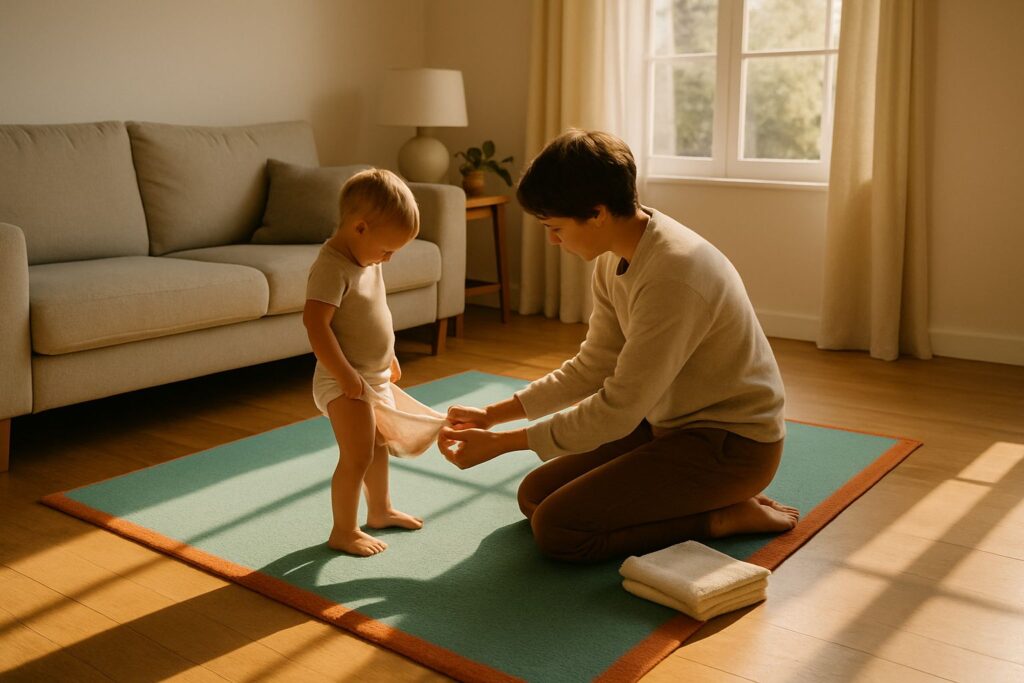
The first three days are typically spent at home, diaper off, in regular cotton underwear rather than training pants, because a child feels wetness through cotton underwear far more clearly than through a padded training pant, which is exactly what teaches the sensation of needing to go. Short outings usually follow from around day four.
Most children are dry in the daytime in about a week using this kind of approach. Some children manage it in as little as three days, and some take two or three weeks; both are within the normal range for this process. A child who does not seem ready yet is better off waiting a few weeks than being pushed through a week that will not stick.
Nighttime dryness is a separate skill that develops later and on its own timeline; daytime training does not promise it. It helps to have a few things ready before you start: a potty for the first few days, a toilet seat reducer, a step stool, at least fifteen pairs of underwear, something to protect the mattress and sofa, a handful of small rewards, and pull-ups for sleeping.
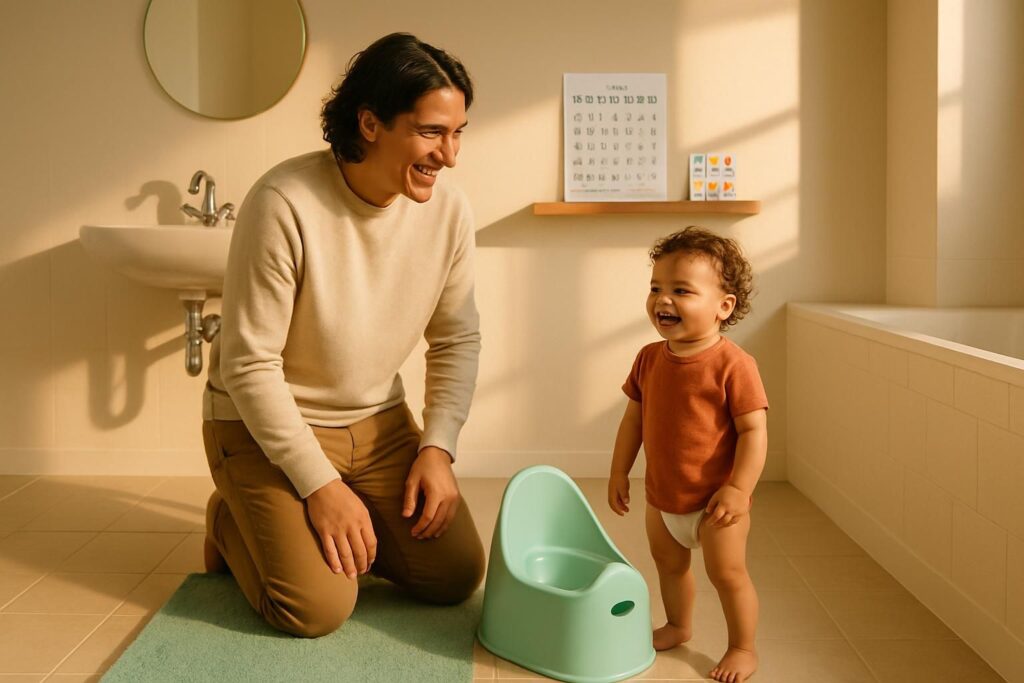
For the first few days at home, a low potty your child can sit on and get off of alone works best, and one that later doubles as a toilet seat reducer saves you buying twice, like this one:
As an Amazon Associate we earn from qualifying purchases. Some links in this article are affiliate links: if you buy through them we earn a small commission, at no extra cost to you, and it does not affect what we recommend.
When to pause instead of pushing through
Some signs mean the better move is to stop for now: strong fear of the toilet or potty, real resistance at every sit, or a child who shows no interest at all in staying dry. HealthyChildren.org, the parent-facing site from the American Academy of Pediatrics, describes readiness signs including staying dry for longer stretches, showing awareness of a wet or dirty diaper, and being able to follow simple instructions, and notes that training tends to go more smoothly once several of these signs are present rather than none.
If an attempt is not working, the method’s own advice is to stop and leave it a few weeks before trying again, rather than grinding through a week that is clearly going badly. That pause is a normal part of the process, not a setback.
Children who are autistic, have Down syndrome, or are non-verbal are trained successfully with this same approach, usually over a longer stretch, and by reading physical and behavioral signals rather than waiting for the child to say the words.
Some questions belong with a doctor or child health clinic rather than an article: ongoing constipation, a child who seems to be withholding stool, repeated urinary tract infections, or bedwetting that continues past about age 6. The Mayo Clinic notes that most children achieve nighttime dryness by around age 7, and that ongoing bedwetting is worth discussing with a pediatrician if it continues well past the age when most children have outgrown it.
Where to get the day-by-day plan
This method can be followed without buying anything. What a structured plan adds is not the idea, it is the specifics: what to do on day one, day two and day three, including what to do when a day goes badly, plus somewhere to ask when it does.
The 7-Day Potty Training Video Course covers this program across roughly forty short videos grouped by day. It includes the full handbook as a PDF for parents who would rather read, a digital AI coach available for questions at any hour, and printable sticker cards, a tracking schedule and a certificate you print at home.
Frequently asked questions
What is the 10-10-10 rule for potty training?
The 10-10-10 rule is not actually a potty training rule for children, it is a house-training guideline for puppies: about 10 minutes outside, staying within about 10 feet of the door, within 10 minutes of eating, drinking or waking. Search results mix dog and child training, which is why the term shows up in toddler searches. There is no pediatric version of this rule, and no children's health organization recommends it.
Is it better to potty train every 15 or 30 minutes?
Neither interval is the actual goal, because both make the parent responsible for timing instead of the child. Interval sitting can produce a child who goes on command but never learns to notice or signal the need themselves, and it often creates resistance to sitting at all. The better approach is to track this specific child's own timing for a few days using a schedule, then hand the initiative to the child by asking them to tell you when they need to go.
What is the 333 rule in potty training?
There is no widely recognized, established '333 rule' for potty training. If you have seen the phrase used, it is likely a loose shorthand someone invented for a three-day style approach rather than a standard method with an agreed definition. The safer question to ask about any named rule is whether it puts the parent or the child in charge of timing, since that is what actually predicts whether it helps.
How long should a toddler sit on the potty?
A minute or two is usually enough for a single sit. Sits stretched out for ten minutes or more, or timed to last through a show, tend to make a child bored or resistant rather than more successful. If a child seems frightened of sitting at all, that is a sign to pause and build familiarity before trying again, not a sign to extend the sit.
What is a red flag for potty training?
Strong fear of the potty or toilet, real resistance at every attempt to sit, and complete lack of interest in staying dry are all signs a child is not ready yet and that it is better to pause than push through. Physical red flags such as pain while urinating, straining or withholding stool, or blood in the diaper are different: those belong with a doctor or child health clinic rather than being managed through a training method. Repeated urinary tract infections or bedwetting that continues past about age 6 also warrant a medical conversation.
What is the hardest day of potty training?
There is no single universally hardest day, but resistance often shows up around day four or five rather than on day two. By that point the novelty has worn off and the child can get tired of being asked, over and over, whether they need to go, which sometimes shows up as pushback or refusing to sit at all. If that happens, asking less often and giving the child more room to bring it up themselves usually helps more than asking more insistently.
Ready for the next step?
The 7-Day Potty Training Video Course walks you through this program in forty short videos, grouped per day, with a digital AI coach you can ask a question at eleven at night on day four. The full handbook comes with it as a PDF to read and print. Nothing is shipped, so you can start today.