

There is no single hardest age. The toughest attempts are usually the ones started before a child is ready, or well after a strong-willed routine has settled in, which is why parents most often point to the stretch around 3 to 3.5 years old. Readiness signs predict how hard the week goes far better than age alone.
Most children who start ready are dry in the daytime in about a week. Some get there in three days. Others take two or three weeks, and that is still completely normal. A child who isn’t ready yet isn’t behind, they just need more time, and starting late is never something to feel bad about.
Why age is the wrong thing to measure (and what to measure instead)
Age is a rough guide at best. What actually predicts an easier week is a cluster of readiness signs: staying dry for longer stretches, hiding to poop, telling you a diaper is wet, showing interest in the bathroom, being able to pull pants up and down, and following a simple two-step instruction.
The real goal of any potty training attempt is the moment the child says, on their own, that they need to go. Everything else, including the potty itself, is scaffolding that comes down once that happens.
If you’re not sure where your child stands, it helps to look at this more carefully before you pick a date. You can read more about when to start potty training, or answer a few questions about your own child’s signals.
Answer a few questions about your child’s signals
A child who is genuinely frightened of the potty or the toilet is not ready yet, no matter their age. The honest move is to build familiarity first, in low-pressure ways, and start the real week later. Nothing about the Potty Training Box Method is lost by waiting.
Watch this one together with your child before you try again.
Potty training at 18 to 24 months: what makes it easy and what makes it hard
Toddlers this young often show less resistance simply because they haven’t developed strong opinions yet. That’s the upside. The downside is that language and bladder awareness may not have caught up, which means more of the work falls on the parent reading signals rather than the child announcing them.
Signs it’s genuinely too early: no interest at all in the bathroom, an inability to stay dry for even an hour or two, or visible panic at the sight of the potty. None of these mean a child never trains easily, they just mean now isn’t the moment.
If you start at this age and it stalls after a day or two, the method’s own advice is to stop and leave it a few weeks before trying again. That pause is part of the process, not a failed attempt.
Potty training at 2 to 2.5: why this window often goes smoothest
Language, basic bladder control and a general eagerness to please often line up somewhere in this window, which is why many parents report an easier week here than earlier or later. Cooperation tends to be higher and power struggles fewer.
The structure that works at this age is the same one that works at any age: the first three days happen at home, where the child learns fastest, and short outings follow once things feel steady.
Early on, you create opportunities by offering the potty at natural moments. As the week goes on, that offering fades and gives way to a simple question: will you tell me when you need to pee? Learning why timed sits slow you down explains why handing initiative to the child, rather than putting them on a schedule, is what actually speeds things up.
Potty training a 3 year old: why it can feel harder and what actually helps
Three year olds often have stronger opinions, a well established diaper habit, and sometimes preschool pressure layered on top. Power struggles show up more here than at younger ages, simply because the child has more say in the matter and knows it.
The upside is that older children often learn faster once they actually commit, because they can understand the whole idea in one go rather than piecing it together gradually.
If refusal shows up, the fix usually isn’t more asking, it’s less. Cutting back on how often you check in and handing the child more responsibility for noticing their own body tends to work better than repeating the question. This is not a late start and it is not a parenting failure, it’s simply a different personality to work with.
Potty training at 4 and beyond: when to keep going and when to ask for help
Some children are simply later than average, and that is not unusual. At this age the approach shifts slightly toward honest conversation and handing the child clear responsibility, without punishment for accidents.
Some things genuinely belong with a doctor rather than a parenting method: withholding stool, signs of constipation, pain while peeing, repeated urinary infections, no daytime progress at all despite real attempts, or bedwetting that continues past age 6. If any of these describe your child, talk to your pediatrician rather than pushing harder at home.
Night dryness is a separate milestone from daytime training and tends to come later, sometimes years later, regardless of how well daytime training went.
Age by age: what usually helps, what usually gets in the way
| Age band | What usually helps | What usually gets in the way |
|---|---|---|
| 18 to 24 months | Low resistance, blank slate | Language and bladder awareness still developing |
| 2 to 2.5 years | Language, cooperation, eagerness to please | Attention span still short |
| 2.5 to 3 years | Physical readiness usually solid | Growing independence, occasional pushback |
| 3 to 4 years | Fast once committed, understands the whole idea | Established habits, stronger opinions, power struggles |
| 4 and older | Can reason things through, take real responsibility | Preschool pressure, occasional embarrassment |
Day 4 or 5 is usually harder than any age
Across ages, the hardest day in a potty training week tends to be day 4 or 5, not day 2 as some guides suggest. Resistance shows up here because the child gets tired of being asked will you tell me when you need to pee, over and over.
The fix isn’t pushing through with more reminders, it’s the opposite: ask less often and hand more of the responsibility to the child. Keep a few fixed moments regardless, such as before and after sleep and before leaving the house, both during the training week and afterward. For a closer look at this specific stretch, why day 4 is the hardest day walks through what to actually do when it happens.
How the tracking schedule tells you whether the timing is right
A tracking schedule records when your particular child actually goes, so you learn their pattern rather than guessing at one. It typically includes columns for time of drinking, time on the toilet, whether nothing happened, whether a pee attempt was a success or an accident, whether a poop attempt was a success or an accident, and a notes column.
For the schedule to actually show you something, give the drink in one go rather than in sips spread across the afternoon. Only then can you see how much went in and how long it took before your child needed to go, which is exactly the connection the schedule is built to reveal.
This is never a fixed interval imposed on the child by the clock. Offering the potty every thirty minutes because a schedule says so is a different, competing approach, and it teaches the opposite of what this method is built around. If the schedule shows no pattern at all after a few days, that’s useful information too: it may simply mean your child isn’t ready yet.
Starting at any age: what the seven-day method actually asks of you
Whatever age you start at, the structure stays the same: three days at home first, because that’s when a child learns fastest, followed by short outings. Training moves from potty to toilet, and diapers come off in favor of regular cotton underwear rather than training pants, since a child feels wetness more honestly through cotton.
Before you begin, it helps to have a few things ready: a potty, a toilet seat reducer, a step stool, at least 15 pairs of underwear, something to protect the mattress and sofa, a handful of small rewards, and pull-ups for sleeping. A full rundown of what to have ready before you start covers this in more detail.
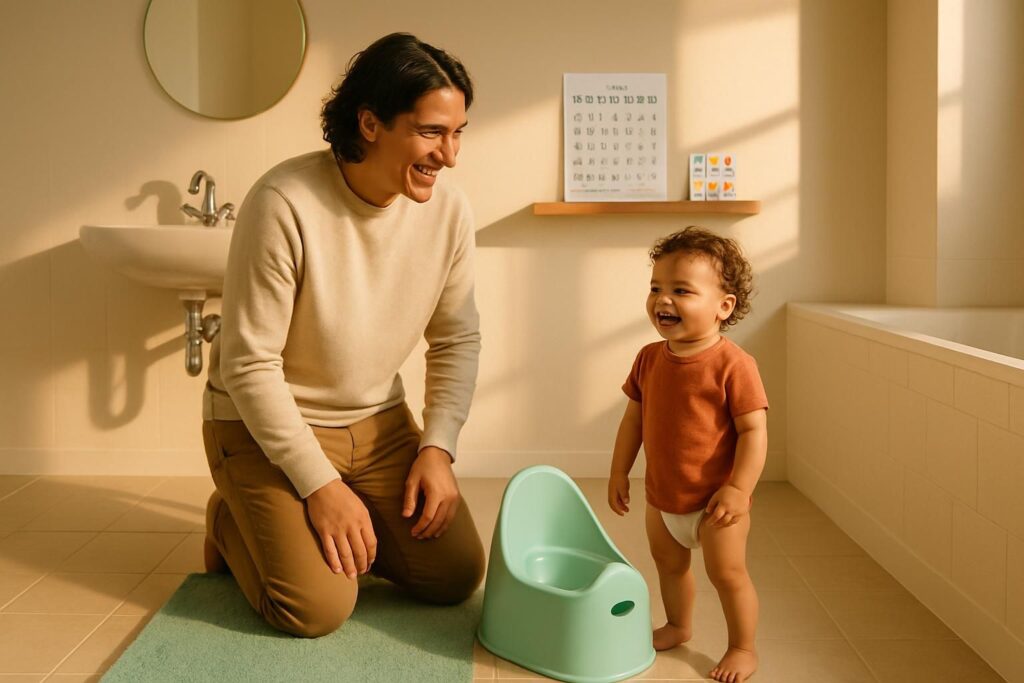
For the first three days at home, you want a potty your child can sit on steadily with a removable inner bowl that rinses out in seconds, like this one:
As an Amazon Associate we earn from qualifying purchases. Some links in this article are affiliate links: if you buy through them we earn a small commission, at no extra cost to you, and it does not affect what we recommend.
For parents who want the whole plan laid out day by day, The 7-Day Potty Training Video Course covers the same seven-day structure across 40 short videos of about three minutes each, grouped by day, plus a digital AI coach that answers questions any time of day or night. The course includes a printable sticker system that builds from 3 squares up to 5, 7 and then 9, so the reward comes quickly at first and grows rarer as your child improves, along with a printable tracking schedule and printable certificates for your child to keep. You can also see the complete 7-day method for the full walkthrough.
The same approach is used successfully with children who are autistic, have Down syndrome, or are non-verbal, usually over a longer stretch of time and by reading the child’s own signals rather than waiting for them to be told.
If the week does not work, stop and try again later
Stopping partway through is a legitimate move, not a failure. If a week clearly isn’t clicking, the honest advice is to pause and leave it a few weeks before trying again, rather than pushing through resistance.
Accidents are part of learning, not evidence that something has gone wrong. Regression happens too, often around a big change like a new sibling or a move, and it’s usually short lived. Treat it as a bump, not a reason to start completely over.
Frequently asked questions
At what age are most girls fully potty trained?
There's no set age that applies to all girls, since readiness signs and how a child responds to the method matter far more than sex. Most children who start when genuinely ready are dry in the daytime within about a week, whether they're a boy or a girl.
What is the hardest age to potty train a boy?
There's no single hardest age for boys specifically. The toughest attempts tend to be the ones started before a child shows readiness signs, or attempted after a strong-willed routine has already set in, often somewhere around 3 to 3.5 years old.
Is it normal for a 5 year old to not be potty trained?
Daytime accidents becoming rare by age 5 is common, but every child's timeline differs and a late start is not unusual. If a 5 year old is showing no daytime progress at all despite real attempts, or has other symptoms like constipation or painful peeing, that's worth discussing with a pediatrician.
Should a 4 year old be fully potty trained?
Many 4 year olds are daytime trained, but plenty are still working on it, and that's within a normal range. Night dryness is a separate and later milestone, so a daytime-trained 4 year old still wearing overnight protection is completely typical.
Can you start potty training too early at 18 months?
It's possible to start before a child is ready at any age, including 18 months. Signs it's too early include no interest in the bathroom, an inability to stay dry for an hour or two, or visible fear of the potty. If those show up, it's fine to pause and try again in a few weeks.
How long does potty training take once you start?
Most children who start when ready are dry in the daytime in about a week. Some manage it in as few as three days, while others take two or three weeks, and both are within a normal range. Night dryness is separate and usually comes later.
Ready for the next step?
The 7-Day Potty Training Video Course walks you through this program in forty short videos, grouped per day, with a digital AI coach you can ask a question at eleven at night on day four. The full handbook comes with it as a PDF to read and print. Nothing is shipped, so you can start today.
This article was written with AI assistance and checked by Dustin van de Sande.