Is It Normal for a 2 or 3 Year Old Not to Be Potty Trained?


Yes, it is completely normal for a 2 or 3 year old not to be potty trained. Readiness depends on physical and behavioral signals, not age alone, and the normal range is wide: some children are ready before 2, many not until 3 or later. There is no single right age, and no need to compare your child to others.
Readiness shows up as a set of signs your child gives you, not a date on a calendar. A child who stays dry for a couple of hours, notices a wet diaper, or can pull pants up and down is telling you something useful. A child who shows none of that yet simply isn’t there, and that is not a reflection of anything you have or haven’t done.
What is the average age kids are fully toilet trained in the US?
There is no single average age that applies to every child, and any number that sounds precise is worth being skeptical of. The American Academy of Pediatrics, via HealthyChildren.org, notes that most children show signs of readiness somewhere between 18 months and 3 years, which is a wide window rather than a target date.
Daytime dryness typically comes first. Night-time dryness is a separate skill that develops later, often well after daytime training is solid, because it depends on a child’s bladder capacity and sleep signals maturing rather than on the training method used.
It helps to hold those two facts apart. A 3 year old who is dry all day but still needs a pull-up overnight is not behind. That is simply the usual order these two skills arrive in.
Is age 3 too late to potty train?
No, age 3 is not too late, and many children actually learn faster at 3 than they would have at 2. Older toddlers tend to understand instructions better, have more bladder control, and can connect cause and effect in a way that makes the whole process shorter.
Preschool or daycare enrollment deadlines are often what puts pressure on parents at this age, not any real sign that the child has fallen behind. If a program requires potty independence by a certain date, it is reasonable to mention that deadline to your child’s care team and ask what flexibility exists, rather than forcing training before a child is ready.
A child who shows genuine readiness signals at 3 can often learn the daytime skill in about a week. Some manage it in three days, others take two or three weeks, and that range is normal too.
How do I tell the difference between not ready and just not interested?
Physical readiness looks like staying dry for two hours or more, having fairly predictable bowel movements, and being able to pull pants up and down without much help. Understanding readiness looks like following a simple two-step instruction and being able to say or show that something happened, even nonverbally.
Refusal is often ordinary toddler autonomy rather than an inability to learn. Two and three year olds push back on all kinds of things they are perfectly capable of doing, and the potty is no exception.
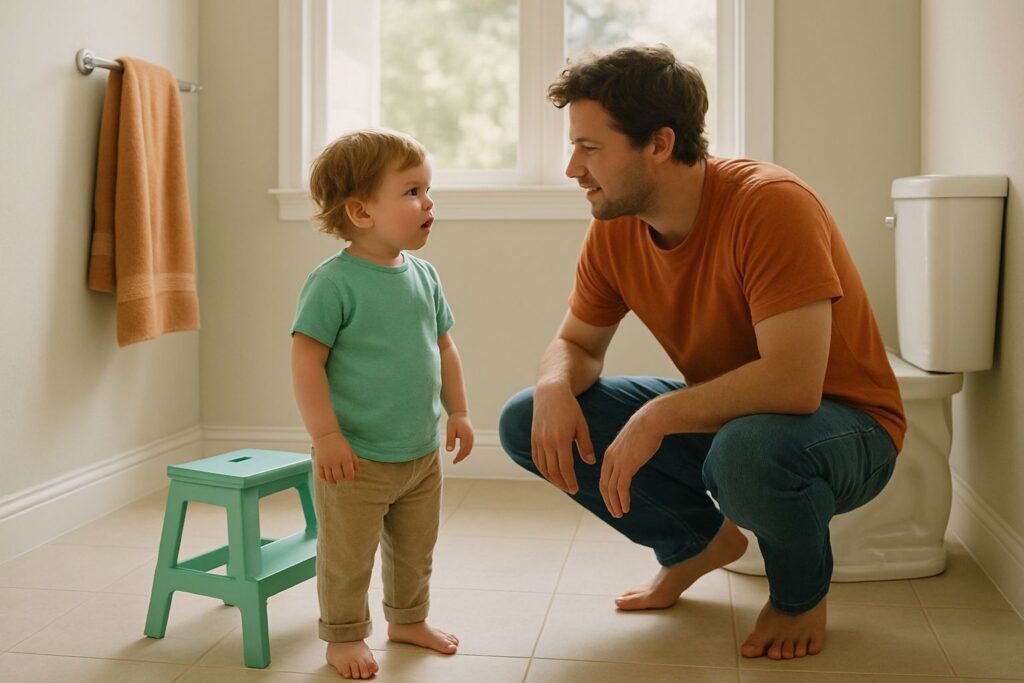
Fear is different from refusal, and it means wait. A child who cries or panics at the sight of the potty or toilet is not ready yet, and pushing through fear tends to set training back rather than move it forward. The better plan is to build familiarity first, let the child sit on the potty fully clothed a few times, read books about it, and start the real attempt later.
A simple picture book you can read together makes the potty feel familiar long before your child has to sit on it, like this one:
As an Amazon Associate we earn from qualifying purchases. Some links in this article are affiliate links: if you buy through them we earn a small commission, at no extra cost to you, and it does not affect what we recommend.
| What you see | What it usually means | What to do next |
|---|---|---|
| Dry for two hours or more | Bladder is maturing | Good sign to start soon |
| Tells you after they went | Aware, not yet anticipating | Keep building awareness |
| Tells you before they go | Ready to start | Begin the method |
| Refuses to sit but is curious | Normal autonomy, not fear | Keep it low pressure, try again soon |
| Cries or is scared of the toilet | Not ready yet | Build familiarity, start later |
| Holding in poop | Possible constipation | Talk to your pediatrician |
When should I worry about my toddler not being potty trained?
Most late potty training has no medical cause and simply reflects a child’s own pace. That said, some signs belong with a pediatrician or child health clinic rather than being managed at home: ongoing constipation, holding in bowel movements, painful urination, or a suspected urinary tract infection.
The American Academy of Pediatrics also notes that a child who shows no readiness signs at all by around age 4, or who has broader developmental concerns, is worth discussing with a pediatrician. Ongoing bedwetting past age 6 is also a conversation for a doctor rather than something to address through a training method.
This article does not diagnose and cannot replace a medical opinion. If any of the above sounds like your child, a conversation with your pediatrician is the right next step, and it does not mean training has to stop in the meantime for everything else.
Should I push, or should I wait?
If your child is not ready, waiting is the plan, not a failure. There is no benefit to starting early, and plenty of children who wait a few more weeks or months learn faster once they do start, precisely because they were actually ready. A parent who does not see any of the readiness signs yet is better off waiting than buying anything today, since the Potty Training Box Method works best once a child is actually showing signals to build on.
If you already tried and it stalled, the method’s own advice is to stop and leave it a while before trying again, rather than pushing through a bad stretch. That pause is part of how the method works, not a sign it didn’t work the first time. Plenty of parents are on their second or third attempt by the time it sticks.
Accidents during an attempt are part of learning, not a signal to quit or to be upset. Treating them that way is what actually slows a child down.
What potty training a ready 3 year old actually looks like
When a child does look ready, a focused first three days at home tends to work best, because that is when most of the learning happens, with short outings following once the basics are in place. The diaper comes off during the day in favor of regular cotton underwear rather than training pants, since a child feels wetness through cotton in a way that helps the lesson land.
The child uses a potty for most of the first three days, then moves to the toilet with a seat reducer and step stool as confidence builds. The actual goal throughout is getting your child to tell you they need to go, so instead of constantly prompting, you start asking something like ‘will you tell me when you need to pee’, with the potty offer stepping back as the child’s own signal takes over.
There are only a few fixed moments where you still offer rather than wait to be asked: before and after sleep, and before leaving the house. Everything else is built around the child’s own initiative.
A tracking schedule is used during this stretch to record when this particular child actually goes, so you learn their pattern rather than imposing a schedule on them. It is a tool for reading your child, not a timetable to enforce.
Giving a full cup to drink in one go, rather than in sips spread through the day, makes the link between drinking and needing to go visible on that same schedule. Sticker cards build from 3 squares up to 5, 7, and 9, so the reward comes fast at first and gets rarer as the habit takes over from the stickers.
It helps to have a few things ready before day one: a potty, a toilet seat reducer, a step stool, at least 15 pairs of underwear, something to protect the mattress and sofa, small rewards, and pull-ups for sleep.
For parents in the US, the method comes as the 7-Day Potty Training Video Course: about forty short videos grouped by day, with the full handbook as a PDF for a parent who prefers to read the plan and run it independently, a digital AI coach for questions at any hour, plus sticker cards, a tracking schedule, and a certificate that you print at home. You can see how the seven-day video course works before deciding. Either way, the method itself can also be followed without buying anything, using the same principles described here.
Late potty training with autism, Down syndrome, or a non-verbal child
This same method is used successfully with children who are autistic, have Down syndrome, or are non-verbal, usually over a longer stretch than a typical week. The core shift is the same: reading a child’s own signals rather than waiting for them to say something in words.
There is no promised timeline for these children, and there shouldn’t be one. Progress tends to be steadier when it’s paced to the individual child rather than measured against a generic week.
Anything medical or developmental should stay with your child’s doctor or care team, who know that child’s specific needs. This article can describe the training approach, but it cannot and does not replace that guidance.
Frequently asked questions
Is it normal for a 2 year old not to be potty trained?
Yes, it's very normal. Readiness typically shows up somewhere between 18 months and 3 years, and plenty of 2 year olds simply aren't showing the physical or behavioral signs yet. There's no fixed age a child should be trained by, and waiting for real signs of readiness usually makes the process shorter, not longer.
Is age 3 too late to potty train?
No, 3 is not too late at all. Many 3 year olds learn faster than they would have at 2, because they understand instructions better and have more bladder control. A child who shows genuine readiness at 3 can often learn the daytime skill in about a week, sometimes two or three.
When should I worry about my toddler not being potty trained?
Most late potty training has no medical cause. It's worth talking to a pediatrician about constipation, holding in bowel movements, painful urination, suspected urinary tract infections, no readiness signs at all by around age 4, or broader developmental concerns. This article does not diagnose, so any of those signs should go to your child's doctor.
What can I do if my 2 year old refuses to potty train?
First check whether it's refusal or fear: a child who's curious but resistant is usually showing normal toddler autonomy, while a child who cries or panics at the potty or toilet isn't ready yet. If it's fear, build familiarity first, let them sit on it clothed, read about it, and start again later. If it's refusal without fear, a short pause and a low-pressure restart often works better than pushing through.
At what age should a child be fully toilet trained during the day?
There's no single age a child should be fully trained by. The American Academy of Pediatrics notes most children show readiness signs between 18 months and 3 years, and daytime dryness typically arrives well before night-time dryness, which is a separate skill that comes later.
How often should I put my toddler on the potty when we start?
Rather than a fixed interval, the method uses a tracking schedule to record when your particular child actually goes, so you learn their pattern instead of guessing. The only moments you consistently offer the potty are before and after sleep and before leaving the house. Everything else steps back as the child starts telling you themselves that they need to go.
Ready for the next step?
The 7-Day Potty Training Video Course walks you through this program in forty short videos, grouped per day, with a digital AI coach you can ask a question at eleven at night on day four. The full handbook comes with it as a PDF to read and print. Nothing is shipped, so you can start today.