

A book suits a parent who reads well and will build their own plan from it. A video course suits a parent who wants to be told what to do each morning and has questions at 10pm. Physical kits with printed reward materials exist in some markets, but the decision that matters for most readers here is between a book and a course. The method matters more than the format, and no program replaces readiness. The 7-Day Potty Training Video Course is one structured option built around this last point: the child signals the need, the parent follows a day-by-day plan rather than a clock.
Before comparing named products, it helps to know what you are actually paying for in each format, because the differences are less about content and more about how much structure and support you get when a session does not go well.
What are you actually buying? Four formats, honestly described
A parenting book on potty training is a one-time read. You get the theory and a plan, and then you build the day-by-day structure yourself from notes in the margins. There is no one to ask when day four goes sideways.
An online video course is short, sequenced content, usually a few minutes per day, that tells you what to do that morning and what to watch for that evening. Some courses include a way to ask questions as they come up, which matters more than it sounds like it would at 9pm on a bad night.
A kit or box style program, sold in some markets, pairs a written plan with ready-made reward materials, sticker charts and tracking sheets you fill in by hand as you go. Free blog posts and the handout your pediatrician gives you are useful for background and readiness signs, but none of them lay out day one, day two, and day three, or what to do when none of it works on day one.
What differs between these formats is not what they contain in a checklist sense, but what each one costs you in time: reading versus watching, building your own system versus following one that is already sequenced for you, and whether anyone answers a question when a session falls apart.
How the best-known potty training books compare
As an Amazon Associate we earn from qualifying purchases. Some links in this article are affiliate links: if you buy through them we earn a small commission, at no extra cost to you, and it does not affect what we recommend.
Oh Crap! Potty Training uses a block-based approach built around extended naked time at home, and it leaves a lot of interpretation to the parent: you read the signs, you decide when to move to the next block. It is widely used and well regarded for its blunt, reassuring tone about accidents.
Toilet Training in Less Than a Day is a long-standing method developed by psychologists Nathan Azrin and Richard Foxx, built around an intensive, heavily parent-led single session using a doll to model the steps. It is one of the oldest structured approaches still in print and is closer to a behavioral protocol than a week-long plan.
3 Day Potty Training by Lora Jensen describes a fast, condensed method along similar lines: extended time without a diaper, frequent prompting in the first days, and a fast taper once the child starts signaling on their own.
What every book shares is that nobody prompts you the next morning and nobody answers your question at 10pm when your child refuses to sit down. A book also does not come with materials: no tracking sheet, no reward cards. A parent who wants that structure and reward material built in tends to choose a program that includes it, such as a video course. A book genuinely suits a second-time parent, a confident reader, or a family with a flexible week and no urgent deadline like a daycare start date.
Is Oh Crap Potty Training worth it, or would a course suit you better?
Oh Crap! Potty Training is worth reading for its tone and its honesty about accidents being part of the process rather than a setback. It has been recommended by parents and childcare providers for years, and its emphasis on going without diapers rather than transitioning through pull-ups lines up with what most structured methods, including this one, actually teach.
Where parents commonly get stuck with a book-only approach is not day one or two, it is day four or five, when a child who has been asked repeatedly to signal starts to push back. This is a well-known pattern in structured potty training: the child gets tired of being asked constantly, and resistance shows up right when the parent expects things to be getting easier. A book gives you the theory for that moment, but you still have to recognize it and decide what to change, alone, mid-week.
The trade-off is reading time versus watching time: a book asks for an evening of reading up front, a course asks for three minutes each morning and answers questions as they arise. Neither one is automatically better. A book you actually finish and follow will beat a course you only half watch, and a course with support will beat a book you were too tired to reread on the hard day. If you are weighing whether the extra structure is worth it at all, it is worth reading a plain look at whether a paid potty training program is worth it before you decide.
What the 7-Day Potty Training Video Course is, and what makes it different
The 7-Day Potty Training Video Course is forty short videos, each about three minutes, grouped by day and covering day one through day seven. It also includes a digital AI coach that answers questions at any hour, which is the part a book cannot replace.
The sticker cards, the tracking schedule, and the certificate are part of the course and are printed at home by the buyer. There is no physical box: this is a digital program you access and print yourself.
The core principle stays the same regardless of format: the child takes the initiative. Instead of running a timer, the parent asks something like “will you tell me when you need to pee?” and lets the child answer for themselves, rather than sitting them down on a fixed interval.
Two exceptions stay in place for good, during training and afterwards: before and after sleep, and before leaving the house. Outside of those moments, the aim is for the child to say it first.
The first three days are spent at home, since that is when a child learns the most, with short outings following once things settle. The plan moves from potty to toilet as the child gets steadier, rather than starting on the toilet itself.
How do I compare programs on the things that actually matter?
Five things are worth checking before you commit to any program: the format itself, the time it asks of you each day, what happens when it goes wrong, what materials are included, and who it actually suits. The support question is the one most buying guides skip entirely, and it is the one that matters most on day four or five.
Reusability also matters if you expect a younger sibling later. A book stays useful as-is. A course you can watch again.
| Format | What you get | Who it suits |
|---|---|---|
| Book | Full plan, no daily prompts, no support | Confident readers, flexible week |
| Video course | Daily short videos, AI coach, printable materials | Parents who want daily structure and someone to ask |
| Free articles and handouts | Background and readiness signs, no day-by-day plan | Early research, before committing to a method |
What do you need to have ready, whichever program you pick?
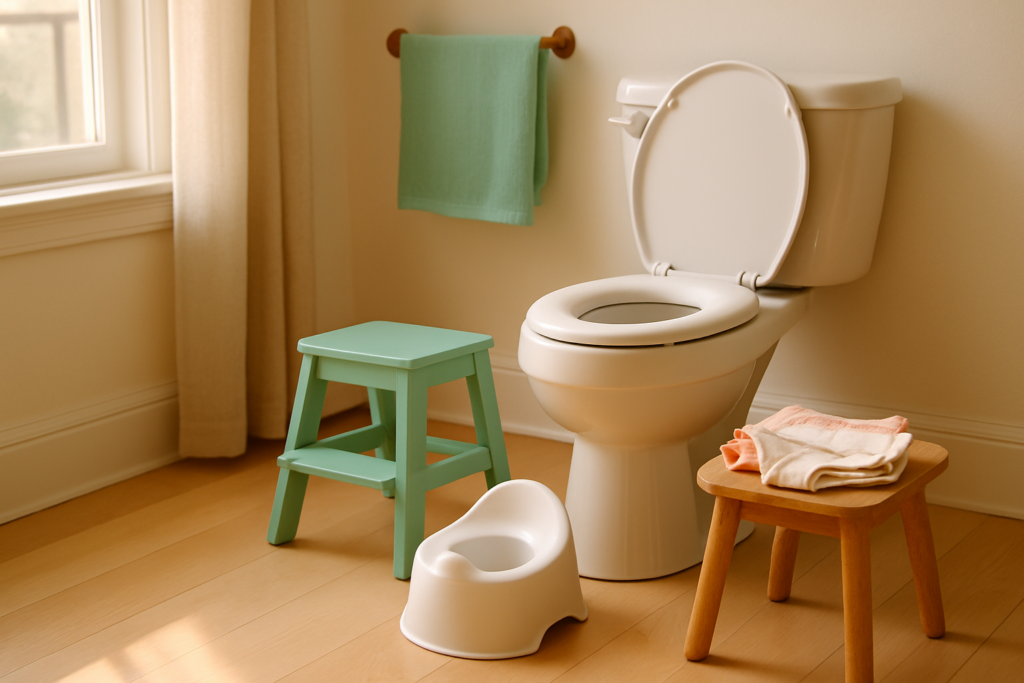
Whichever format you choose, a few things help on day one: a potty, mostly used in the first three days, a toilet seat reducer, and a step stool for reaching the sink and the toilet independently.
Plan on at least fifteen pairs of regular cotton underwear. The diaper comes off from day one and stays off during the day, since a child feels wetness through cotton underwear in a way they do not through training pants, and that feeling is part of how they learn. Training pants are deliberately left out of most structured methods for this reason.
Add something to protect the mattress and the sofa, a handful of small rewards, and pull-ups for sleeping, since night dryness is handled separately and later. Beyond materials, the most useful thing to have ready is a stretch of about three days where you can mostly stay home.
How the tracking sheet tells you when your child needs to go
A tracking sheet records what your child actually does, it is not a timetable you impose on them. The point is to learn this particular child’s pattern, not to run everyone on the same schedule.
A typical sheet has six columns: time of drinking, time on the toilet, a yes or no for “nothing happened”, pee marked green for a success or red for an accident, poop marked the same way, and a notes column for anything worth remembering.
When you fill it in, it helps to let your child drink a full cup in one go rather than in sips spread across the afternoon. That is the only way to see the actual link between how much they drank and how long it took before they needed to go, which is exactly what the sheet is designed to show.
Offering the potty often in the first days is scaffolding, not the method itself. As the sheet fills in and the pattern becomes clear, the parent offers less and asks more, moving from “let’s try the potty” toward “will you tell me when you need to go?”
Why sticker cards that get harder are better than one big chart
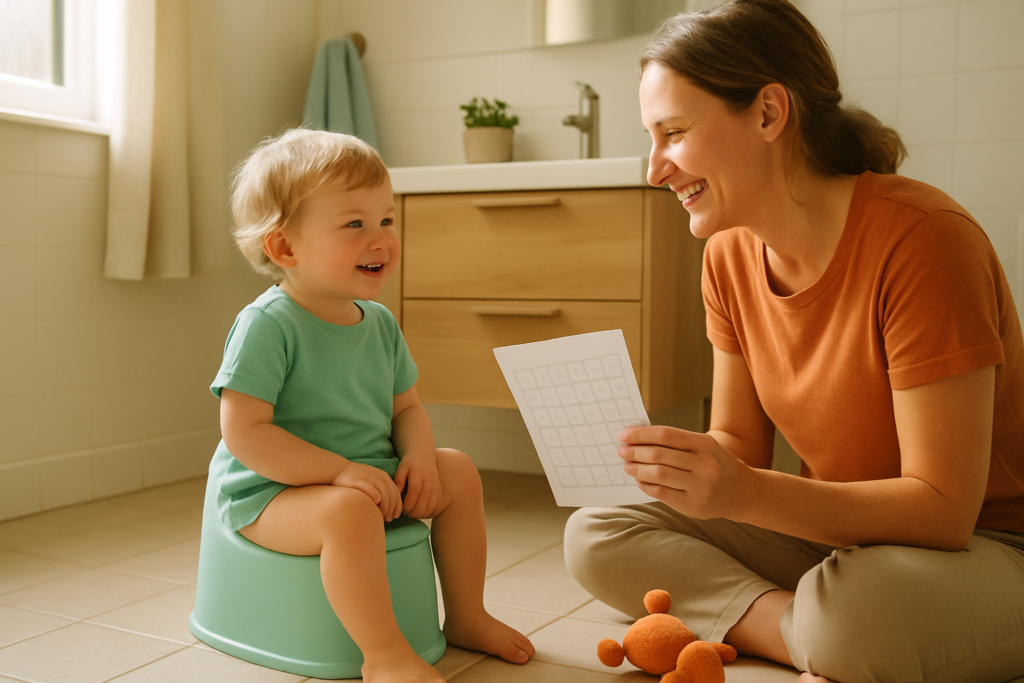
Sticker cards that work well come in four sizes used in order: three squares, then five, then seven, then nine. They are never a single fixed chart, because the growing size is the entire mechanism.
The reward arrives fast at three squares, so a child sees quickly that the system works and that trying pays off. As the squares increase, the reward gets rarer, so the habit that forms outlasts the stickers instead of stopping the moment the prizes do.
A single chart with a fixed number of squares, say twenty from the start, tends to stall partway through, because the distance to the next reward stays the same the whole time regardless of how well the child is doing. Increasing difficulty keeps the child working toward something achievable at every stage.
When you should not buy any program yet
A child who is frightened of the potty or the toilet is not ready for a structured week yet. The honest move is to build familiarity first, with no pressure to perform, and start the actual training later.
Common signs of readiness include staying dry for longer stretches, showing interest in the bathroom, being able to follow simple two-step instructions, and expressing discomfort with a dirty diaper. None of these guarantee a smooth week, but their absence is a reasonable reason to wait. For a fuller look at how pediatric guidance frames these signs, see what pediatricians recommend for potty training.
If an attempt does not work, the method’s own advice is to stop and leave it a while before trying again, rather than pushing through a bad week. That pause is part of the method, not a failure of it.
Big life changes are also a reason to wait: a new baby in the house, a house move, or starting daycare all add stress that makes a training week harder than it needs to be.
The same method is used successfully with children who are autistic, have Down syndrome, or are non-verbal, usually over a longer stretch and by reading the child’s own signals rather than waiting for them to say it out loud.
Constipation, stool withholding, urinary tract infections, or bedwetting that continues past age six are medical questions. They belong with a doctor or child health clinic, not with any book, course, or article, including this one.
So which one should you buy? A short decision guide
If you want the theory and are confident building your own day-by-day structure, a book is a reasonable choice, and a well-followed book will outperform a course you only half watch.
If you want to be told what to do each morning, and you want someone to ask when day five gets hard, the video course is built for that: daily videos, a coach available at any hour, and materials included that you print yourself.
If you already tried once and it fell apart partway through, pick whichever format includes support, since the gap that sank the first attempt is usually not the plan itself but having nobody to ask when it wobbled.
Be honest about the timeline either way: most children are dry in the daytime in about a week, some manage it in as little as three days, and others take two or three weeks. A child who is not ready yet is better off waiting than being pushed through a week that will not stick. Night-time dryness is a separate milestone that comes later and is not something any book or course can promise on a fixed schedule.
Frequently asked questions
What should I buy for potty training?
Buy based on how you like to be supported, not on price. A book suits a confident reader who will build their own day-by-day structure. A video course suits a parent who wants to be told what to do each morning and wants someone to ask when a session goes badly, with reward materials included that you print yourself.
Is Oh Crap Potty Training worth it?
Yes, for a parent who wants a well-regarded, honestly written book and is comfortable interpreting the plan themselves. It does not include daily prompts or support for the hard days, which is the main gap parents report, usually around day four or five when a child starts resisting.
What do pediatricians recommend for potty training?
Pediatric guidance generally centers on waiting for signs of readiness rather than a fixed age, and on a positive, low-pressure approach rather than punishment for accidents. For a fuller breakdown, see <a href='https://pottytrainingbox.com/what-pediatricians-recommend-potty-training-2/'>what pediatricians recommend for potty training</a>.
What is the 10-10-10 rule for potty training?
The 10-10-10 rule is a widely circulated parenting shorthand rather than a clinical guideline, and it does not have one consistent definition across the sources that use it. Structured methods built around a child's own initiative work differently: you track when your child actually needs to go, ask them directly whether they will tell you when they need to pee, and keep fixed moments only before and after sleep and before leaving the house.
Is a potty training course better than a book?
Neither format is inherently better. A course gives you daily structure and a way to ask questions as they come up, which helps on the day resistance shows up. A book gives you the full theory in one sitting for a reader who prefers to plan things out themselves.
How often should I put my child on the potty?
Rather than a fixed interval, track when your child actually drinks, uses the toilet, and has accidents for a few days using a simple sheet, then use that pattern to offer fewer, better-timed opportunities. Beyond that, the goal is to ask your child directly whether they will tell you when they need to go, keeping only sleep times and leaving the house as fixed moments.
Ready for the next step?
The 7-Day Potty Training Video Course walks you through this program in forty short videos, grouped per day, with a digital AI coach you can ask a question at eleven at night on day four. The full handbook comes with it as a PDF to read and print. Nothing is shipped, so you can start today.
Sources
This article was written with AI assistance and checked by Dustin van de Sande.