
Most children reach daytime dryness in about a week of focused training, though some take three days and others two to three weeks. Work backward from the start date: four weeks out is comfortable, one week out is tight but possible. A child who isn’t ready should wait regardless of the calendar. Night dryness comes later and is rarely a preschool requirement.
How much time do you need before preschool starts?
Four weeks out is the comfortable zone. That gives you three full days at home for the initial training, then two to three weeks of shorter and longer outings to practice using a real bathroom outside the house. One week out is tight but not impossible, especially if your child is already showing clear readiness signs like staying dry for a couple of hours or telling you after an accident.
The American Academy of Pediatrics notes that readiness typically shows up somewhere between 18 months and about 3 years, with a wide range that is completely normal. A start date on a preschool calendar does not change where your child actually is in that range. If your child is showing fear, resisting strongly, or simply isn’t interested yet, the honest move is to wait and try again in a few weeks, even if that means starting school in pull-ups for a little while.
Does my child actually have to be potty trained for preschool?
It depends entirely on the program, and there is no single national rule. Requirements vary by whether it’s a daycare, a church preschool, a Head Start program, or a public pre-K classroom, and state child care licensing rules differ on what staff are and aren’t permitted to require.
Publicly funded programs, and any classroom serving a child with an IEP or an individualized plan, often cannot make toilet training a condition of enrollment. Private preschools, on the other hand, frequently do require it, sometimes as early as the 3s classroom.
Rather than guessing from a parenting forum, call or email the director directly. Ask specifically: do they accept pull-ups or only underwear, who changes an accident, how many spare outfits should you send, and do teachers help a child in the bathroom or expect independence. The answers to those four questions matter more than anything you’ll read online, because they come from the actual program your child is attending.
Your countdown plan: what to do in the four weeks before the start date
A countdown works better than a vague sense of urgency. Here is roughly what each week looks like if you’re working backward from a preschool start date.
| Weeks before start date | What you do | What you should see |
|---|---|---|
| 4 weeks out | Gather supplies, talk about it casually | Child curious, not anxious |
| 3 weeks out | Three days at home, diaper off | Child starting to tell you |
| 2 weeks out | Short then longer outings | Child signals before you ask |
| 1 week out | Practice the school routine | Bathroom stop feels normal |
| First week of school | Send spares, expect a few accidents | Improvement, not perfection |
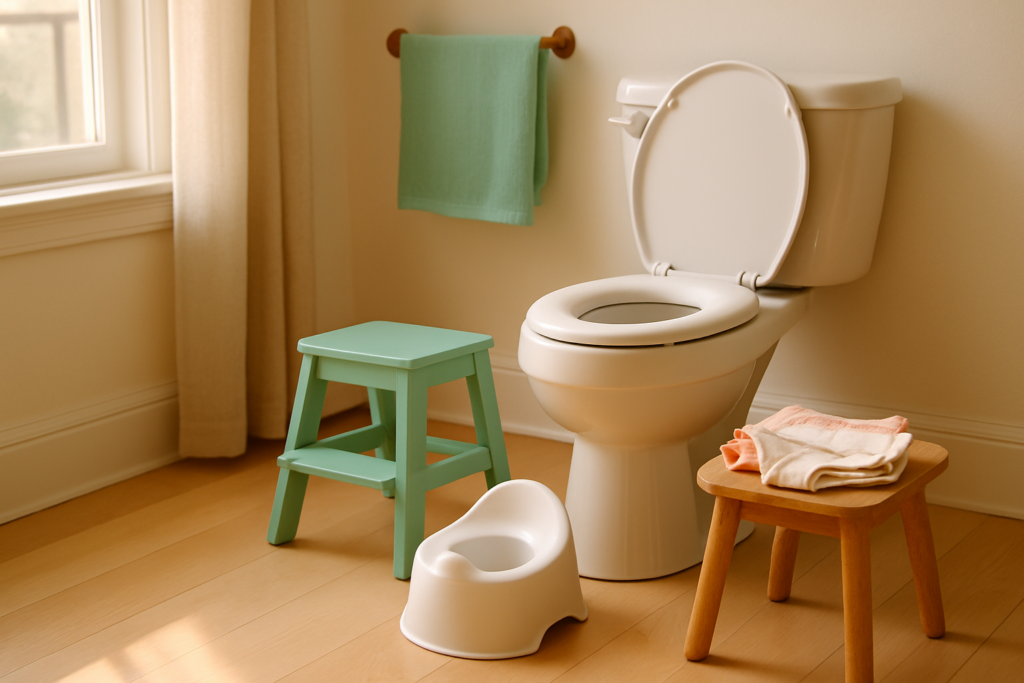
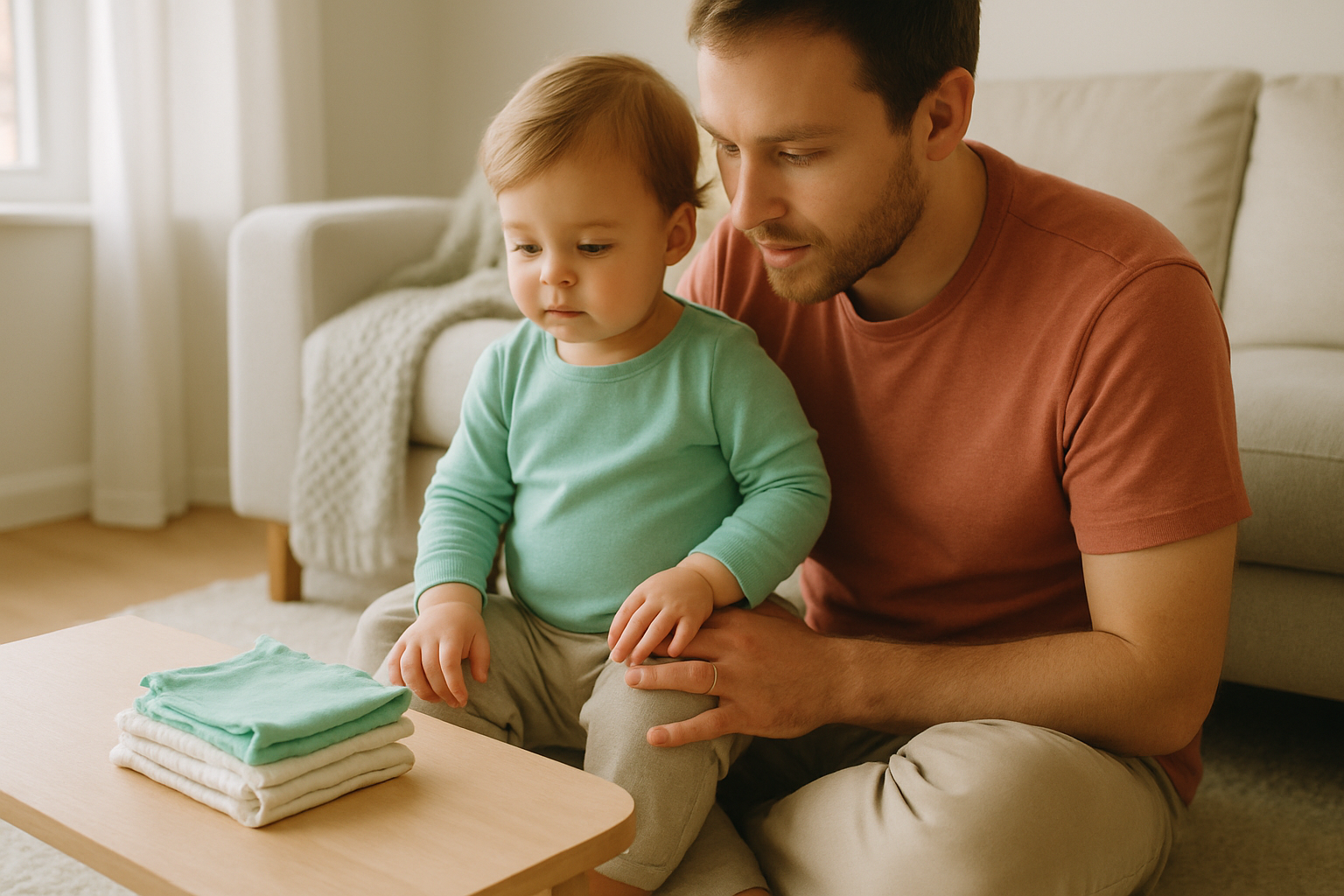
In week four, put together what you actually need to potty train, including a potty for the first days, a toilet seat reducer, a step stool, a stack of cotton underwear, something to protect the mattress and sofa, a few small rewards, and pull-ups for sleeping. Talk about the plan with your child in ordinary language, the way you’d mention any upcoming change.
Week three is the three days at home, diaper off, cotton underwear on, and the potty always within reach. The method works with regular cotton underwear rather than training pants, because a child feels wet in cotton right away and connects that feeling to what just happened. Training pants feel too much like a diaper to teach that lesson. For what each day of the week actually looks like, including the days that go sideways, it helps to have a plan rather than improvise on the fly.
Week two shifts to short outings, then longer ones, and the balance moves from you creating opportunities to your child speaking up on their own. Week one is about matching the school routine, and that routine has a specific script behind it: a bathroom stop before leaving the house and after nap, practiced daily until it feels ordinary.
What “potty trained enough for preschool” really means
The goal is not a child who never has an accident. It is a child who has started to say they need to go, rather than a parent asking on a timer. That shift, from parent-prompted to child-initiated, is the actual finish line, not a perfect streak of dry days.
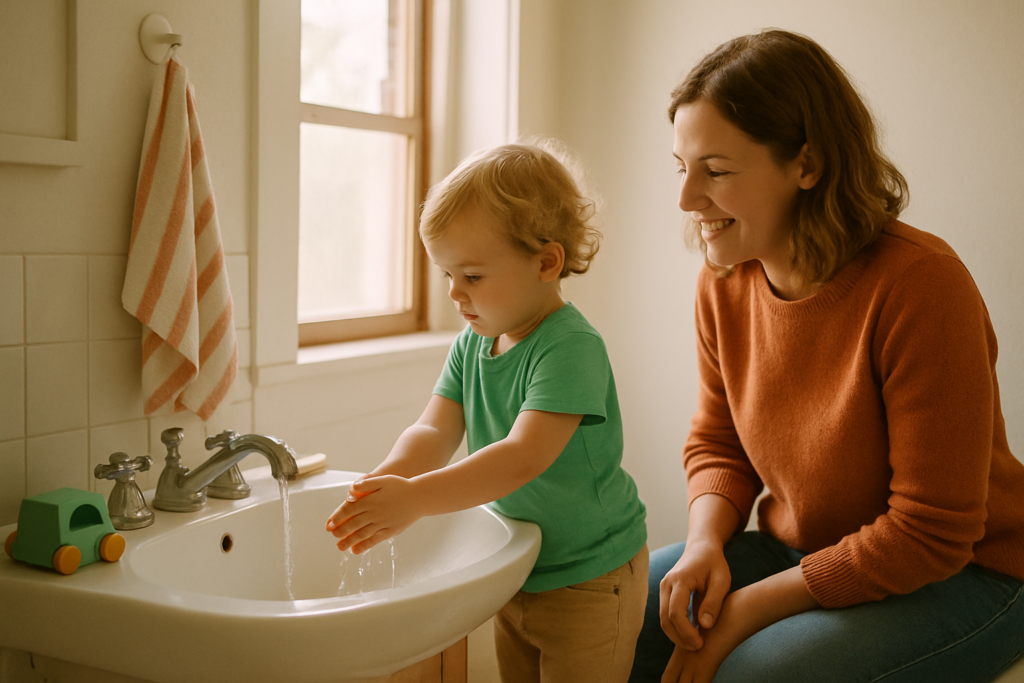
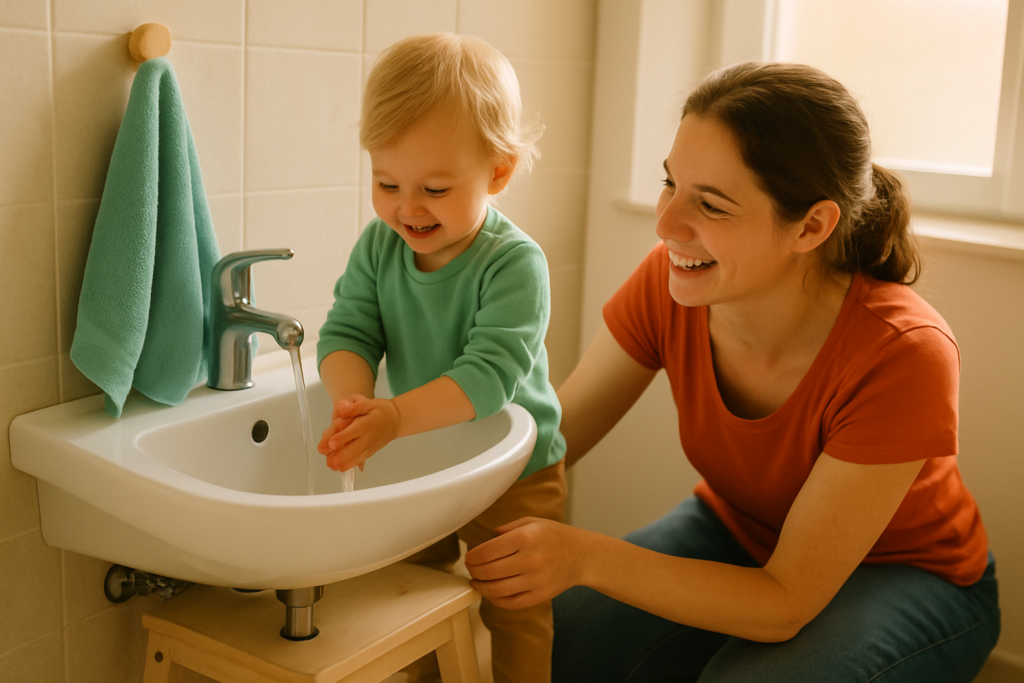
A few concrete skills matter more in a classroom than perfect dryness: telling any adult, not just a parent, that they need to go; pulling pants down and back up without help; sitting on a regular toilet with a step stool instead of a small potty; and washing hands afterward without being walked through every step. Practicing on an actual toilet at home in the weeks before school starts, rather than only the potty, makes the classroom bathroom feel familiar instead of enormous.
Accidents in the first weeks of school are normal, even for a child who has been dry at home for a month. New room, new bathroom, new schedule, and a child who is busy and distracted is more likely to notice the need late. That is not a sign the training failed. It’s a sign the child is adjusting to a new environment on top of a new skill.
How do I know when my child needs to go? Reading the pattern instead of watching the clock
You find this out by tracking, not by guessing on a fixed schedule. A tracking schedule records, in columns, the time your child drank something, the time they sat on the toilet, whether nothing happened (yes or no), whether they peed (marked green for success, red for an accident), whether they had a bowel movement (green or red the same way), and a notes column for anything else worth remembering. Over a few days that record shows you this particular child’s pattern, which is the entire point.
When you fill it in, have your child drink a cup in one go rather than sipping it across an hour. Sipped slowly, you can’t tell how much went in or how long it takes to come back out; drunk in one go, the amount and the timing line up, and that link between how much a child drinks and how soon they need to go is exactly what the schedule is meant to reveal.
Instead of putting your child on the potty every thirty minutes because a schedule says so, ask them directly: “you tell me when you need to pee.” That question, asked consistently, is what teaches a child to notice their own body instead of waiting for a parent to notice for them. The only moments worth building into a fixed routine are before and after sleep and before you leave the house, and that holds true during training and long after it, not as a rule to police the rest of the day by.
A schedule built around the clock instead of the child ends up training the parent to watch a timer, not the child to read their own signals. It can look organized on paper, but it works against the one thing that actually makes potty training stick.
Day 4 or 5 is usually the hard one, not day 2
Resistance most often shows up on day four or five of training, not day two. By then the child has usually heard “you tell me when you need to pee” dozens of times, and the repetition itself becomes the irritant, not the toilet.
The fix is to ask less, not more. Back off the frequency of the question and hand more of the responsibility to your child directly: let a longer stretch pass without prompting and see whether they come to you first. That pullback is often what breaks the standoff, because it removes the thing they were pushing against.
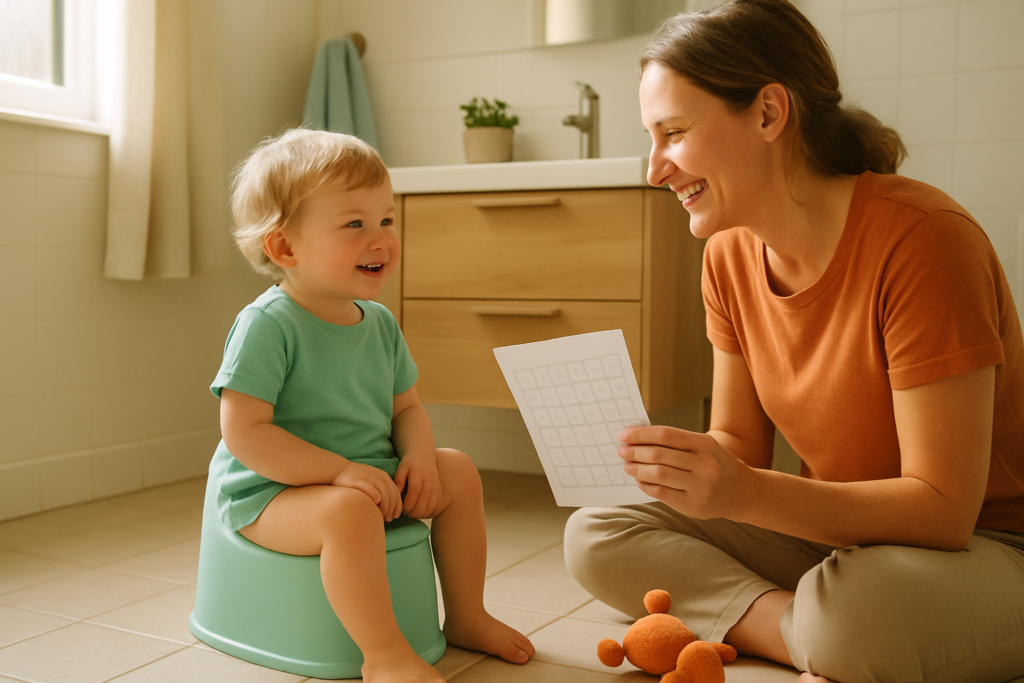
Rewards should follow the same pattern of pulling back rather than continuing at full strength or stopping outright. Sticker cards that grow from three squares, to five, to seven, to nine work well for this: the reward comes quickly and often at the start, when three squares fill up fast, and gets rarer as the child improves, so the habit outlasts the stickers instead of ending abruptly when they do. Whatever reward system you use, the shape matters more than the specific items: quick and frequent at first, then gradually less frequent.
Treat any accidents during this stretch, or any other, as part of learning rather than a setback to fix by pushing harder. A day-four meltdown over being asked one too many times is not a sign the method isn’t working. It is usually a sign it’s time to ask less.
What if my child isn’t ready in time?
A child who is frightened of the potty or the toilet is not ready, and a preschool start date doesn’t change that. The honest move is to build familiarity first, through books, watching a parent or sibling, or simply sitting on the potty fully clothed with no expectation attached, and start the actual training later.
If an attempt genuinely isn’t working, the method’s own guidance is to stop and leave it alone for a few weeks before trying again, rather than pushing through a bad stretch. That pause is not giving up. It’s part of how the method is meant to be used.
Talk to the program before assuming the deadline is fixed. Many preschools are more flexible in practice than their handbook suggests, particularly about the first few weeks of a new school year when several families are in the same position. A short, honest conversation with the director often gets further than trying to force a training timeline to match an enrollment date.
For children who are autistic, have Down syndrome, or are non-verbal, potty training commonly takes longer and relies more on reading a child’s individual signals than on them announcing the need in words. That is a longer process by design, not a sign of a stalled one.
Avoid starting the week a new sibling arrives, right after a move, or the same week as the first day of school itself. Any one of those is enough disruption on its own; stacking training on top of it usually means neither goes well.
How to work with the teacher so home and school say the same thing
Consistency between home and the classroom makes the transition faster, and it starts with sharing specifics rather than a general update. Tell the teacher the exact words your child uses for needing to go, and describe what their signals look like: a certain wiggle, going quiet, holding their pants.
Ask the teacher to use the same phrasing you’ve been using at home, something close to “you tell me when you need to go,” rather than a different script that asks the child to relearn the cue in a new setting.
Pack a labeled bag of spare clothes, including a full extra outfit and a plastic bag for anything wet that needs to come home. Agree with the teacher on what happens to that bag: does it come straight home, or stay in a cubby.
Expect a few accidents in the first week at school even for a child who has been reliably dry at home for a month. New adults, a shared bathroom, and a full schedule all make it a little harder to catch the signal in time, and that adjustment is normal rather than a step backward.
Doing this in a week: the program in the 7-Day Potty Training Video Course
The 7-Day Potty Training Video Course is the same seven-day method laid out as roughly 40 short videos, about three minutes each, grouped by day so you know exactly what to watch and do that day. It includes a digital AI coach that answers questions any time, which matters most on the days that don’t go as planned.
The sticker cards, the tracking schedule, and the certificate are part of the course, and you print them at home yourself as you go. What the course adds over a free article is the thing a deadline-panicked parent actually needs: a specific plan for day one, day two, day three, including what to do when a day goes badly, plus somewhere to ask when it does.
As always, there are no guarantees either way: most children reach daytime dryness in about a week, some take less time, and some take more.
Frequently asked questions
Can my 3 year old go to preschool if they are not potty trained?
Often yes, since it depends on the specific program rather than a universal rule. Publicly funded programs and classrooms serving children with an IEP frequently cannot require it, while some private preschools do. Call the director and ask directly whether pull-ups are accepted and how accidents are handled.
How long does potty training actually take?
Most children reach daytime dryness in about a week of focused, consistent training. Some manage it in as little as three days, while others take two to three weeks, and both are normal. Night dryness is separate and usually comes later, sometimes months after daytime training is solid.
Should an almost 4 year old be potty trained?
Most children are dry in the daytime well before age 4, but a wide range is normal and a late starter is not a cause for alarm on its own. If a 4 year old is showing little interest, resisting strongly, or seems frightened of the toilet, it's worth mentioning at the next pediatrician visit rather than guessing. Persistent constipation, withholding, or signs of a urinary issue should always go to a doctor rather than being managed at home.
What is the 10, 10, 10 rule for potty training?
You may see the '10, 10, 10 rule' mentioned online as shorthand for a fixed schedule of sitting a child on the potty at set intervals for a set number of minutes. There's no single agreed version of it, and sitting a child down by the clock trains the parent to watch a timer rather than training the child to notice their own body. A tracking schedule that records when your particular child actually goes, paired with asking them to tell you, gets more reliable results than any fixed interval.
Should my child wear pull-ups or underwear to preschool?
Regular cotton underwear works better for learning because the child feels wet immediately and connects that feeling to the accident. Pull-ups feel similar to a diaper and can slow that learning down during the day. Pull-ups still make sense for naps and overnight, since night dryness is a separate skill that comes later.
What happens if my child has accidents at preschool?
Accidents in the first week or two of a new classroom are common, even for a child who has been reliably dry at home for a month. New environment, new bathroom, and a packed schedule all make it harder for a child to notice and act on the signal in time. Send labeled spare clothes and treat it as part of the adjustment, not a sign that training failed.
Ready for the next step?
The 7-Day Potty Training Video Course walks you through this program in forty short videos, grouped per day, with a digital AI coach you can ask a question at eleven at night on day four. The full handbook comes with it as a PDF to read and print. Nothing is shipped, so you can start today.
Sources
This article was written with AI assistance and checked by Dustin van de Sande.