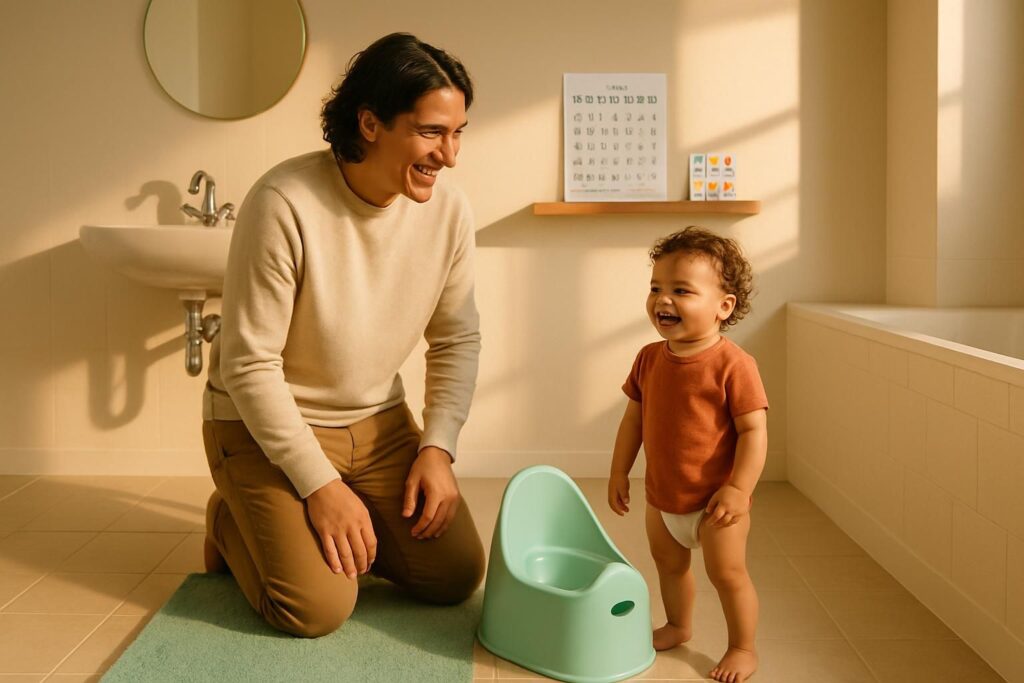


A red flag for potty training is any sign your child isn’t ready yet, or a sign something physical or emotional needs attention first. Readiness flags (no awareness of being wet, can’t follow simple instructions) mean wait. Medical flags (pain, blood, stool withholding, no progress by around age four) mean call your doctor, not push through.
It helps to split the signs into two very different groups. One group just means your child’s body or brain isn’t quite there yet, and more time fixes it on its own. The other group is a question for a pediatrician, not a parenting choice. Waiting isn’t failing, even if you already tried once and it didn’t stick.
What counts as a red flag for potty training?
Most of what you’ll worry about during potty training is ordinary friction, not a red flag at all. A true red flag falls into one of two buckets: a readiness sign that says wait a while, or a physical sign that says talk to your doctor. Most of what feels alarming in the first week, tears, a flat refusal one afternoon, a sudden accident after three dry days, is just a normal bump, not either of these. Knowing which bucket you’re in changes what you do next, and that’s the whole point of sorting them out before you start, not after three frustrating days.
Which red flags mean your child just needs more time?
These signs point to a child who isn’t ready yet, not a child who is behind. According to the American Academy of Pediatrics, signs of bladder and bowel control typically emerge between 18 and 24 months, and training in the United States usually begins somewhere between age 2 and 3.
- Their diaper is soaked again within an hour, with no dry stretch of an hour or two anywhere in the day.
- They show no awareness of being wet or dirty: no pause, no face, no reaching for you, no hiding in a corner to go.
- They can’t follow a simple two-step instruction, or the words you use for potty, pee, and poop don’t seem to land yet.
- They can’t get their own pants up and down with help, or can’t sit steadily on a potty or seat.
- They’re in a hard-no phase right now, refusing nearly everything you ask of them, not just the potty.
- Something big just happened or is about to: a new baby, a move, starting daycare, a parent traveling for work.
If several of these sound familiar, the honest answer is to wait a few weeks and check again, not to push through on schedule.
A short readiness check can make this easier than guessing on your own.
Check your child’s readiness in two minutes
If none of these apply to your child, you may be exactly at the right moment, and it’s worth reading about when to start potty training to confirm the timing.
Your toddler is scared of the potty: is that a red flag?
Fear of the potty or the toilet is a real red flag, and it means wait, not push harder. A child who is genuinely afraid isn’t being difficult. They’re telling you something, and the fix is familiarity, not persuasion.
This fear usually shows up in one of a few predictable forms: fear of the flush being loud and sudden, fear of the toilet’s opening feeling too big to sit over safely, or a strange discomfort with the idea of poop, which feels like a part of them, disappearing into the bowl.
Build familiarity without any pressure to perform. Keep the potty out in the open where your child can see and touch it. Let them sit on it fully clothed while you read a book together. Dump a dirty diaper into the toilet together so they see where it goes, without asking them to sit there themselves. Give this two to four weeks before you reconsider starting.
As an Amazon Associate we earn from qualifying purchases. Some links in this article are affiliate links: if you buy through them we earn a small commission, at no extra cost to you, and it does not affect what we recommend.
A simple picture book can take some of the edge off without any pressure attached. Potty by Leslie Patricelli is a gentle, low-stakes way to introduce the idea.
If your child is specifically wary of the potty itself, this short video is made to watch together before you try again.
When is a red flag actually a question for your doctor?
Some signs during potty training are not a parenting problem at all, and belong with a pediatrician rather than a method. Pain or crying when peeing or pooping, straining that looks distressing, or blood in the urine or stool all deserve a call, not a wait-and-see approach.
Hard, pellet-like stool, or a pattern of withholding poop for days at a time, often points to constipation, which commonly gets in the way of potty training and is worth raising at a well-child visit. Soiling after a child has been reliably dry for a while is also worth mentioning to a doctor rather than retraining from scratch on your own.
A weak urine stream, frequent dribbling, or sudden new daytime wetting after months of being dry are the kind of changes the National Institute of Diabetes and Digestive and Kidney Diseases flags as reasons to check in with a doctor about bladder control.
No daytime progress at all by around age four is worth raising with your doctor, not treating as a verdict on your parenting. The same goes for bedwetting that continues well past age six, which the American Academy of Pediatrics covers as its own, separate topic from daytime training. We don’t diagnose any of this here. A doctor or your child’s well-child visit is the right next step.
Red flags vs. normal bumps: how to tell the difference
Most of what feels alarming in week one is actually just part of learning, not a reason to stop. Accidents in the first few days are expected, not a red flag. Resistance around day 4 or 5 is also normal: many children get tired of being asked constantly and push back, which is boredom and a bid for control, not a sign the method has failed. The fix is usually to ask less often and hand a bit more responsibility back to your child, not to abandon the attempt.
| What you’re seeing | Normal bump or red flag | What to do |
|---|---|---|
| Accidents in week one | Normal bump | Keep going, change calmly |
| Resistance on day 4 or 5 | Normal bump | Ask less often, let them lead |
| Crying every time you ask them to sit | Red flag | Pause, rebuild familiarity |
| Fear of the flush | Red flag | Wait, build comfort slowly |
| Holding poop for days | Red flag, medical | Call your doctor |
| Pain or blood | Red flag, medical | Call your doctor now |
| No awareness of being wet | Red flag, readiness | Wait a few weeks |
| Sudden wetting after months dry | Red flag, medical | Call your doctor |
What to do if you already started and the red flags showed up
Stopping partway through is part of a sound approach, not a sign you failed. If a genuine red flag shows up mid-attempt, the honest move is to pause for a few weeks rather than grind through it.
Stop cleanly: go back to diapers without turning it into a conversation, an apology, or a lecture for your child. There’s no need to explain what went wrong. Just keep the potty where it normally lives in the bathroom, so it stays a familiar, ordinary object rather than something associated with a failed attempt.
You’ll know the pause has worked when your child starts showing the readiness signs again on their own: longer dry stretches, awareness of being wet, curiosity about the bathroom instead of avoidance. At that point you can try again, and a restart is about your child’s readiness, not about buying something new.
How a structured program tells you when to start, pause, and keep going
The Potty Training Box Method is a seven day, day by day program: the first three days are spent at home, short outings follow, and the approach moves gradually from potty to toilet while the child learns to signal the need themselves. Instead of putting a child on the potty by the clock, the central habit is asking, will you tell me when you need to pee, so the child keeps the initiative rather than the parent running the schedule.
Tracking schedules exist to record when this particular child actually goes, not to impose a timetable. For the schedule to be useful, it works best when your child drinks a full cup in one go rather than sipping it over time, so you can actually see how long it takes between drinking and needing to go. Sticker cards come in four sizes, 3, 5, 7, and 9 squares, used in that order, so the reward lands fast at first and then gets rarer as the habit takes hold on its own.
If you want the day by day plan laid out for you, the 7-Day Potty Training Video Course carries the same seven day program across forty short videos grouped by day, plus a digital AI coach for questions at any hour. The tracking schedules, sticker cards, and the pee and poop certificates are included as printable materials that come with the course. Most children are dry in the daytime in about a week once they’re truly ready, some in as few as three days, others take two or three weeks, and nighttime dryness is a separate milestone that tends to come later.
Red flags that have nothing to do with your child
Sometimes the timing problem isn’t your child at all. Starting without at least three clear days at home in the next couple of weeks sets everyone up for frustration. A trip, a holiday visit, or a hospital stay sitting right in the middle of your planned window is a good reason to pick a different week.
Check with daycare or preschool before you start, since a mismatch between what happens at home and what happens there can confuse a toddler who is just learning the routine. If two caregivers in the house don’t agree yet on the plan, settle that first. And if you’re genuinely running on empty, it’s fair to choose a calmer month. A tired, stretched-thin parent is a legitimate reason to wait, not a reason to feel behind.
Children who are autistic, non-verbal, or have Down syndrome
A later start and a longer timeline are normal for many of these children, not a red flag by itself. The American Academy of Pediatrics notes that toilet training a child with a developmental delay or disability often takes a different pace and approach than a typical timeline.
Where a child isn’t using words yet, the practical shift is reading physical signals rather than waiting to be told verbally: a pause in play, a particular face, a hand near the diaper. The same basic structure, consistent routine, clear rewards, short low-pressure sessions, still works, just stretched over a longer period and adjusted to the child’s own pace. Where a therapist or doctor is already involved, loop them in on the plan so everyone is working from the same signals.
Frequently asked questions
When should you worry about potty training?
Worry less about slow progress and more about specific signs: pain or blood when going, stool withholding for days, no daytime awareness at all by around age four, or bedwetting that continues well past age six. Ordinary accidents, resistance, and a slower pace than another family's child are not reasons to worry on their own.
What is the hardest age to potty train?
There isn't one fixed hardest age, since readiness varies by child rather than birthday. Many parents find the hardest day isn't tied to age at all but to day 4 or 5 of an attempt, when a child grows tired of being asked and pushes back out of boredom rather than inability.
At what age is a child usually fully potty trained?
According to the American Academy of Pediatrics, most children begin toilet training between ages 2 and 3. Exact timing varies widely and a slower pace than that is not unusual or a cause for alarm on its own.
Is being scared of the potty a red flag?
Yes, genuine fear of the potty or toilet is a sign to wait rather than push through. Building familiarity with no pressure for two to four weeks, letting your child sit fully clothed or watch a diaper get dumped into the toilet, usually resolves it before you try again.
Should I keep going if my toddler holds their poop?
No, stool withholding over several days is a medical question, not something to train through. It often points toward constipation, which is worth raising with your doctor or at a well-child visit before you continue with potty training.
Is it bad to stop potty training and start again later?
No, pausing for a few weeks when things aren't working is a normal, recommended part of the process rather than quitting. Go back to diapers without ceremony, keep the potty visible and ordinary in the bathroom, and watch for readiness signs returning before trying again.
Ready for the next step?
The 7-Day Potty Training Video Course walks you through this program in forty short videos, grouped per day, with a digital AI coach you can ask a question at eleven at night on day four. The full handbook comes with it as a PDF to read and print. Nothing is shipped, so you can start today.
Sources
- American Academy of Pediatrics (healthychildren.org) (Signs of bladder and bowel control typically emerge between 18 and 24 months, and train…)
- American Academy of Pediatrics (healthychildren.org) (Bedwetting past age six is its own topic, separate from daytime training.)
- American Academy of Pediatrics (healthychildren.org) (Toilet training a child with a developmental delay or disability often takes a differen…)
- National Institute of Diabetes and Digestive and Kidney Diseases (NIH) (A weak urine stream, frequent dribbling, or sudden new daytime wetting are reasons to c…)
This article was written with AI assistance and checked by Dustin van de Sande.