

If you’re on day 4 or 5 and hitting sudden refusal, that’s usually the normal hard part, solved by asking less often, not stopping. If your child seems scared, hasn’t had one success in days, or has had accidents nonstop for weeks, stop and try again in a few weeks. Pausing is part of the method, not a failure.
Potty training isn’t working: pause or push through?
Most children are dry in the daytime in about a week using this kind of structured approach. Some manage it in three days, others need two or three weeks, and a child who genuinely isn’t ready should wait rather than be pushed through it.
Why day 4 or 5 is the hardest day (and what it actually means)
The first three days at home usually go better than parents expect, because a toddler is still curious about the new routine. Resistance tends to show up on day 4 or 5, not day 2, once the novelty wears off and the child gets bored of being asked the same question over and over.
The question that wears thin is some version of ‘will you tell me when you need to pee?’ Asked every twenty minutes, it stops feeling like an invitation and starts feeling like nagging. A toddler who is otherwise doing well can dig in simply to get you to stop asking.
The fix is to ask less, not more. Hand the child more responsibility for noticing their own body instead of prompting constantly. Keep only a few fixed check-in moments: before and after naps or bedtime, and before you leave the house. Those two or three moments stay in place both during training and afterward, but everything else should fade into the background.
An accident during this stretch is information, not failure. It tells you the child isn’t reading their own signal yet at that particular time of day, which is exactly what you want to know before you push further.
Is this resistance, or is my child just not ready?
Resistance and not-ready look similar from the outside but call for opposite responses, so it’s worth telling them apart before you decide anything.
Signs pointing to resistance: your child has had some real successes already, can hold their pee for a while, and clearly understands the question but is choosing to ignore it or test you. This is a child who is capable and mildly rebelling, not a child who is lost.
Signs pointing to not-ready: zero successes after several full days of trying, visible fear of the potty or toilet, an inability to stay dry for even short stretches, or genuine distress rather than defiance. A child who is frightened of the equipment itself is not ready yet. The honest move is to build familiarity first, with no pressure to perform, and start the actual training later.
Being three years old and still in diapers is common and not a red flag by itself. The American Academy of Pediatrics notes that toilet training readiness varies widely and that most children achieve daytime control between ages 2 and 4. There is a real line to a doctor’s office, though: constipation, stool withholding, pain when urinating, or broader developmental concerns are medical questions, not training questions, and belong with a pediatrician rather than a potty training plan.
How to stop without it feeling like a failure
Stopping is a legitimate decision, not a concession, and it works best when it’s calm and low-key rather than a big event. Tell your child plainly and without drama: diapers for a while longer, and you’ll try again when they’re ready. No lecture, no disappointment in your voice.
As an Amazon Associate we earn from qualifying purchases. Some links in this article are affiliate links: if you buy through them we earn a small commission, at no extra cost to you, and it does not affect what we recommend.
Leave the potty where it is. Don’t remove it as a consequence and don’t turn it into a punishment or a reward you’re withholding. Keep the bathroom routine light during the pause: let your child sit on the potty before bath time with no expectation attached, watch you use the toilet if they’re curious, or read a potty-themed picture book together. Once Upon a Potty is a gentle, low-pressure choice for this stage.
Give it real time, a few weeks rather than a few days. A quick second attempt right after a rough first one usually just repeats the same standoff. If your child is in daycare, tell the staff you’re pausing so nobody keeps prompting at drop-off while you’ve backed off at home; consistency between home and daycare matters more than either one alone.
What to change before you restart (not just a rerun of the same week)
Restarting with the exact same week rarely fixes what went wrong the first time. A few concrete changes make a real difference.
- Go diaper-free with regular cotton underwear rather than training pants. A child feels wetness clearly in cotton underwear, which is the whole point; training pants absorb enough that the sensation gets muted and the lesson doesn’t land.
- Clear three full days at home before you begin. That stretch is where most of the learning happens, and outings before day four tend to undo progress rather than build on it.
- Have your child drink a cup in one go rather than sipping on and off all morning. That’s the only way to see clearly how long it takes between a full drink and a need to pee.
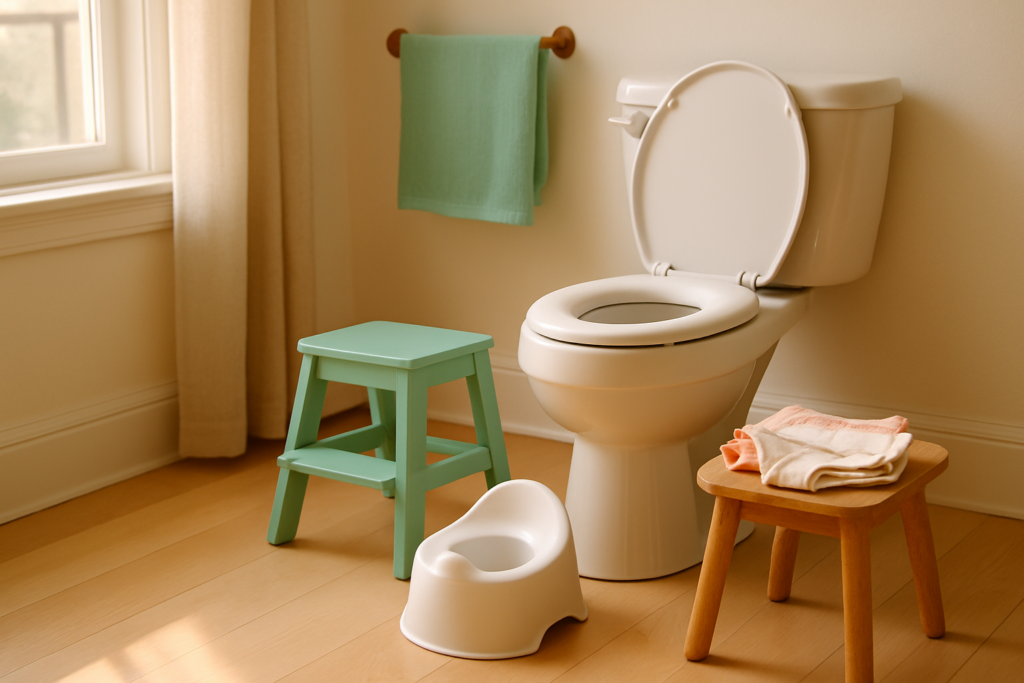
- Have the basics ready ahead of time: a potty for the first few days, a toilet seat reducer, a step stool, at least fifteen pairs of underwear, something to protect the mattress and sofa, a few small rewards, and pull-ups for sleep.
- Use a reward that arrives quickly at first and then gets rarer over time, so the new habit outlasts the stickers instead of stopping the moment they do.
How often should I put my child on the potty during a restart?
The honest answer reframes the question: the goal isn’t a schedule, it’s your child telling you they need to go. Instead of sitting them down every thirty minutes, you ask ‘will you tell me when you need to pee?’ and let them come to you.
There are only a few fixed moments worth keeping non-negotiable: before and after sleep, and before you leave the house. Those apply both during the training week and long after it’s finished.
Early offering of the potty in the first day or two is scaffolding, not the method itself. It exists to create opportunities and gather information about your particular child’s timing, and it comes down within days as your child starts signaling on their own.
Using a tracking schedule to see what is really going wrong
A tracking schedule turns a vague sense that ‘this isn’t working’ into an actual pattern you can read. The standard layout has six columns: time of drinking, time on the toilet or potty, whether nothing happened (yes or no), pee marked green for success or red for an accident, poop marked the same way, and a notes column for anything unusual.
| What you’re seeing | What it usually means | What to do next |
|---|---|---|
| Sudden refusal on day 4 or 5 | Normal resistance to being asked constantly | Ask less often, keep only the fixed check-ins |
| No successes at all after several days | Child likely isn’t ready yet | Stop, wait a few weeks, try again later |
| Fear of the potty or toilet | Not a training problem, a familiarity problem | Build comfort with no pressure before restarting |
| Accidents cluster at one time of day | A gap in that specific window, not overall failure | Ask once more at that time, then let go |
| It was working, then suddenly stopped | Likely regression from a life change, not a training failure | Respond calmly and consistently rather than restarting formal training |
Green marks a success and red marks an accident, so a quick glance at two or three days of records usually shows whether accidents are scattered randomly, which often means genuinely not ready, or clustered around one predictable time, which is an easy fix.
Potty training regression: when it was working and then stopped
Regression means a child who was previously dry starts having frequent accidents again, and it’s common enough that it doesn’t automatically point to a training mistake. Typical triggers include a new sibling, a move, starting daycare or preschool, an illness, or a scary or painful bowel movement that makes the child anxious about the bathroom.
Most regressions are short and respond to calm, low-drama handling rather than a full training week. Extra patience, a return to those same fixed check-in moments, and avoiding blame usually settle things within a couple of weeks. Restarting a whole structured program over a regression tends to add pressure the child doesn’t need.
Some regressions do need a doctor. Constipation and stool withholding are well known to interfere with toilet training and are worth ruling out with a pediatrician, according to the Mayo Clinic. Painful urination, or bedwetting that continues past age 6, are also medical questions rather than training ones; the American Academy of Pediatrics notes that bedwetting beyond that age is a reasonable point to bring it up with a doctor.
What a structured seven-day plan gives you on the bad days
A day-by-day plan is most useful exactly on the days like day 4 or 5, when it’s hard to tell whether to push through or pull back. The 7-Day Potty Training Video Course covers this directly: it’s built as about forty short videos of roughly three minutes each, grouped by day, and it includes guidance for the days that go badly, not only the ones that go smoothly.
It also includes a digital AI coach that answers questions any time of day, which matters most at 9pm on a bad day when the wait for tomorrow’s advice feels too long. The tracking schedule, the sticker cards in their four sizes of three, five, seven and nine squares, and the certificate at the end are all part of the course and printed at home by the buyer.
None of this is required to potty train. The method can be followed without the course as well.
Frequently asked questions
Should I quit potty training and start again later?
Yes, if your child shows fear of the potty or toilet, has had zero successes after several days, or is in constant distress, stopping and waiting a few weeks is the right call, not a failure. Pausing is built into the method itself when things clearly aren't working. If instead your child is having occasional successes but is refusing on day 4 or 5, that's usually resistance, and asking less often solves it without needing to quit.
How long should I wait before restarting potty training?
Wait a few weeks rather than a few days, so the pause actually changes something before you try again. Restarting too quickly with the same approach tends to produce the same standoff. Use the waiting period to build calm, low-pressure familiarity with the bathroom instead of counting down days.
What is a red flag for potty training?
Genuine red flags include a child who seems frightened of the potty or toilet, painful urination, signs of constipation or stool withholding, or bedwetting that continues past age 6. These are medical or developmental questions that belong with a pediatrician rather than something to solve by pushing harder on training.
Is it normal for a 3 year old not to be potty trained?
Yes, it's common. The American Academy of Pediatrics notes that readiness and the age of daytime dryness vary widely among children, generally landing somewhere between ages 2 and 4. Being 3 and still in diapers is not, on its own, a sign of anything wrong.
Why does my toddler suddenly refuse to use the potty after a few good days?
This is usually resistance that shows up around day 4 or 5, not a sign the child isn't capable. It's often triggered by being asked repeatedly whether they need to go, which starts to feel like nagging rather than an invitation. Asking less often and letting the child take more initiative usually resolves it within a day or two.
Is potty training regression normal, and what causes it?
Yes, regression is common and usually short-lived. Common triggers include a new sibling, a move, starting daycare, illness, or a painful bowel movement that makes a child anxious about the bathroom. Most cases settle with calm, low-drama responses rather than a fresh round of formal training, though ongoing constipation or pain should be checked by a doctor.
Ready for the next step?
The 7-Day Potty Training Video Course walks you through this program in forty short videos, grouped per day, with a digital AI coach you can ask a question at eleven at night on day four. The full handbook comes with it as a PDF to read and print. Nothing is shipped, so you can start today.
Sources
- HealthyChildren.org (American Academy of Pediatrics)
- Mayo Clinic
- HealthyChildren.org (American Academy of Pediatrics)
This article was written with AI assistance and checked by Dustin van de Sande.