
A child is considered potty trained when they recognize the need to go, tell you or head to the bathroom on their own, and stay dry through a normal day with only occasional accidents. This covers daytime only. Needing help with wiping, buttons or hand washing is normal, not a sign your child is not trained.
Why nobody agrees on what potty trained means
Scroll through any parenting group and you will see potty trained defined a dozen different ways in the same thread. One mom means zero accidents, ever. Another means her toddler can get to the bathroom alone but still calls out for help with buttons. A third counts her child as trained even though he still wears a pull-up for naps.
Daycares and preschools each write their own policy, and grandparents often work from whatever standard was common decades ago. None of these definitions is wrong, they are just measuring different things. Comparing your child against a stranger’s private definition online is not a useful exercise, and if your child is working through the milestones below, you are not behind.
The four milestones that make up potty trained (they do not arrive together)
Potty trained is not one switch that flips. It is four separate skills, and most children build them in this rough order, though the pace between them varies a lot:
- Recognizing the feeling. The child notices a full bladder or bowel before it is too late, rather than after.
- Telling you or going alone. This is the self-initiating step: the child acts on that feeling instead of waiting to be asked.
- Holding on. The child can wait long enough to reach a bathroom, including during a car ride or a trip to the store.
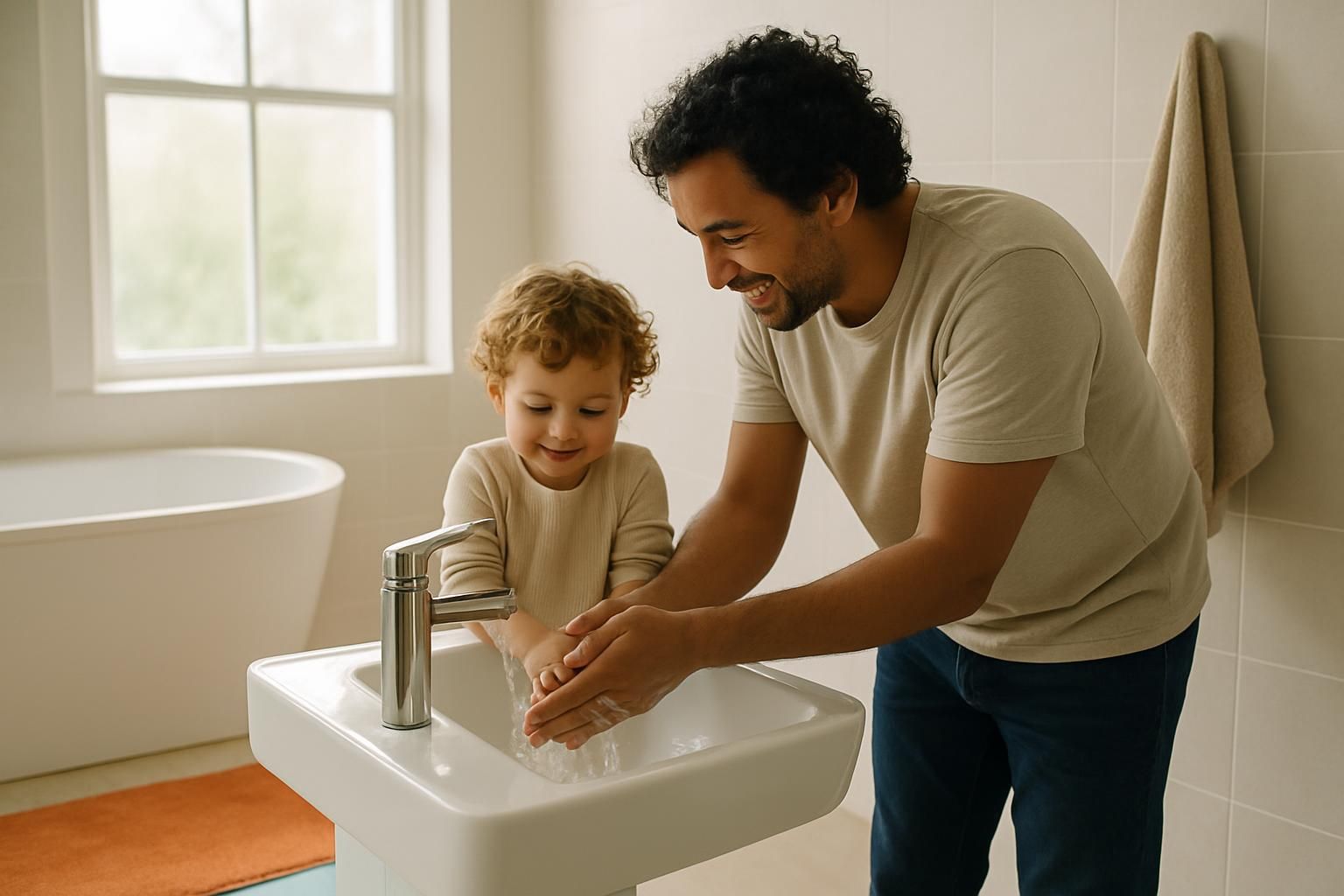
- Practical independence. Pulling pants down and up, wiping, flushing, washing hands. This piece keeps developing for months after the other three are solid.
Pee control almost always arrives before poop control, and that is ordinary rather than a sign of a problem. A child can be reliably dry and still need help with the last part of a bowel movement for a while.
| Milestone | What it looks like in practice | When it usually shows up |
|---|---|---|
| Recognizes the need | Pauses, goes still, or grabs at their diaper or pants | Often the first sign, sometimes months before training starts |
| Tells you or goes alone | Says “pee” or “potty” unprompted, or heads to the bathroom on their own | Early in training, strengthens over the first week |
| Holds on until the bathroom | Waits through a car ride or the walk from the playground | Builds over the weeks following training |
| Manages pants and wiping | Pulls pants down, wipes with some help, flushes, washes hands | Keeps improving for months, often into preschool |
| Dry overnight | Wakes up dry without a pull-up | A separate, later milestone, sometimes years later |
The real test: does your child tell you, or do you tell them?
Here is the question that actually settles it. If your child stays dry because you ask every thirty minutes whether they need to go, you have a system that works, but your child is not trained yet. You are doing the work. The milestone is reached when the initiative moves to them.
This is the core idea behind the child-led potty training approach: instead of offering the potty on a schedule, you ask your child, “will you tell me when you need to pee?” and let them answer it. The Potty Training Box Method is built around exactly this, a seven-day program that moves a child from potty to toilet with the specific goal of the child signaling the need themselves, rather than being run on a timer.
Two moments stay on a routine even after training is long finished: before and after sleep, and before you leave the house. Outside of those, the point is to stop prompting and start watching. Tracking what your child actually does, not what you want them to do, is how you learn their real timing. A schedule you impose on the child is a different approach, and it tends to teach the opposite lesson.
How to tell if your child is actually there: a week of honest checking
Pick one ordinary week, no extra effort, no pep talks, just the usual school run, the store, the playground, a visit to grandparents. Then count something simple: of the successful bathroom trips, how many did your child start, and how many did you start?
As things settle, most families see accidents drop to the occasional slip rather than disappear completely, and that is a normal landing point, not a sign of incomplete training. Watch for the signals that come right before a trip: a pause mid-play, a sudden fidget, going still, or wandering off to a corner. Those are the tells that the recognizing-the-feeling milestone is working.
If you are not sure whether your child is even ready to start this process, it helps to check the concrete signs rather than guess.
Take the two-minute readiness check
One detail worth tracking carefully: give your child their full cup to drink in one go rather than in sips spread over an hour. That is the only way to see how much went in and how long it then takes before they need the bathroom, and that link between amount and timing is exactly what a tracking schedule is meant to show you.
What does “potty trained for preschool” actually mean?
Most preschools define it narrowly: the child recognizes the need and goes without constant reminders, manages pants with minimal help, and can tell an adult they need to go. Full independent wiping is usually not required at this stage.
Pull-ups for naptime are commonly allowed, but policies vary a great deal between centers, so ask the specific school for their written requirement rather than going by a forum post about a different preschool. Accidents in the first weeks of a new classroom are expected, since a new room, new adults and new routine can unsettle even a child who was solid at home.
Give yourself more lead time than you think you need. If you are working backward from a start date, it helps to know how much time you actually need before preschool so the training itself is not rushed.
Daytime dry vs night dry: why they are not the same achievement
Daytime dryness is a learned behavior: recognizing the feeling, acting on it, holding on. Night dryness depends on something your child cannot practice their way into as directly, namely the body either waking to the sensation or producing less urine overnight. According to the American Academy of Pediatrics, bedwetting is common in young children and resolves for most children with time rather than training (healthychildren.org).
According to UC Davis Health, most children complete potty training by around 36 months of age, though the process commonly takes several months from start to finish rather than happening all at once (health.ucdavis.edu). Most children are dry during the day in about a week of focused training, some in as few as three days, others take two or three weeks, and a child who resists every attempt may simply not be ready yet.
A child can be fully day trained and still wear a pull-up to bed for months or even a couple of years afterward, and that is not a failure of the daytime training. If you are working on the overnight piece specifically, how to night potty train covers that separately. Bedwetting that continues past age 6 is worth discussing with your pediatrician rather than managing alone (niddk.nih.gov).
Accidents, sick days and big changes: does that mean they are not trained?
No. An accident does not erase the milestone, and it does not reset any clock. Illness, a new sibling, a move, starting daycare, or simply being absorbed in play are all common triggers for a slip, even in a child who has been reliably dry for months.
In the moment, stay calm, change your child, and move on without commentary about what went wrong. Shame does not speed anything up and tends to make a child more anxious around the bathroom, which works against you.
If accidents are becoming frequent again after a stretch of being dry, that is worth a closer look at potty training regression rather than assuming the earlier training has failed.
If an accident just happened, watching this together can help turn it into something ordinary rather than upsetting, for both of you.
What if your child is not there yet?
If your child is frightened of the potty or the toilet, that is a timing problem, not a failure, and the honest move is to build familiarity first and try again later. If an attempt genuinely is not working, the method’s own guidance is to stop and leave it alone for a while rather than pushing through a bad stretch.
It is also common for day 4 or 5 to be the hardest day of a training week, often because the child is simply tired of being asked “will you tell me when you need to pee” so often and starts pushing back. The fix is usually to ask less, not more, and hand more of the responsibility back to the child.
This approach is also used successfully with children who are autistic, have Down syndrome, or are non-verbal, usually over a longer stretch, by reading the child’s own signals rather than waiting for them to announce it in words. And if your two or three year old simply is not ready yet, is it normal for a 2 or 3 year old not to be potty trained is worth reading before you assume something is wrong.
For a structured way to run the week, the 7-Day Potty Training Video Course covers the same seven-day program as about forty short videos grouped by day, with a digital coach available to answer questions whenever they come up, plus printable sticker cards, a tracking schedule and a certificate you print at home.
Frequently asked questions
How do I know if my kid is potty trained?
Your child recognizes the need to go, tells you or heads to the bathroom on their own, and stays dry through a normal day with only occasional accidents. Needing help with wiping or buttons does not undo this. If you are still the one prompting every trip, the system is working but the training is not quite finished yet.
Should a 4 year old be fully potty trained?
Most children are day trained well before age 4. The American Academy of Pediatrics notes toilet training commonly begins between 2 and 3 years, and UC Davis Health reports that most children complete the process by around 36 months, though it commonly takes several months overall. A 4 year old still having occasional daytime accidents or needing a pull-up at night is within the normal range, not a cause for alarm.
At what age are most children fully potty trained?
The American Academy of Pediatrics notes that toilet training typically begins between 2 and 3 years of age. According to UC Davis Health, most children complete the process by around 36 months, though the timeline commonly spans several months. Night dryness, a separate milestone, often takes longer and sometimes arrives years later.
Is my child still potty trained if they have accidents?
Yes. Occasional accidents are a normal part of a child who is still consolidating the skill, not a sign that training has failed or needs to restart. Frequent accidents returning after a solid stretch of dryness is worth a closer look as potty training regression rather than a reason to panic.
Does potty trained include nighttime?
No, daytime and nighttime dryness are separate achievements. Daytime dryness is a learned behavior built through training, while night dryness depends on the body's own development and often arrives later, sometimes well after a child is confidently day trained.
Does potty trained mean they can wipe themselves?
No. Full independent wiping is one of the last pieces to develop and often lags behind the rest for months. A child can be considered potty trained while still needing help finishing a wipe, pulling pants back up, or washing hands properly.
Ready for the next step?
The 7-Day Potty Training Video Course walks you through this program in forty short videos, grouped per day, with a digital AI coach you can ask a question at eleven at night on day four. The full handbook comes with it as a PDF to read and print. Nothing is shipped, so you can start today.
Sources
- American Academy of Pediatrics (healthychildren.org) (Toilet training typically begins between 2 and 3 years of age in the United States.)
- UC Davis Health (Most children complete potty training by around 36 months of age, and the process commo…)
- American Academy of Pediatrics (healthychildren.org) (Bedwetting is common in young children and typically resolves with time.)
- National Institute of Diabetes and Digestive and Kidney Diseases (NIH) (Bladder control problems and bedwetting in children, including when to seek medical gui…)
This article was written with AI assistance and checked by Dustin van de Sande.