

Most children can be dry in the daytime in about a week using a structured, child-led method. Some manage it in three days, others need two or three weeks, and that is still normal. Night-time dryness is separate and comes later. A child who is frightened of the potty should wait. There is no guarantee, only a plan.
A week is a realistic target for a toddler who is showing signs of readiness: staying dry for a couple of hours at a time, telling you (in words or gestures) that they have gone, or showing interest in the bathroom. The American Academy of Pediatrics notes that readiness varies widely from child to child, and that pushing before a child is ready usually backfires. If your child is scared of the potty or toilet, the honest move is to build familiarity first and try again later.
What makes a 7-day method different from the 3-day, every-15-minutes approach
The method described here is built around the child taking initiative, not around the clock. Instead of sitting a child on the potty every fifteen or twenty minutes because a schedule says so, you ask a simple question repeatedly through the day: will you tell me when you need to go? That single shift, from parent-led timing to child-led signaling, is the whole point of the approach.
There are a few fixed exceptions that stay in place even after the week is over: before and after sleep, and before leaving the house. Outside those moments, the aim is to ask less over time, not more. Timed sitting every fifteen minutes is a different, competing method, and it teaches a child to wait to be told rather than to notice their own body.
The first three days happen at home, because that is when a child learns the most, with short outings following once the basics are in place. The diaper comes off and stays off, and the child wears regular cotton underwear rather than training pants, because underwear lets a child feel wetness in a way that pull-up style pants do not. Accidents are treated as part of learning here, never as a failure on the child’s part or the parent’s.
What to have ready before day one
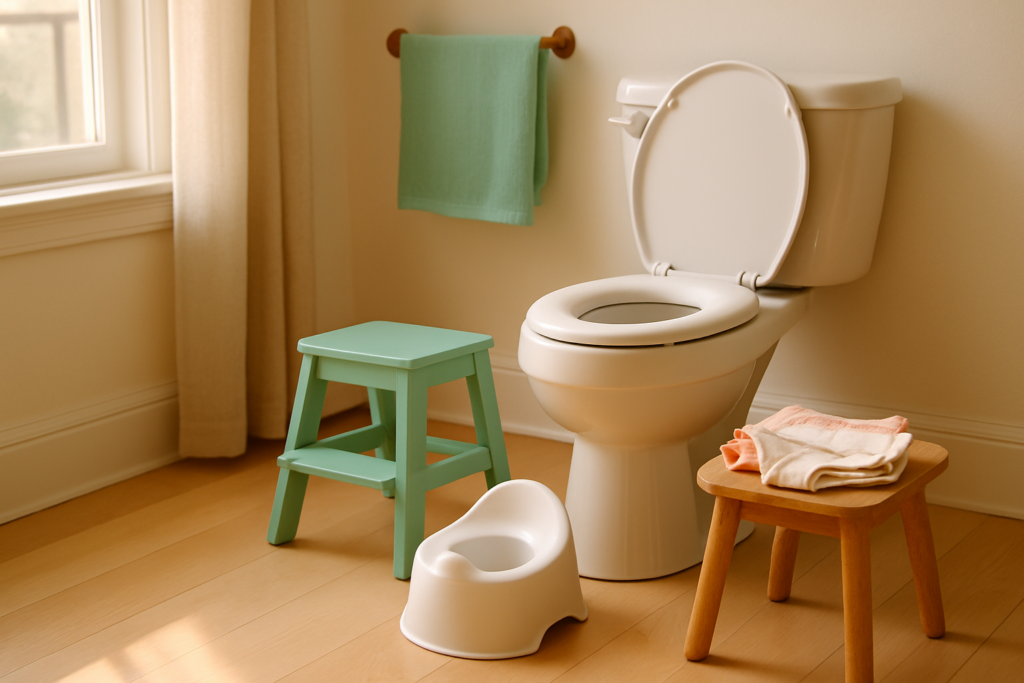
A few practical items make the difference between a smooth start and a chaotic one. You will want a potty, mostly useful for the first three days, a toilet seat reducer, and a step stool so your child can manage the regular toilet independently as the week goes on. At least fifteen pairs of cotton underwear is not an exaggeration, given how many changes the early days involve.
As an Amazon Associate we earn from qualifying purchases. Some links in this article are affiliate links: if you buy through them we earn a small commission, at no extra cost to you, and it does not affect what we recommend.
Add something to protect the mattress and sofa, a handful of small rewards, and pull-ups for sleeping, since night-time dryness is a separate skill that this method does not promise. Clear three days at home on the calendar before you start; a week that begins on the way to daycare rarely goes well. In the days beforehand, reading a potty-themed picture book together can help build familiarity, such as Once Upon a Potty.
Day 1 and 2: diaper off, home all day, learning this child’s timing
The diaper comes off first thing in the morning and stays off indoors for the rest of the week. The phrase to repeat, gently and often, is you tell me when you need to go, said instead of simply plunking the child on the potty on a timer.
Give drinks as a full cup emptied in one sitting rather than sipped across the morning. A full cup makes the link between drinking and needing to go visible, both to you and eventually to your child, which is exactly what the tracking chart is built to capture.
Write down the time of drinking, the time on the toilet, whether nothing happened, whether there was pee (marked green for success or red for an accident), whether there was poop (same green or red system), and any notes. Expect a lot of accidents on day one. Clean them up calmly, and praise big and immediately when something goes right; the reward at this early stage should come fast and often.
Day 3: still home, fewer prompts, first real successes
By day three, patterns usually start to show up in the times you have recorded. This is the point to ask less and wait more, letting the child start to offer information rather than being asked constantly.
This is also a natural moment to shift from the potty toward the toilet itself, using the seat reducer and step stool so the transition feels manageable rather than sudden. Poop control often lags behind pee control, and that gap is completely normal rather than a sign that something is wrong. If your child is holding on or hiding to poop, stay calm about it, keep the routine consistent, and avoid turning it into a battle.
Day 4 and 5: the hardest days, and why resistance shows up now
Resistance in a potty training week typically peaks on day four or five, not day two. By this point, many toddlers are simply tired of being asked will you tell me when you need to go, and that boredom shows up as pushback, refusal, or a sudden run of accidents after two good days.
The fix is to ask less often, not more, and to hand more responsibility back to the child. A dip after early success is normal and does not mean the week has failed. If things genuinely are not working, the method’s own advice is to stop and leave it a few weeks before trying again, rather than pushing through a child who is not ready. That pause is part of the plan, not a defeat.
Day 6 and 7: first outings, daycare and staying dry away from home
Short outings come in toward the end of the week, starting small and building up in length as confidence grows. A trip to the toilet before leaving the house becomes a permanent habit from here on, one of the fixed moments that stays even after the training week ends.
Pack spare underwear and a full change of clothes for any outing, always. If your child attends daycare or preschool, tell staff what phrase and routine you are using at home so the message stays consistent in both places. Starting the week over a weekend, so the hardest early days fall on days you are home anyway, tends to keep the week from being broken in half by a return to work or daycare partway through.
| Day | What you do | What to expect |
|---|---|---|
| 1 to 2 | Diaper off, home all day, ask often, record everything | Many accidents, big praise for small wins |
| 3 | Ask less, move toward the toilet, watch for patterns | First real successes, poop often lags behind pee |
| 4 to 5 | Ask even less, hand back responsibility | Resistance often peaks here, a dip is normal |
| 6 to 7 | Short outings, toilet before leaving the house | Growing confidence away from home |
How rewards work without the child quitting when the stickers stop
The sticker cards used across the week come in four sizes: three, five, seven and nine squares, used in that order rather than as a single fixed card. The reward arrives quickly at three squares so a young child can see straight away that the system works.
As the child improves, the cards get bigger and the reward gets rarer, which is deliberate: the habit is meant to outlast the stickers rather than stop the moment they do. A certificate at the end of the week marks the milestone, but ordinary praise, said warmly and specifically, matters just as much as any sticker.
What the tracking chart is actually for
The tracking chart records what your child actually does, it does not tell your child when to go. That distinction matters: the chart is there so you learn this particular child’s pattern, not so you can impose a schedule on them. Offering the potty often in the early days is scaffolding to gather that information, and it comes down as your child starts to signal on their own.
The columns are time of drinking, time on the toilet, whether nothing happened, pee (green for success, red for an accident), poop (same color system), and a notes column. Giving a full cup in one go rather than sips lets you actually see the gap between drinking and needing to go, which is the whole reason the chart exists. Most parents can read a clear pattern within a couple of weeks of charts. A faster, clock-driven method like the 3-day potty training rule compresses that same learning into far less time, which is one reason the two approaches can feel so different in practice even though both use tools like tracking and rewards.
Following the week with the video course or the handbook
If you would rather follow a structured plan than build one from scratch, the 7-Day Potty Training Video Course covers this same seven-day method as about forty short videos, roughly three minutes each, grouped by day, along with a digital AI coach that answers questions at any hour. Sticker cards, a tracking chart and a certificate are included as printables you print yourself at home.
The Potty Training Handbook covers the same method as a download you read and work through on your own, with no built-in support. The method described in this article can also be followed without either product.
When a week is not the right plan
A child who is genuinely frightened of the potty or the toilet is not ready yet, and the honest move is to build familiarity slowly, with books, a friendly attitude, and no pressure, before trying a structured week. Children who are autistic, have Down syndrome, or are non-verbal are often trained successfully with this same approach, usually over a longer stretch, with the parent reading the child’s own signals rather than waiting to be told in words.
Some questions are not for an article to answer. Constipation, withholding stool, pain when peeing, or recurring urinary infections belong with a doctor or your child’s health clinic, not with a training plan. Bedwetting that continues past around age six is also worth a conversation with a doctor rather than something to solve at home. A pause, whenever it is needed, is part of the method itself, not a sign that anything has gone wrong.
Frequently asked questions
Can potty training really be done in a week?
Most children can become dry in the daytime in about a week when they are showing genuine signs of readiness. Some do it in as little as three days, others take two or three weeks, and both are normal. Night-time dryness is separate and usually comes later. There is no guarantee attached to any timeline, only a plan to follow.
What's the hardest day of potty training?
Day four or five is usually the hardest, not day two. By that point many toddlers are tired of being asked whether they need to go and push back, sometimes with a run of accidents after a couple of good days. The fix is to ask less often and let the child take more of the responsibility themselves, not to push harder.
What is the 3-day potty training trick, and is it the same thing?
The 3-day method is a faster, more intensive version that is generally built around a fixed clock, sitting the child on the potty at set intervals rather than waiting for the child to signal. This method works the opposite way, asking the child to take the initiative and offering the potty less as the week goes on. You can read a full comparison in the 3-day potty training rule explained.
How often should I put my child on the potty?
The method is not built around a fixed interval like every fifteen or twenty minutes. Instead, you ask your child directly whether they need to go and record when accidents and successes happen, so you learn that child's own pattern. Over the week you offer the potty less and let the child start signaling on their own, except before and after sleep and before leaving the house, which stay as fixed habits.
Should my child wear training pants or regular underwear during the week?
Regular cotton underwear works better than training pants for this method, because a child feels wetness through cotton in a way that pull-up style pants do not let them feel. That sensation is part of what teaches a child to notice the need to go before it happens. Training pants can make the whole week harder to read.
What do I do if we get to day 5 and it is going badly?
A dip in success after a couple of good days is common around day four or five and is not a reason to quit outright. Try asking less often rather than more, and hand a bit more responsibility to your child. If it genuinely is not working, the method's own advice is to stop and try again in a few weeks rather than pushing through.
Ready for the next step?
The 7-Day Potty Training Video Course walks you through this program in forty short videos, grouped per day, with a digital AI coach you can ask a question at eleven at night on day four. The full handbook comes with it as a PDF to read and print. Nothing is shipped, so you can start today.
Sources
This article was written with AI assistance and checked by Dustin van de Sande.