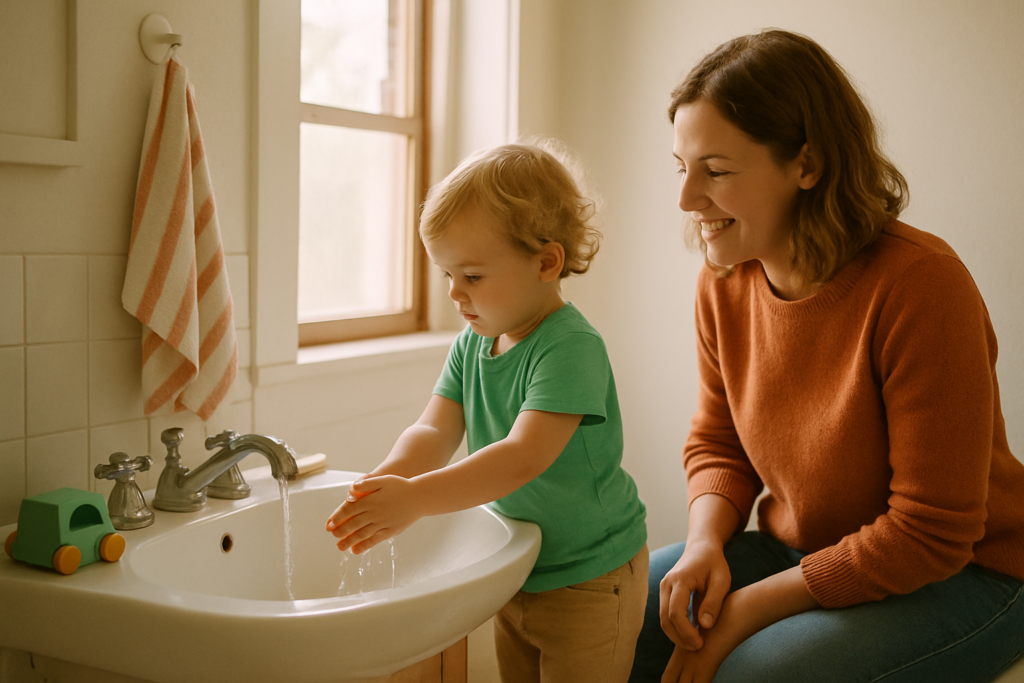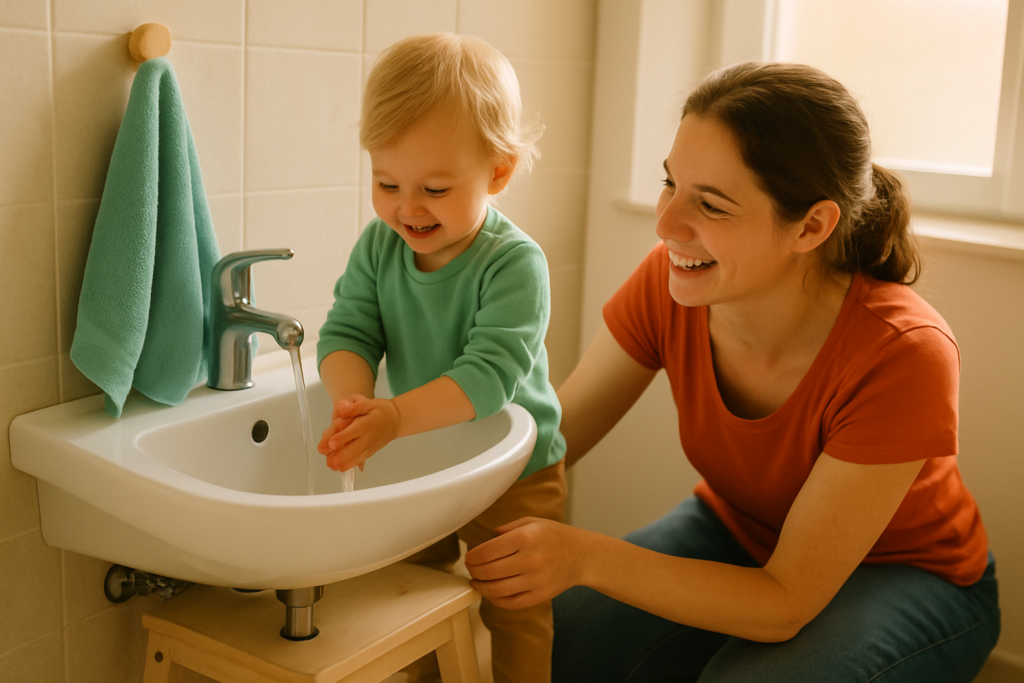


If your 3-year-old still isn’t potty trained, start by checking readiness, then clear three days at home, drop the diaper for regular cotton underwear, and follow a day-by-day plan with a tracking sheet. Most children are dry in the daytime within about a week; some take three days, others two to three weeks. Starting at 3 isn’t too late.
Three is a perfectly ordinary age to start, not a late one. Plenty of children are still in diapers at this age, and there is nothing about the calendar that makes learning harder for a child’s body. What makes a difference is having a clear plan for day one, day two and day three, including what to do on the days that go badly, rather than a vague hope that it will click on its own.
A structured, seven-day approach works because it keeps one principle at the center: the child learns to say it themselves. Instead of the parent running the whole show, the goal is the moment your toddler tells you they need to go, and every part of the plan builds toward that.
Is 3 Actually Late, and Does Starting Later Make It Harder?
Daytime dryness has a wide normal range, and plenty of children are not fully trained until well into their fourth year. There is no fixed age by which a child must be out of diapers, and starting at 3 does not put a child behind in any lasting way.
What often changes around 3 is not ability but personality. Toddlers this age have more language, more opinions, and more willingness to say no to something a parent wants. That is exactly why potty training can feel harder now than it might have at 22 months, even though the child is physically more ready than they were then. If you’re wondering whether this is normal for your family specifically, it can help to read whether it’s normal for a 3 year old not to be potty trained alongside this article, since that piece covers the reassurance side and this one covers the plan.
There are real advantages to starting at 3. A 3-year-old can usually follow a simple two-step instruction, pull pants up and down without help, and hold on for longer stretches than a younger toddler can. Night dryness is a separate skill that develops on its own timeline, sometimes years later, and no potty training approach controls when that happens.
Is Your 3-Year-Old Ready, or Is Something Else Going On?
Readiness shows up as a handful of concrete signs, not a single moment of certainty. Look for dry stretches of two hours or more, awareness that a diaper is wet or soiled, curiosity about the bathroom or about other family members using it, and the ability to follow a simple instruction like ‘bring me your shoes.’
Because these signs can be hard to judge from the middle of a busy week, a short online readiness test can help you see where your child actually stands before you commit to a start date.
A child who is genuinely frightened of the potty or the toilet is not ready yet, and pushing through that fear tends to backfire. The honest move is to build familiarity first, let the child watch, sit on it fully clothed, flush it themselves, and start training later once the fear has faded.
Some concerns don’t belong in a potty training article at all. If your child is in pain when peeing, seems to be withholding poop, is severely constipated, or you have any ongoing concern about their development, that is a conversation for your pediatrician, not something to work around at home.
Why the 3-Day Bare-Bottom Method Often Fails With an Older Toddler
As an Amazon Associate we earn from qualifying purchases. Some links in this article are affiliate links: if you buy through them we earn a small commission, at no extra cost to you, and it does not affect what we recommend.
A first attempt at potty training frequently doesn’t stick at this age, and that is not a sign the parent did something wrong. Many families try a fast, unstructured ‘naked and free at home for a weekend’ approach, sometimes inspired by popular guides like Oh Crap! Potty Training, and it works beautifully for some toddlers and stalls out for others, especially the ones who are old enough to dig in their heels.
What a structured, named program adds over a general method is specificity: what to actually do on day one, what changes on day two, what to do when day three goes sideways and your toddler has had four accidents by lunchtime, and someone to ask when you’re stuck.
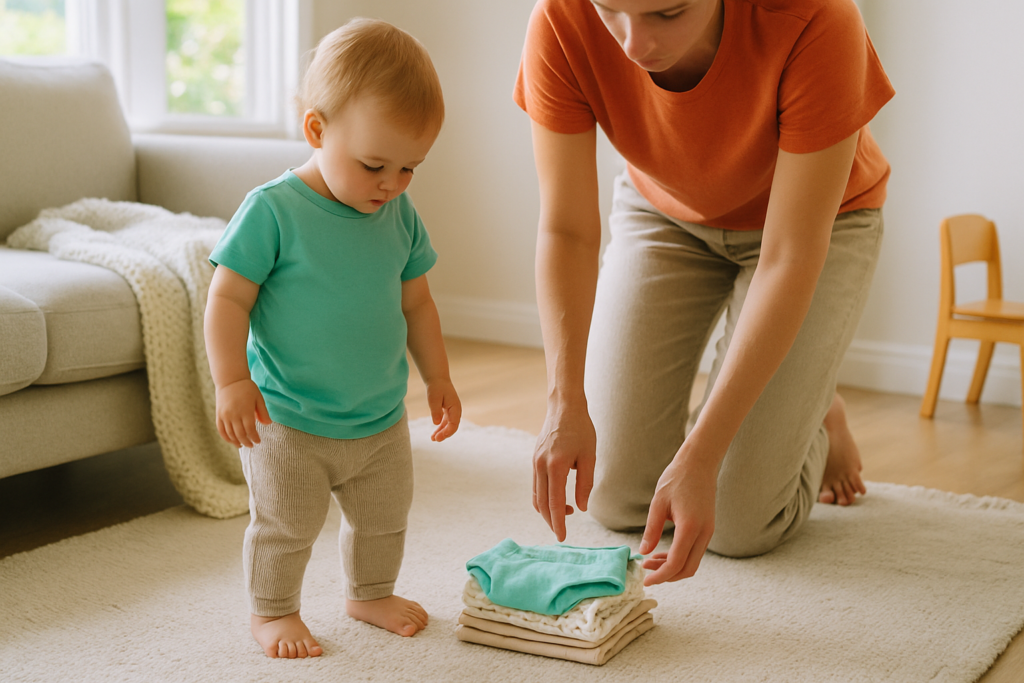
None of this involves training pants. The training works with the diaper off entirely and regular cotton underwear instead, because a child feels wetness through cotton in a way they simply don’t through a padded training pant, and that feeling is part of what teaches them to notice and hold on.
What to Have Ready Before Day One
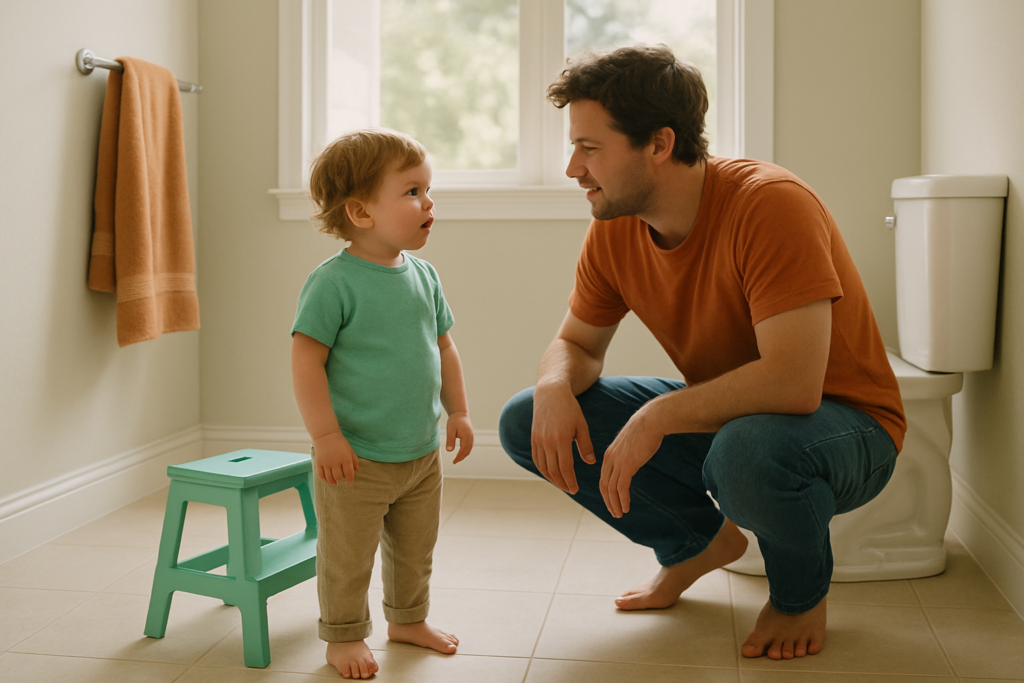
Before you start, it helps to have a few things on hand: a potty, mostly useful for the first three days, a toilet seat reducer, a step stool, at least fifteen pairs of underwear, something to protect the mattress and the sofa, a handful of small rewards, and pull-ups for sleeping. None of this needs to be elaborate, and it’s worth gathering it a day or two ahead so the first morning isn’t spent hunting for supplies.
For those first three days, a low potty with a removable inner bowl saves you a lot of cleanup, like this one:
As an Amazon Associate we earn from qualifying purchases. Some links in this article are affiliate links: if you buy through them we earn a small commission, at no extra cost to you, and it does not affect what we recommend.
Clear three consecutive days at home before you begin. This is when the child learns the most, and trying to train around a busy week of errands and outings makes it harder for everyone.
Tell daycare or preschool what you’re doing and when, so the same wording and expectations carry over there too. And talk to your 3-year-old ahead of time, in plain terms: this is the week the diapers go away and big-kid underwear comes in.
The Seven-Day Plan, Day by Day
Days one through three stay at home, because that’s when a child gets the most repetitions and the fastest feedback. From day four, short outings, a trip to the mailbox, a quick errand, start layering back in. Somewhere in this stretch, the potty gives way to the toilet with the seat reducer and step stool, so the child is using the same equipment they’ll use for years.
| Day | What you’re doing | What to expect |
|---|---|---|
| Days 1 to 3 | Stay home, diaper off, cotton underwear, use the tracking schedule | Frequent accidents, some early successes, lots of praise |
| Days 4 to 5 | Short outings, move from potty toward the toilet | Often the hardest stretch: resistance and boredom with being asked |
| Days 6 to 7 | Ask less often, hand over more responsibility | Fewer prompts needed, child starts signaling on their own |
The core question through all of this is not ‘do you need to go?’ asked on a schedule. It’s ‘will you tell me when you need to pee?’ asked at natural moments, so the child does the noticing rather than the parent doing it for them. A few moments stay fixed even once training is done: before and after sleep, and before leaving the house.
Contrary to what a lot of general advice repeats, day two usually isn’t the roughest day. Day four or five tends to be, because by then the child is simply tired of being asked the same question over and over and starts pushing back. The fix isn’t to ask more, it’s to ask less and let your toddler carry more of the responsibility themselves. If you’re in the middle of that stretch right now, it can help to read more about whether this kind of pushback at 3 is normal before you assume something has gone wrong.
How Often Should I Put My 3-Year-Old on the Potty?
The better question isn’t how often to put your child on the potty, it’s how to learn when this particular child actually needs to go. A fixed interval, like every 30 minutes regardless of what the child is doing, teaches a parent’s schedule instead of the child’s body.
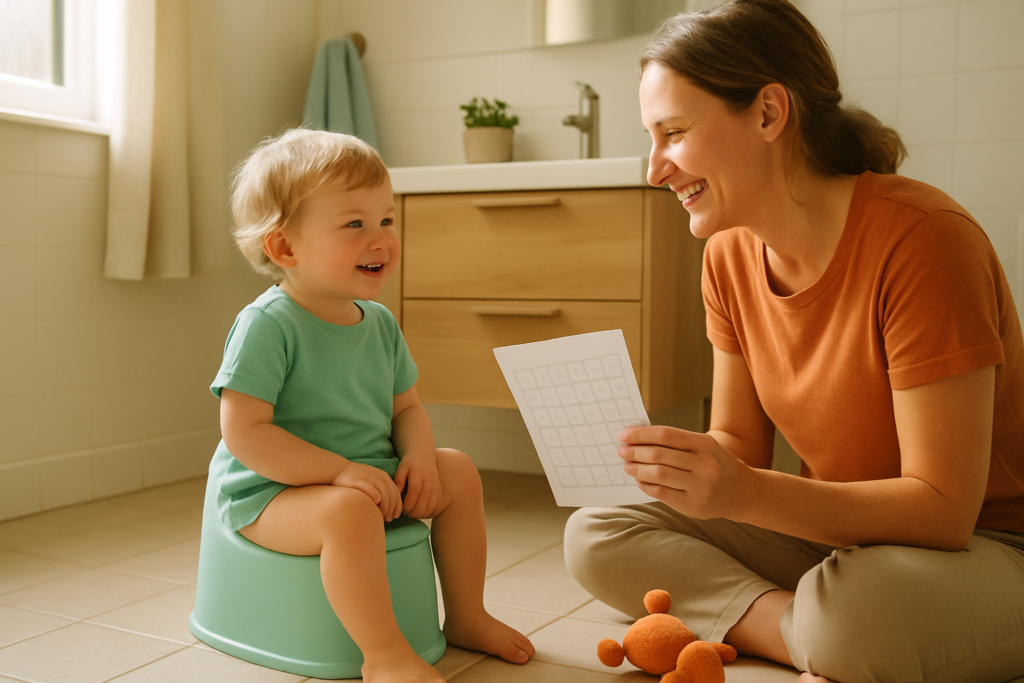
A tracking schedule solves this by recording what actually happens over several days.
| Column | What it captures |
|---|---|
| Time of drinking | When the child drank the cup |
| Time on the toilet | When they were offered or sat down |
| Nothing happened | Yes or no |
| Pee | Green for success, red for an accident |
| Poop | Green for success, red for an accident |
| Notes | Anything else worth remembering |
It helps to have the child drink a full cup in one go rather than sipping it across the afternoon, since that’s the only way to see the real link between how much they drank and how long it took before they needed to go. Within a few days, the offering fades and the child starts signaling on their own, with fixed moments like before and after sleep and before leaving the house staying in place even afterward.
What to Do When Your 3-Year-Old Flat-Out Refuses
Refusal at this age is almost always about control, not ability. A 3-year-old who says no to the potty is often testing whether they get a say, not telling you their body isn’t ready.
Offer choices instead of pressure: which underwear to wear today, which stuffed animal sits on the step stool, whether to try before or after a snack. Small decisions like these give a strong-willed toddler somewhere to put their independence that isn’t a standoff with you.
Treat every accident as part of learning, never as a failure, and never something to scold. If the fear or refusal is really about the potty itself, it can help to watch something together first.
If refusal continues and nothing seems to be working after a real attempt, the method’s own advice is to stop and leave it a while before trying again, rather than pushing through day after day of conflict.
Rewards That Keep Working After Week One
A single sticker chart tends to lose its pull fast, which is why an escalating system works better over a full week. Sticker cards come in four sizes, 3, 5, 7 and 9 squares, used in that order, so the reward comes quickly at three squares to show the child it’s working, then grows rarer as the child improves, so the habit outlasts the stickers instead of stopping the moment they do.
The sticker cards themselves cover the day-to-day wins, and a pee certificate and a poop certificate mark the bigger milestones. These, along with the tracking schedule, are part of the 7-Day Potty Training Video Course and are printed at home as you go. Alongside these, it’s worth having a few small rewards of your own ready, nothing elaborate, just something the child is genuinely excited to earn.
What About Daycare, Preschool, and Kids Who Need Longer
Keeping the same wording and the same approach at daycare as at home makes a real difference. If staff are using different words or a different routine, it can confuse a child who is still working out the pattern.
If a preschool start date is close and your child isn’t ready, it’s usually better to keep working at your own pace than to rush a training attempt just to hit a deadline, since starting under pressure often takes longer, not less time.
This kind of structured approach is also used successfully with children who are autistic, have Down syndrome, or are non-verbal, usually over a longer stretch and by reading the child’s own signals closely rather than waiting to be told in words. Night dryness stays a separate matter throughout all of this. It develops on its own timeline and comes later, regardless of how daytime training goes.
Where to Get the Day-by-Day Plan
For families who want the structure without designing it themselves, the 7-Day Potty Training Video Course lays out the same seven-day method as roughly forty short videos, about three minutes each, grouped by day, plus a digital AI coach that answers questions any time of day or night. The sticker cards, tracking schedule and certificates are part of the course and printed at home as you go.
It’s worth being honest about what this does and doesn’t do. It helps parents follow a clear plan instead of improvising one, but it doesn’t guarantee an outcome, and a child who genuinely isn’t ready yet should wait rather than start on a schedule.
Frequently asked questions
Is it normal for a 3 year old to not be potty trained?
Yes. Daytime dryness happens across a wide age range, and plenty of 3-year-olds are still in diapers. It becomes worth a closer look mainly if there's real fear of the potty, pain, or ongoing constipation, none of which are simply a matter of age.
Is age 3 too late to potty train?
No. Three is a common age to start, and it comes with real advantages: better language, more physical control, and the ability to follow instructions. Starting at 3 does not put a child behind in any lasting way.
How long does it take to potty train a 3 year old?
Most children are dry during the day in about a week using a structured approach. Some manage it in as little as three days, while others take two to three weeks, and that variation is normal rather than a sign of trouble.
What do I do if my 3 year old refuses to sit on the potty?
Refusal at this age is usually about control rather than ability, so offering small choices, like which underwear to wear, tends to work better than pressure. If a child seems genuinely frightened of the potty rather than just resistant, build familiarity first and try again later.
How often should I take my 3 year old to the toilet?
Rather than a fixed interval, use a tracking sheet for a few days to learn when this particular child actually goes, based on drinking times and past accidents. Offering fades quickly as the child starts to signal on their own, with a few fixed moments, like before and after sleep, staying in place.
My 3 year old pees on the potty but holds their poop. What now?
Withholding poop is common during potty training. If it continues, or if your child seems constipated or in pain, this is a question for your pediatrician rather than something to manage alone at home.
Ready for the next step?
The 7-Day Potty Training Video Course walks you through this program in forty short videos, grouped per day, with a digital AI coach you can ask a question at eleven at night on day four. The full handbook comes with it as a PDF to read and print. Nothing is shipped, so you can start today.
Sources
This article was written with AI assistance and checked by Dustin van de Sande.