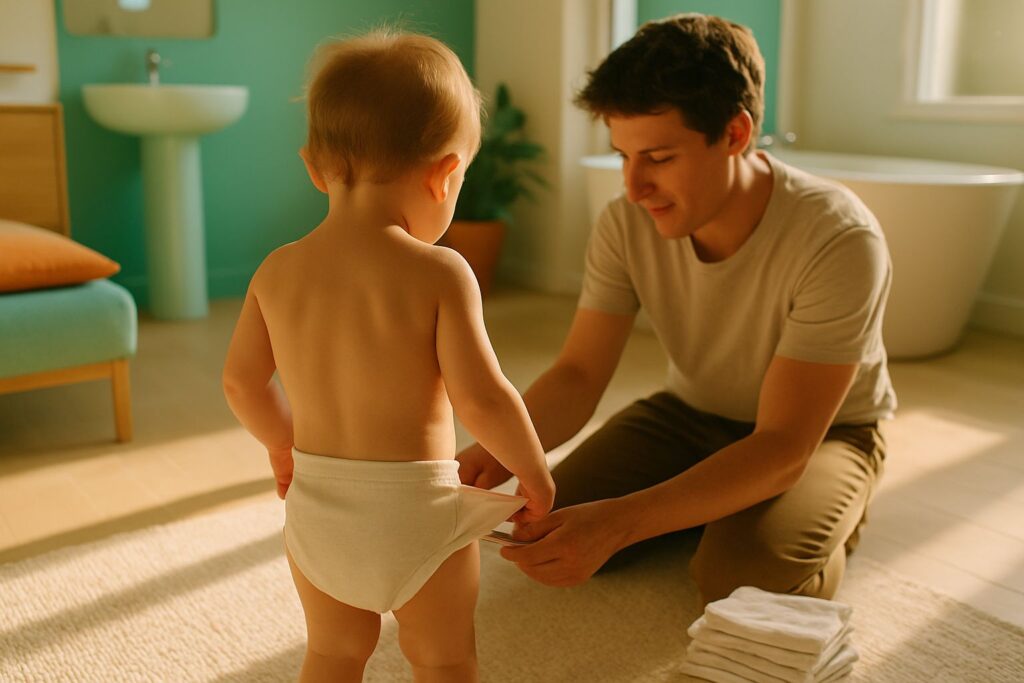

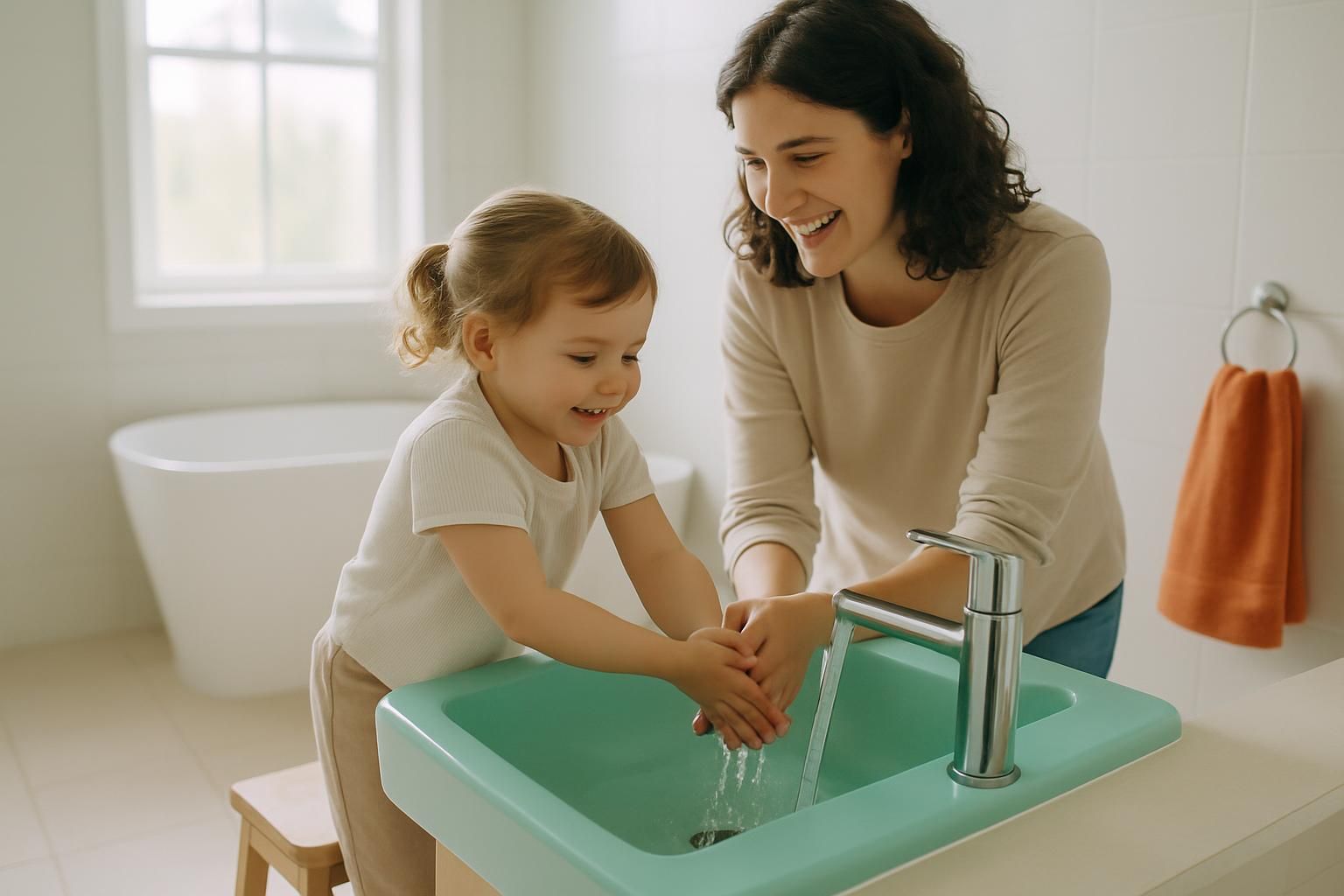
The plan is the same for girls and boys: watch for readiness, follow a consistent step-by-step approach, and let the child lead. The real differences are practical, not developmental: how a girl wipes, whether a boy sits or stands first, and how a potty or seat fits. Neither sex trains faster or easier than the other.
A handful of small, real details change depending on anatomy. Girls need to learn to wipe front to back from the very first day. Boys usually learn to sit before they learn to stand, because sitting lets them handle both pee and poop with one skill instead of two. A potty or toilet seat needs to fit the child’s body either way, but the fit matters a bit differently for each. None of that changes the order of events, how long it takes, or whether your child is ready to start.
What doesn’t change is readiness. A child who points at a wet diaper, hides to poop, stays dry for an hour or two, or asks questions about the bathroom is showing you they’re ready, and that has nothing to do with whether they’re a girl or a boy.
Is it true boys potty train later than girls?
There is a real, measured difference, but it’s small and it describes groups, not individuals. The American Academy of Pediatrics notes that boys, on average, finish toilet training a few months later than girls, a gap of roughly half a year across large groups of children.
An average across thousands of children tells you almost nothing about the one child in front of you. Plenty of boys train earlier than plenty of girls, and plenty of girls take longer than plenty of boys. Most children, regardless of sex, start somewhere between 18 months and 3 years old, and that window is wide for a reason: kids get ready at different times.
Waiting for your own child’s signals beats starting on the strength of a statistic. A boy who is showing every readiness sign at 22 months doesn’t need to wait because boys supposedly train later, and a girl who isn’t showing those signs at 2 and a half doesn’t need to start because girls supposedly train earlier. Watch for staying dry for stretches of an hour or more, telling you before or after they’ve gone, showing curiosity about the toilet, and being able to pull pants up and down with a little help.
If you want a clearer read on where your own child stands, there’s a short online test built for exactly this question.
What actually changes when you potty train a girl
The biggest practical habit to build early is wiping front to back, every single time, from day one. This matters for hygiene reasons that are worth taking seriously, and most girls need a parent’s help with wiping for a long while after they’re otherwise reliably using the potty, so don’t expect her to take over the job quickly.
If she leans back while sitting on the potty or a reducer seat, pee can go forward rather than straight down, so it helps to have her feet supported, whether on the floor or a step stool, with her hips settled back on the seat rather than perched on the edge.
Clothing matters more than people expect. Dresses, tights, and anything with buttons or snaps slow a child down at exactly the moment speed matters most. Plain cotton underwear and easy pull-up-and-down pants or shorts work best for the training days themselves, however she usually dresses the rest of the time.
Cotton underwear, not training pants, is the right choice during this stretch, because she needs to actually feel wet to connect the sensation with the event, something a padded training pant makes much harder. Training works with the diaper off and plain cotton underwear on from the very first day.
A simple picture book can help some toddlers get comfortable with the idea before you start. Potty is a popular, straightforward choice many parents read together in the lead-up to training.
What actually changes when you potty train a boy
Sit first for everything, pee and poop both, before any mention of standing. This isn’t a stylistic choice, it’s practical: early on, pee and poop often arrive close together, and sitting lets him handle both with the one skill he’s already learning instead of splitting it into two separate routines to master at once.
When he’s sitting, have him tuck down a little rather than sitting bolt upright, so the stream goes into the bowl instead of up and out over the front rim.
Foreskin care, if he’s uncircumcised, is a question for his pediatrician, not something to work out from an article. Ask about it at a regular checkup if you’re unsure.
Should boys sit or stand to pee?
Sit first, always, and introduce standing later, once he reliably stays dry sitting down and can reach the bowl safely. Teaching both at once early on means he’s learning two skills instead of one, and splitting his attention that way usually slows things down rather than speeding them up.
Standing too early also risks losing ground on poop training specifically, since a boy who’s used to standing for pee may resist sitting back down when he needs to poop, right when that habit is still fragile.
When you do introduce standing, a step stool to get him level with the bowl, some aim practice, and a small floating target, a bit of toilet paper or a cereal-piece sized object, make it concrete rather than abstract. Some boys are happy sitting down for months after they’re otherwise fully trained, and that’s completely normal, not a sign anything’s wrong.
| What to watch for | Girls | Boys |
|---|---|---|
| Sitting position | Hips back, feet supported | Tuck down, feet supported |
| Wiping | Front to back, parent helps for a long while | Less critical direction-wise, parent still helps |
| Clothing on training days | Plain cotton underwear, easy pants, skip dresses | Plain cotton underwear, easy pants |
| Potty or seat fit | Deep front rim, stable base | Deep front rim, stable base |
| Standing to pee | Not applicable | Introduced later, after sitting is solid |
What’s the best potty for a girl or a boy?
No potty on the market is made specifically for one sex. What actually matters is a deep front rim that catches forward splash, a wide stable base so it doesn’t tip when a toddler shifts around, and a height and shape that lets feet rest flat rather than dangle.
A built-in pee guard, the little raised shield at the front of some seats, is marketed mostly at boys, but it’s often more of an obstacle than a help for either sex, since toddlers tend to catch themselves on it climbing on and off. A plain open bowl shape tends to cause fewer problems.
As an Amazon Associate we earn from qualifying purchases. Some links in this article are affiliate links: if you buy through them we earn a small commission, at no extra cost to you, and it does not affect what we recommend.
| Item | What to look for | Notes |
|---|---|---|
| BabyBjörn Potty Chair | Low, stable base, deep front rim | Works for either sex |
| Munchkin Sturdy Potty Training Seat | Toilet seat reducer with a secure fit and sturdy handles | Useful once you move to the big toilet |
| Dreambaby Step Stool | Non-slip feet, wide platform | Pairs with the seat reducer for the move to the big toilet |
A seat reducer and step stool are really one pair, needed together once you move from the potty to the big toilet. For the fuller list of everything worth having ready before day one, see what you actually need to potty train.
The part that is identical for both: the plan
Past the anatomy details above, the actual plan doesn’t change by sex at all. The Potty Training Box Method is a seven-day program: the first three days are spent at home, where the child learns the most, followed by short outings once the basics are holding. It works the same way whether you’re training a daughter or a son. The 7-Day Potty Training Video Course teaches this same program as about forty short videos of roughly three minutes each, grouped by day, with a digital AI coach that answers questions at any hour, plus printable tracking schedules, sticker cards, and pee and poop certificates you print at home.
The core idea is that the child takes the initiative, not the clock. Rather than putting a child on a fixed schedule, you ask, ‘will you tell me when you need to pee?’, so the habit becomes hers rather than something done to her on a timer. The exceptions are a few fixed moments that stay in place even after training is done: before and after sleep, and before you leave the house.
A tracking schedule is how you learn this particular child’s own timing instead of guessing. It records the time they drank, the time on the toilet, whether nothing happened, and whether pee and poop were a success or an accident, plus a notes column. For the schedule to actually tell you anything useful, have the child drink a full cup in one go rather than sipping it across the afternoon; only then do you know how much went in and how long it takes before they need to go, which is exactly the link the schedule is built to show you.
The sticker cards work the same way for every child: they come in four sizes, 3, 5, 7, then 9 squares, used in that order. The reward comes fast at three squares so the child sees that it works, then grows rarer as the squares increase, so the habit outlasts the stickers instead of stopping the moment they do.
For a fuller walkthrough of what the first day actually looks like, start with what day one actually looks like, and for how the week unfolds overall, see what each day of the week looks like.
Day 4 or 5 is the hardest day, for daughters and sons alike
The hardest day of the week is usually day 4 or day 5, not day 2 as some advice suggests. By then the child is often tired of being asked ‘will you tell me when you need to pee?’ over and over, and that boredom shows up as resistance: refusing the potty, having more accidents than the day before, or seeming to backslide altogether.
The fix isn’t to ask more, it’s to ask less. Cut back on how often you prompt, and hand more of the responsibility back to the child to notice and say so themselves. This is true for girls and boys equally; it has nothing to do with sex and everything to do with a child getting tired of a question.
Accidents at this stage are part of learning, never a sign of failure, for the child or for you. If a video helps make that concrete for your child right after it happens, this one is built for exactly that moment.
If a few days in it’s clearly not working at all, the method’s own advice is to stop and leave it a few weeks before trying again, rather than pushing through. For more on reading that moment, see when to pause and when to keep going.
What about children who are not ready, or who need longer?
Most children, girls and boys alike, are dry in the daytime in about a week once they start, though some manage it in as little as three days and others take two to three weeks. That range doesn’t break down consistently by sex; readiness and consistency at home matter far more than which sex a child is.
A child who is genuinely frightened of the potty or the toilet isn’t ready yet. The honest move is to build familiarity first with no pressure to perform, a toilet or potty they can sit on fully clothed, books about it, watching a parent use the bathroom, and to start the actual training later once the fear has eased.
This approach has also been used successfully with children who are autistic, have Down syndrome, or are non-verbal, usually over a longer stretch of time and by reading the child’s own signals rather than waiting to be told in words.
Night-time dryness is a separate skill from daytime training and typically comes later for both sexes; the video course doesn’t promise it as part of the daytime week. For more on that separate stage, see night training is a separate step.
Constipation, holding in stool, repeated urinary tract infections, and bedwetting that continues past age 6 are all questions for a doctor or a child health clinic, not something to work through from an article.
Frequently asked questions
Do girls potty train easier than boys?
On average, girls finish a bit earlier than boys, by roughly six months according to the American Academy of Pediatrics, but this is a group average and tells you nothing about one particular child. Readiness signs, not sex, predict how smoothly training goes. A boy who shows clear readiness signs can train just as fast as a girl who shows the same signs.
At what age should I potty train my 2 year old girl?
Two years old falls right in the typical starting window of 18 months to 3 years that applies to both sexes. The better question than age is whether she shows readiness signs: staying dry for an hour or two, telling you she's wet, showing interest in the bathroom, or being able to pull pants up and down herself. If most of those are present, she's likely ready regardless of the exact age on the calendar.
What is the best potty for a girl?
No potty is made specifically for girls. What matters is a deep front rim to catch forward splash, a stable wide base so she doesn't tip, and a height that lets her feet rest flat on the floor or on a step stool rather than dangle. A built-in pee guard tends to get in the way for either sex during climbing on and off, so a simple open-front bowl design usually works best.
Should my son sit or stand to pee at first?
Sitting first is the easier path, because pee and poop often arrive close together in the early weeks, and sitting lets him handle both with one skill instead of learning two separate routines. Standing can be introduced later, once he reliably stays dry and can reach the bowl safely with a step stool. Some boys are happy sitting down for months and that's completely normal.
How do I teach my daughter to wipe front to back?
Say it out loud every single time from day one, front to back, and expect to do the wiping yourself for her for a long while, since the coordination needed to do it well comes later than the basic ability to pee or poop on the potty. Most children need a parent's help with wiping well past the point where they're otherwise fully trained. Consistency in the direction matters more than how quickly she takes over the job herself.
How long does potty training take for boys versus girls?
Most children, girls and boys alike, are dry in the daytime in about a week once they start, though some manage it in as little as three days and others take two to three weeks. That range doesn't break down consistently by sex; readiness and consistency at home matter far more than which sex a child is. Night-time dryness is a separate skill that typically comes later for both.
Ready for the next step?
The 7-Day Potty Training Video Course walks you through this program in forty short videos, grouped per day, with a digital AI coach you can ask a question at eleven at night on day four. The full handbook comes with it as a PDF to read and print. Nothing is shipped, so you can start today.
Sources
This article was written with AI assistance and checked by Dustin van de Sande.