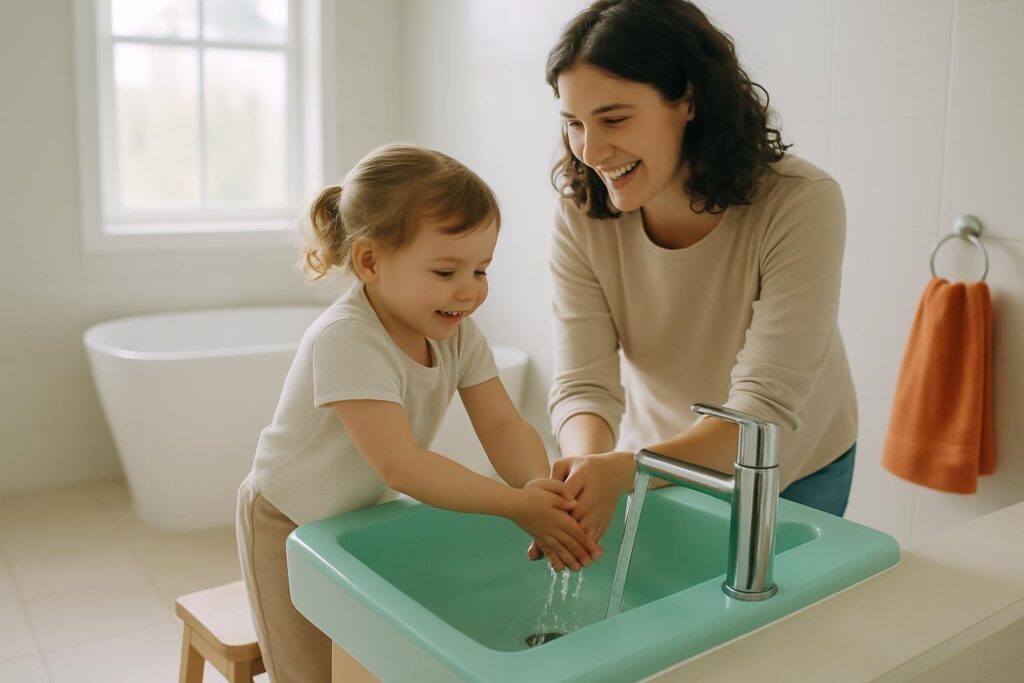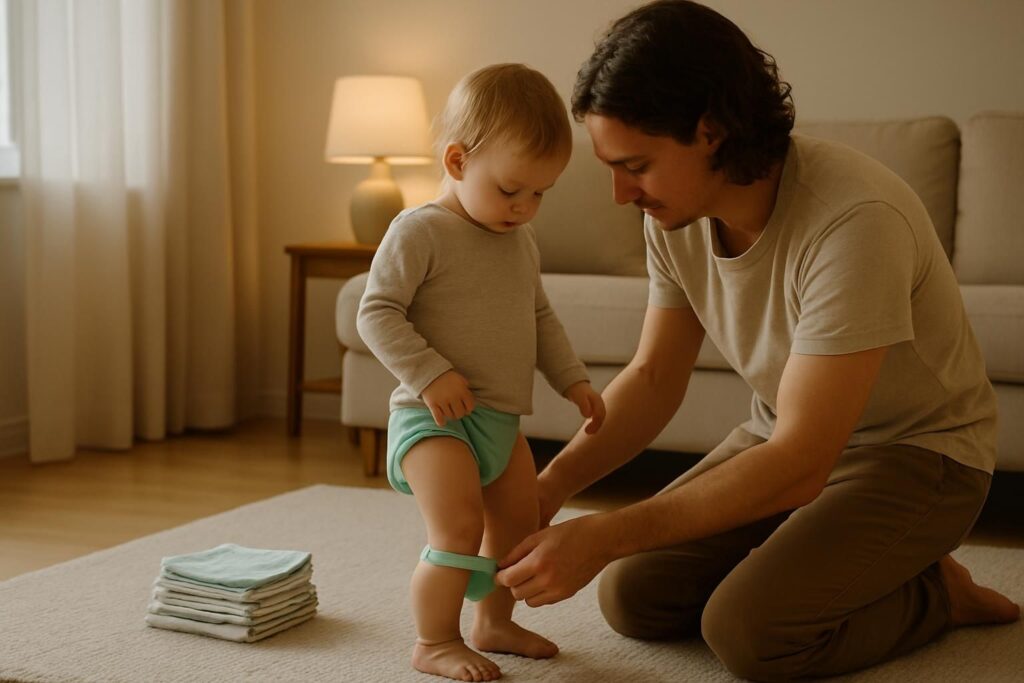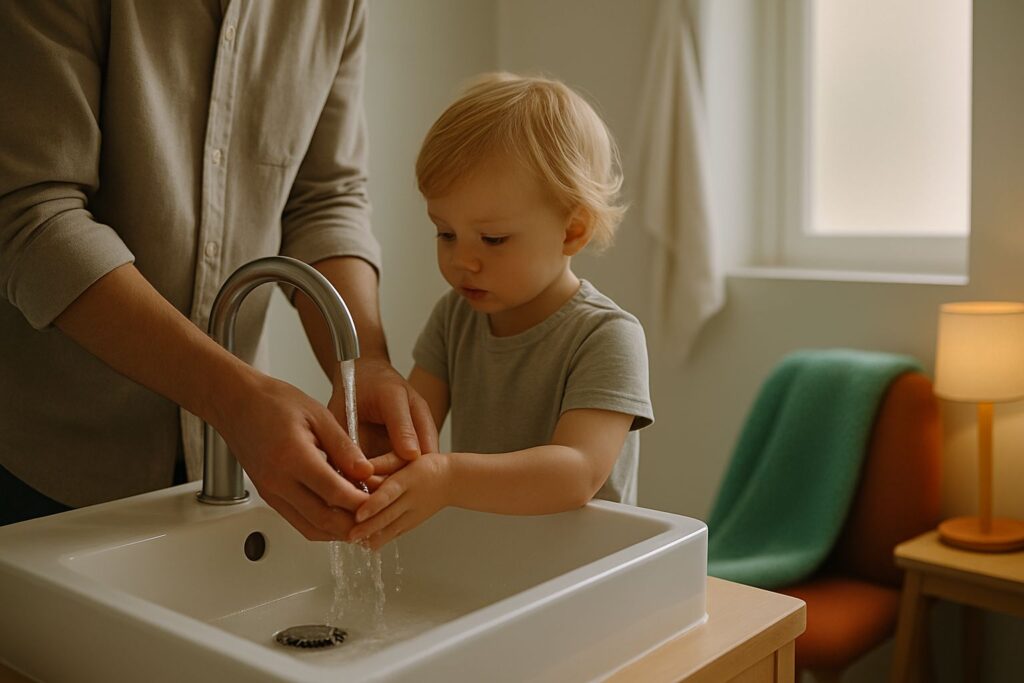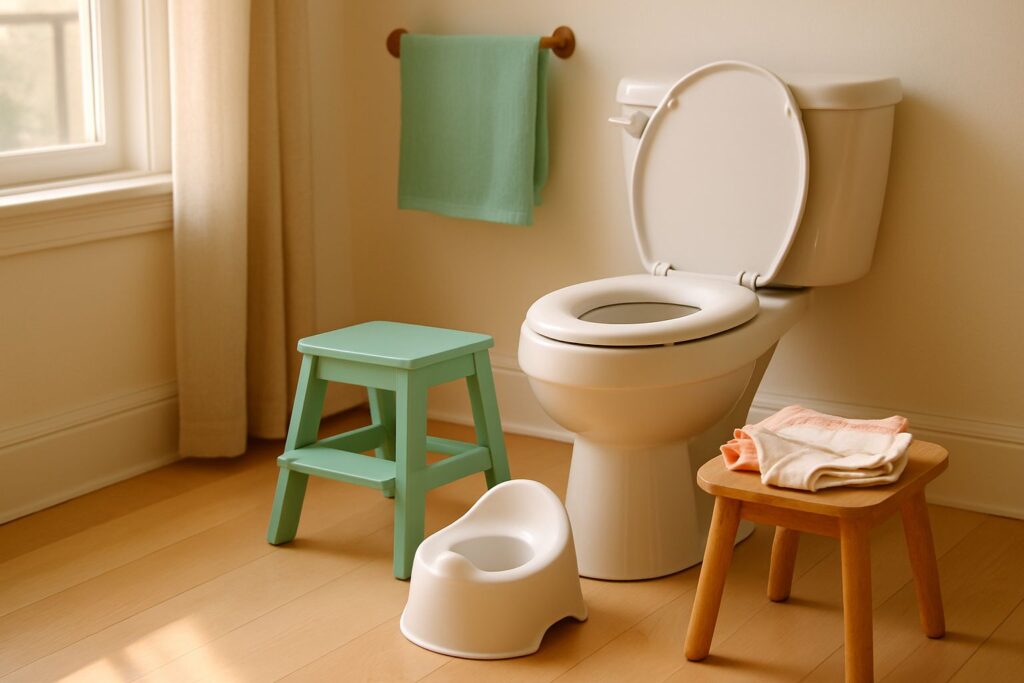

The child-oriented potty training method follows a child’s own readiness and signals instead of a parent-set clock. The adult preps the bathroom, creates chances to succeed, and praises progress, while the child learns to notice the urge, say it out loud, and hold on until reaching the toilet. It usually applies between 18 months and 4 years.
What is the child-oriented potty training method?
This approach traces back to the gradual, low-pressure guidance popularized by pediatrician T. Berry Brazelton, which asked parents to wait for signs of readiness rather than imposing a start date. KidsHealth’s toilet teaching guide reflects that same readiness-based thinking, and it still underpins most mainstream advice today.
What the child actually learns is not just how to use a toilet. It is noticing the physical feeling of needing to go, saying it out loud before an accident happens, and holding on for the short walk to the bathroom. The adult’s job is different: setting up a reachable toilet or potty, creating regular chances to succeed, praising what goes well, and quietly recording what happens so a pattern becomes visible.
Most families start somewhere between 18 months and 4 years old. There is no single correct age, and the American Academy of Pediatrics notes that toilet training in the United States typically begins between 2 and 3 years of age, with most children trained by age 4.
Child-led does not mean waiting forever: what parents get wrong
The most common misreading is that child-led training means doing nothing until a toddler spontaneously asks for underwear. In practice, almost no toddler asks first. A parent still has to create the opportunity, the reminders, and the praise. The child just leads the pace and the final decision to go.
The opposite misreading is just as common: that child-led means no structure at all, a loose free-for-all with no plan. That is not what this approach looks like in practice. Structure still matters: a chosen start date, three concentrated days at home, and a consistent script the whole household uses.
Passive waiting can actually stall a child who is already ready, because nobody ever creates the chance to succeed. If your child seems frightened of the potty or the toilet itself, that is a sign to pause, build familiarity with the bathroom at a relaxed pace, and try again later rather than pushing through fear.
How do you know your toddler is ready?
Real readiness signs include staying dry for two hours or longer, hiding or going still to poop, telling you a diaper is wet, showing curiosity about the bathroom, and being able to pull pants up and down with some help. KidsHealth’s toilet teaching guide lists a similar set of signs worth watching for.
Age alone is not a readiness sign. Neither is an older sibling’s timeline, nor pressure from a preschool enrollment deadline. Children develop bladder and bowel awareness on their own schedule, and pushing ahead of it usually means more accidents, not fewer.
If you are not sure where your child stands, a short readiness check can help you decide whether this week is the right time to start.
A child who is not ready yet should wait. That is not a setback, it is just information, and starting a week or two later usually goes more smoothly than forcing it now.
Child-oriented vs. timed sitting vs. three-day training: how the methods compare
These three approaches answer the same question, who decides when a child goes, very differently. The gradual, Brazelton-style approach is slow, low pressure, and open-ended: there is no fixed end date, and the child’s own pace decides how long it takes.
Scheduled or timed-sit approaches put the parent in charge of the clock, often sitting the child down every 20 to 30 minutes whether or not there is any sign of need. This can produce fast results on paper, but it teaches a child to wait to be told rather than to notice and announce the feeling themselves.
Intensive three-day or weekend approaches, first popularized by psychologists Azrin and Foxx in the 1970s, concentrate everything into one short, high-effort stretch at home with constant parental attention. A structured seven-day plan sits between the two: it keeps the child-led principle but adds a day-by-day script so parents are not improvising alone.
| Approach | Who decides when | What the child learns |
|---|---|---|
| Child-oriented (gradual) | Child signals readiness | To read their own body, no fixed timeline |
| Timed sitting | Parent, every 20 to 30 minutes | To comply with a schedule, wait to be told |
| Intensive 3-day | Parent, concentrated effort | Fast habit formation, high adult involvement |
| Structured 7-day plan | Child signals, parent tracks and guides | Same as gradual, with a clear day-by-day plan |
As an Amazon Associate we earn from qualifying purchases. Some links in this article are affiliate links: if you buy through them we earn a small commission, at no extra cost to you, and it does not affect what we recommend.
If you want to weigh these against each other in more depth, an honest comparison of potty training methods walks through the tradeoffs of each one. Parents who prefer a book-length guide to the three-day intensive style sometimes reach for Potty Training in 3 Days, and those drawn to a more conversational, child-led written guide often pick up Oh Crap! Potty Training.
What the Potty Training Box Method does differently
The Potty Training Box Method is a structured seven-day program built on the child-led principle: the first three days are spent at home, followed by short outings once accidents drop, all built around the child saying when they need to go rather than being sat down on a timer.
The core script is simple. Instead of sitting a child down at set times, you ask, ‘will you tell me when you need to pee?’ and let the child carry that responsibility as much as they can. There are only a few fixed moments where the parent still initiates the offer, rather than waiting: before and after sleep, and before leaving the house. Those two moments stay fixed both during training and well after it is finished.
During training, the diaper comes off and the child wears regular cotton underwear rather than training pants. Cotton underwear lets a child actually feel wetness the way a diaper or a padded training pant does not, which is part of what makes the sensation something they can learn to notice ahead of time.
Accidents are treated as part of learning, not as a failure on the child’s part or the parent’s. A wet pair of underwear is information, just like an entry on the tracking schedule. The response is a calm change and a reminder, not a correction.
How often should you put your child on the potty? Reframing the question
The honest answer is that you are not setting an interval at all, you are learning this particular child’s pattern so the offering can fade out as their own signal takes over. A fixed schedule treats every child the same; a tracking schedule treats your child as the only data point that matters.
A tracking schedule records six things: the time your child drinks, the time they sit on the toilet, whether nothing happened, whether a pee attempt succeeded or was an accident, whether a poop attempt succeeded or was an accident, and a notes column for anything else worth remembering. Over a few days a pattern usually emerges, often a fairly consistent gap between a drink and a trip to the bathroom.
| Column | What it tracks |
|---|---|
| Time of drinking | When the child had something to drink |
| Time on toilet | When the child was offered or used the toilet |
| Nothing happened | Yes or no |
| Pee | Green for success, red for an accident |
| Poop | Green for success, red for an accident |
| Notes | Anything else worth remembering |
It works best when the child drinks a full cup in one go rather than sipping it over the course of an hour. A single, complete drink makes the link between how much went in and how long it takes before the child needs to pee visible on the chart, something that gets muddied if the cup is topped up here and there throughout the day.
As the days go by, the parent’s prompting should give way to the child’s own signal. The early offering is scaffolding, there to create chances to succeed and gather information while the pattern is still unknown. It is not the method itself, and it is meant to come down as soon as the child starts announcing the need on their own.
What a child-led week actually looks like, day by day
The first three days are spent at home with the diaper off, regular drinks, frequent chances to use the potty or toilet, and the tracking schedule filled in as the pattern becomes clear. What day one actually looks like is mostly about watching and recording, not about getting everything right immediately.
Days four and five tend to be the hardest, not day two. By that point the child is often tired of being asked ‘will you tell me when you need to pee?’ over and over, and some pushback or resistance is common. The fix is not to push harder. It is to ask less often and hand the child more of the responsibility for noticing and speaking up themselves.
Short outings usually start once accidents at home have dropped off, first a quick errand, then longer trips as confidence builds. Before leaving the house stays one of the fixed moments where the parent offers the bathroom, regardless of how far along training is.
Most children are dry in the daytime in about a week. Some manage it in three days, others take two or three weeks, and a small number need a longer break before trying again. Night-time dryness is a separate matter that typically comes later and is not something a daytime method promises.
Rewards and praise in a child-led method: do they contradict it?
Some parenting writers argue that rewards shift a child’s motivation from internal to external, training them to perform for a sticker rather than because they feel the accomplishment. It is a fair concern, and the answer lies in how the reward system is actually built.
A rising sticker system answers that objection by design. The sticker cards come in four sizes, 3, 5, 7, and 9 squares, used in that order rather than as a single fixed card. The reward comes quickly at three squares so a child sees right away that the effort works, then becomes steadily rarer as the card sizes grow, which means the habit has to carry more of its own weight as the stickers thin out.
That gradual thinning is what lets the habit outlast the stickers instead of stopping the moment the rewards do. By the time a child reaches the nine-square card, going to the toilet has usually become ordinary rather than something that needs a prize attached to it.
Here’s a short video worth watching together right after a first real success, to celebrate the moment without making a bigger deal of it than the child can handle.
The process closes with two certificates, a pee certificate and a poop certificate, marking the two separate skills rather than treating toilet training as one single finish line.
When child-led training is the right call and when to pause
If an attempt is not working, the method’s own advice is to stop and leave it a while before trying again, rather than pushing through a week that clearly is not going anywhere. That pause is part of the approach, not a failure of it.
The same child-led principle applies to children who are autistic, have Down syndrome, or are non-verbal. Training usually takes a longer stretch with these children, and it relies even more heavily on reading the child’s individual signals rather than waiting for them to say the words out loud.
Regression happens to a lot of children, often around a house move, a new sibling, or starting daycare, and it is not a sign to start the whole program over from day one. Potty training regression usually responds to a few calm, consistent days rather than a full restart.
Some things are outside what any training method should try to handle. Constipation, a child who seems to be withholding stool, repeated urinary tract infections, or bedwetting that continues past age 6 are all worth raising with your child’s doctor or a child health clinic rather than addressing with a potty training approach on your own.
Where to get the step-by-step plan
Reading about the approach is one thing, having a plan for the actual week is another. Before you start, it helps to know what you need to have ready, from a potty to enough changes of underwear to get through the first few days.
The 7-Day Potty Training Video Course carries the same seven-day program described above, laid out as forty short videos of about three minutes each, grouped by day, plus a digital AI coach available for questions at any hour. The sticker cards, tracking schedule, and certificates are part of the course and are printed at home once purchased.
What a plan like this adds over a free article is specificity: what to actually do on day one, day two, and day three, including what to do on the days that go badly, plus somewhere to ask a question when something does not match what you read. It is also something you can come back to for a younger sibling later on.
Frequently asked questions
What is the child-oriented potty training method?
It is an approach that follows a child's own readiness and signals instead of a parent-set schedule. The adult sets up the bathroom, offers regular chances to succeed, praises progress, and tracks what happens, while the child learns to notice the urge, say it out loud, and hold on until reaching the toilet. It traces back to the gradual, low-pressure guidance popularized by pediatrician T. Berry Brazelton.
What's the easiest way to potty train a child?
There is no single easiest way, but most families find it goes more smoothly when they wait for genuine readiness signs, spend the first few concentrated days at home, and use a consistent script and simple rewards. A day-by-day plan that tells you what to do on the hard days, not just the easy ones, tends to reduce the guesswork that makes the process feel harder than it needs to be.
What is the normal age for a child to be toilet trained?
Most children in the United States begin toilet training between 2 and 3 years old and are trained by around age 4, according to the American Academy of Pediatrics. There is a wide normal range, and starting earlier or later than a sibling or classmate does not mean anything is wrong.
Is it okay that my 3 year old isn't potty trained?
Yes. Many children are not fully daytime trained at 3, and the typical range extends to around age 4 for most kids. If your child shows no readiness signs at all by then, or you have specific concerns about constipation or holding patterns, it is worth raising with your child's doctor.
How long after drinking does a 2 year old need to pee?
This varies by child, which is exactly what a tracking schedule is for: recording the time your toddler drinks and the time they actually go lets you see their personal pattern instead of guessing. Having the child drink a full cup in one sitting, rather than sipping over time, makes that link between amount and timing much clearer on the chart.
Is child-led potty training the same as waiting until my child asks?
No. Child-led training still means the parent actively creates chances to go, offers the potty or toilet at key moments, and praises success. It is not passive waiting for a child to request underwear on their own. The child leads the pace and the final decision, but the parent still builds the structure around them.
Ready for the next step?
The 7-Day Potty Training Video Course walks you through this program in forty short videos, grouped per day, with a digital AI coach you can ask a question at eleven at night on day four. The full handbook comes with it as a PDF to read and print. Nothing is shipped, so you can start today.
Sources
- HealthyChildren.org (American Academy of Pediatrics) (Toilet training in the United States typically begins between 2 and 3 years of age, and…)
- KidsHealth (Nemours) (A list of common toilet training readiness signs parents can watch for.)
- HealthyChildren.org (American Academy of Pediatrics) (Night-time dryness is a separate matter from daytime training and tends to come later.)
- NIDDK (National Institutes of Health) (Ongoing bedwetting past age 6 is worth discussing with a doctor rather than addressing…)
This article was written with AI assistance and checked by Dustin van de Sande.