My 5-Year-Old Still Isn’t Potty Trained: What to Do Now

If your 5-year-old still isn’t potty trained, first rule out a medical cause such as constipation or a never-dry history with your doctor, then take the pressure off for a few weeks before running one short, structured home restart where your child takes the lead on saying when they need to go.
The pattern that gets most five-year-olds here is rarely a single disaster. It’s usually one or two attempts that fizzled out, pull-ups worn at school just in case, and a child who can clearly hold it and clearly knows what the toilet is for, but won’t. That’s not a crisis. It’s a stuck pattern, and stuck patterns respond to a change in approach more than to more pressure.
There’s one exception worth naming before anything else: a child who has never once been dry, who holds in poop until it’s hard and painful, or who wets constantly with no progress after a genuine attempt, needs a doctor or child health clinic first. Training advice doesn’t fix a medical issue, and pushing a restart on top of one usually makes things worse.
Is it normal for a 5-year-old not to be potty trained?
Most children reach daytime dryness somewhere between age 2 and 4, according to the American Academy of Pediatrics, which notes that toilet training in the United States typically begins between 2 and 3 and most kids are trained by 4 (healthychildren.org). Five is later than typical, but it’s far from rare, and late does not mean lazy, badly parented, or broken.
It also matters which kind of late you’re dealing with, because the fix is different for each. A child who never really started is simply behind schedule. A child who started, made progress, and then stalled usually hit a specific snag, often around poop or a scary bathroom experience, that never got resolved. A child who was fully trained and has since regressed, wetting again after months of dryness, is telling you something changed, like a new sibling, a move, illness, or stress, and that’s worth naming gently rather than treated as backsliding. You can read more on what counts as potty trained if you’re not sure which category fits, and on at what age a kid is fully potty trained for day and night context.
Night dryness is a separate skill with its own, later timeline, and it isn’t the measure of whether daytime training has worked. Plenty of five-year-olds are reliably dry all day and still need overnight protection, and that’s ordinary, not a sign the daytime training didn’t take.
Why potty training an older child is different from training a toddler
A five-year-old has more language, more bladder control, and far more opinions than a toddler, which means the bottleneck is usually willingness and habit, not physical ability. Your child can very likely do this already. The question is whether doing it has become a battleground, and at this age it often has. The dynamics are different enough from starting late with a 3-year-old that the same advice often misses the point entirely.
Power struggles are the main obstacle once a child is past the toddler stage, and pressure almost always makes them worse. The more a parent insists, reminds, bribes, or threatens, the more potty use becomes a thing the child controls by refusing, which is exactly backwards from what anyone wants. Easing off the pressure isn’t giving in. It’s removing the one thing keeping the standoff alive.
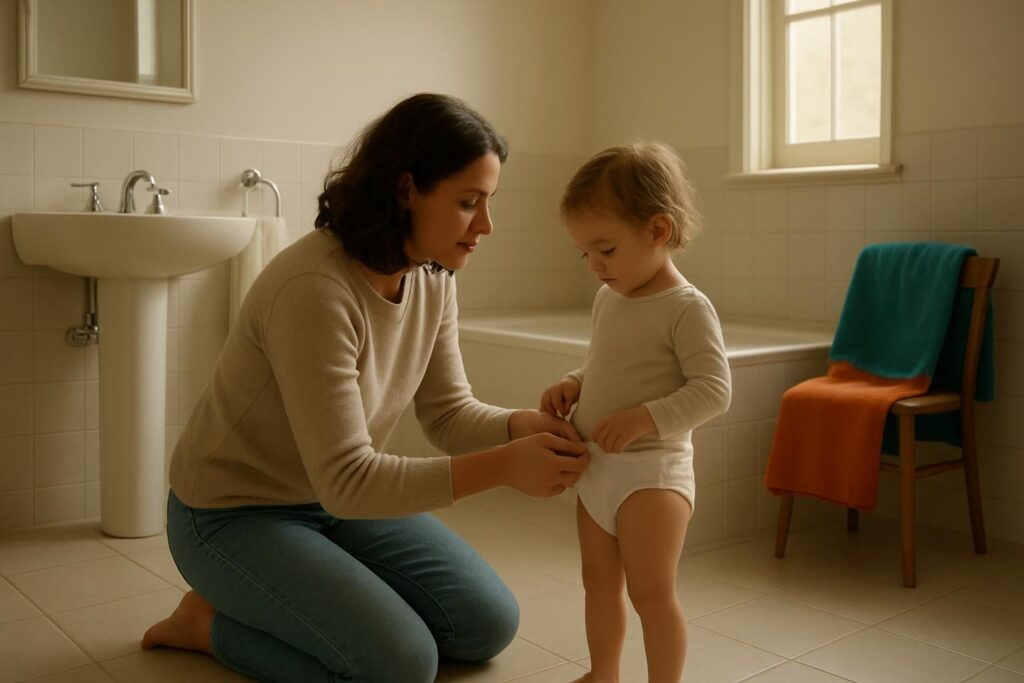
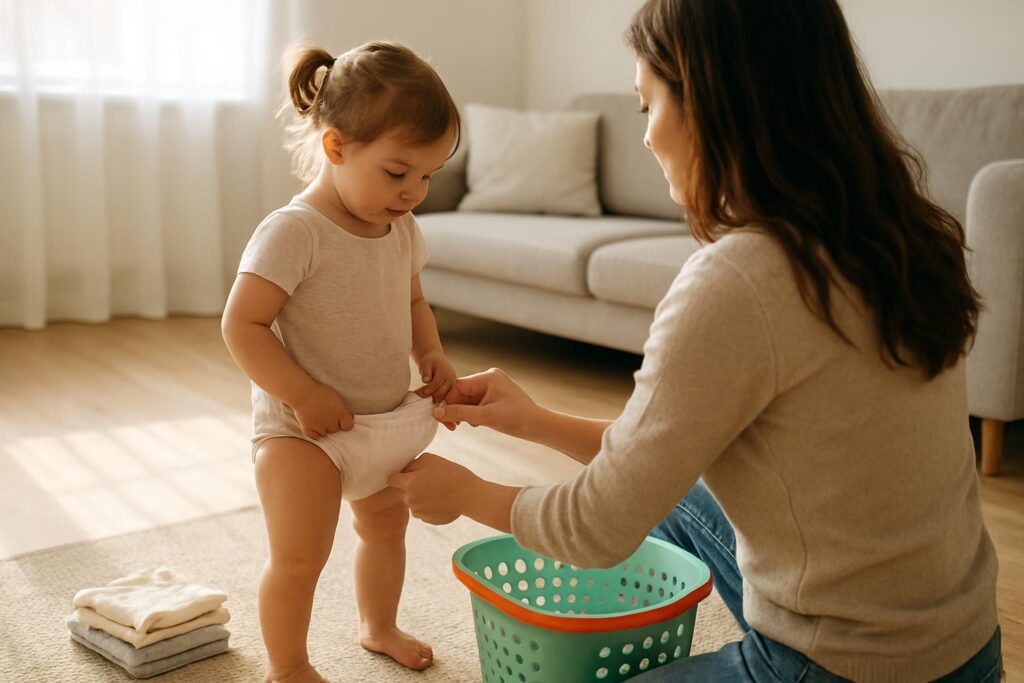
Pull-ups play a quiet role in this too. They’re designed to feel almost dry even when they aren’t, which is useful for travel and sleep but works against the goal during the day, since the child never gets the clear, slightly uncomfortable feeling of being wet that teaches the body to notice the need in advance. Plain cotton underwear doesn’t hide that feeling, which is part of why it does the teaching that pull-ups can’t.
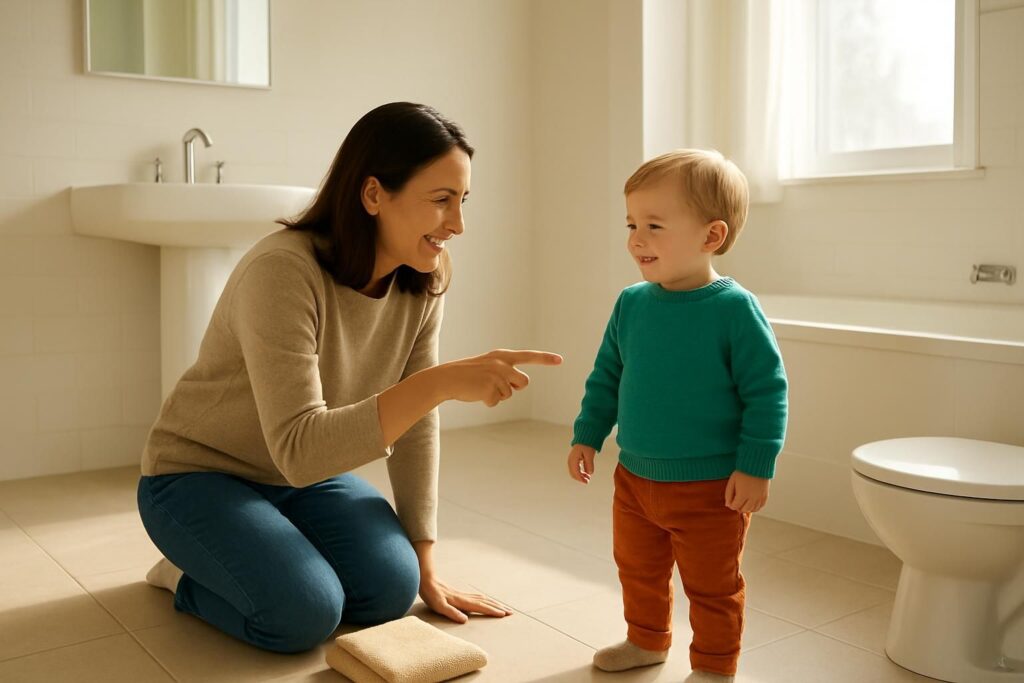
Unlike a toddler, a five-year-old can be told the plan ahead of time and included in building it: picking their own underwear, hearing what the next few days will look like, understanding why the diaper is going away. That’s an advantage this age has over a two-year-old restart, and it’s worth using.
It’s also worth asking, gently, what’s underneath a flat refusal. A fear of the toilet, a fear of pooping specifically, or a painful bowel movement sometime in the past often sits quietly behind resistance that looks like stubbornness on the surface.
If the toilet itself seems to be the sticking point, this video is worth watching together before you try again.
What has to happen before you start again
Rule out the medical side first. Constipation, stool withholding, a child who has never once been dry, or pain when peeing are all reasons to see a doctor or child health clinic before restarting training, not after.
If the last attempt ended in tears, shouting, or a standoff, give it a genuine pause of a few weeks so the subject stops being a fight before you try again. You can read more on when to pause and when to keep going if you’re trying to judge whether now is actually the right moment.
As an Amazon Associate we earn from qualifying purchases. Some links in this article are affiliate links: if you buy through them we earn a small commission, at no extra cost to you, and it does not affect what we recommend.
Have a few things ready before day one, in general terms: a way for your child to sit comfortably and safely on a regular toilet, enough cotton underwear to get through several accidents without doing laundry mid-afternoon, something to protect the mattress and sofa, a handful of small rewards, and pull-ups kept for sleep only. A toilet seat reducer and a sturdy step stool matter more at this age than a potty, since most five-year-olds go straight to the toilet. Clear the calendar for three days at home with as few outings and visitors as you can manage.
Tell your child what’s happening a few days ahead, in plain, matter of fact words, and let them pick out their own underwear. At this age, being told the plan and having a small say in it tends to lower resistance before it even starts.
A story read together can take some of the tension out of the lead up. Noa’s Potty Training Journey is a short ebook some families read with their child in the days before starting, simply to make the idea familiar rather than sudden.
Signs your five-year-old is ready to try again
At five, readiness looks less like physical signs and more like attitude and consistency. Watch for stretches of staying dry for an hour or more, knowing when they’re going even if they don’t say so in time, being able to pull pants up and down alone, following a two-step instruction without help, and any flicker of interest in doing what friends or classmates do.
Signs to wait instead: outright fear of the toilet or bathroom, active withholding of poop, or a recent upheaval like a new sibling, a move, or a big change at school. Starting into one of those is usually starting too soon.
If you’re not sure which column your child falls into, a short readiness quiz can help you see it more clearly before you commit to a restart.
A day-by-day plan for potty training a 5-year-old
Days 1 to 3 happen at home. The diaper comes off for good, cotton underwear goes on, and your child is let in on the plan rather than just subjected to it. Instead of putting your child on the toilet on a schedule, the core move is to ask, ‘will you tell me when you need to go?’, so your child takes the initiative rather than you imposing one. This is the idea at the center of the Potty Training Box Method: a seven-day program that spends the first three days at home and is built entirely around the child learning to signal the need themselves, rather than being walked to the toilet at set intervals.
During those first days, and for a while after training is done, there are only a few fixed moments where you offer the toilet rather than wait: before and after sleep, and before leaving the house. Outside those checkpoints, the aim is to wait for your child to say something.
Track drinking and toilet moments so you learn this particular child’s own timing. Have your child drink a cup in one go rather than in sips, then note the time and how long it takes before they need to pee. A half-finished cup sipped over an hour won’t tell you anything useful, since you won’t know how much went in or how long the gap really was. For more on how to set this up, what to actually track covers it in detail.
| Day | What you do | What to expect |
|---|---|---|
| Day 1 to 3 | Home, diaper off, ask ‘will you tell me?’ | Some accidents, child learning the question |
| Day 4 to 5 | Ask less often, hand over more responsibility | Often the hardest stretch, resistance from boredom with being asked |
| Day 6 to 7 | Short outings, fixed checkpoints only | Fewer accidents, more unprompted signals |
Day 4 or 5 is usually the hardest day, not day 2. By then, many children are bored of being asked ‘will you tell me when you need to go?’ over and over, and that boredom shows up as pushback or ignoring the question outright. The fix isn’t to ask more, it’s to ask less, and to hand your child more of the responsibility for noticing it themselves.
Short outings can start from day 3 onward once the first stretch at home feels steadier, using the toilet before leaving as the one fixed checkpoint.
Accidents are data, not failure. React flatly, change clothes without a lecture, and note the time rather than the mistake. A matter of fact reaction keeps the day moving forward instead of turning into a power struggle.
The 7-Day Potty Training Video Course covers the same seven days as about forty short videos of roughly three minutes each, grouped by day, plus a digital AI coach you can ask questions of at any hour. The sticker cards, tracking schedule, and certificates belong to the course and you print them yourself at home as you go. You can see what’s included at the 7-Day Potty Training Video Course page.
How to handle the fight over pull-ups and school
If kindergarten or school is asking for daytime dryness, time the restart around a school break or a quiet week rather than squeezing it in around drop off and pickup. Three days at home works far better with nowhere else to be. You can read more on getting there before school starts if the school deadline is the main pressure.
Talk to the teacher before you start so the approach matches at both ends: the same phrase used at home, spare underwear left at school, and no public fuss made over an accident in front of classmates. Consistency between home and school matters more at this age than it did at two.
During an active restart, drop daytime pull-ups entirely rather than keeping them as a backup. A pull-up worn ‘just in case’ during the day undoes the whole point of the underwear switch, since your child slips back into not quite feeling it the moment it’s on. Keep pull-ups, including an overnight pull-up or training pant, for sleep only, where they’re doing a different job entirely.
If your child says plainly that they prefer the pull-up, it helps to answer without turning it into a negotiation. Something like ‘I hear you, and we’re trying underwear during the day this week’ keeps the decision with you, calmly, rather than opening it up as something to bargain over.
Rewards that still work on a five-year-old
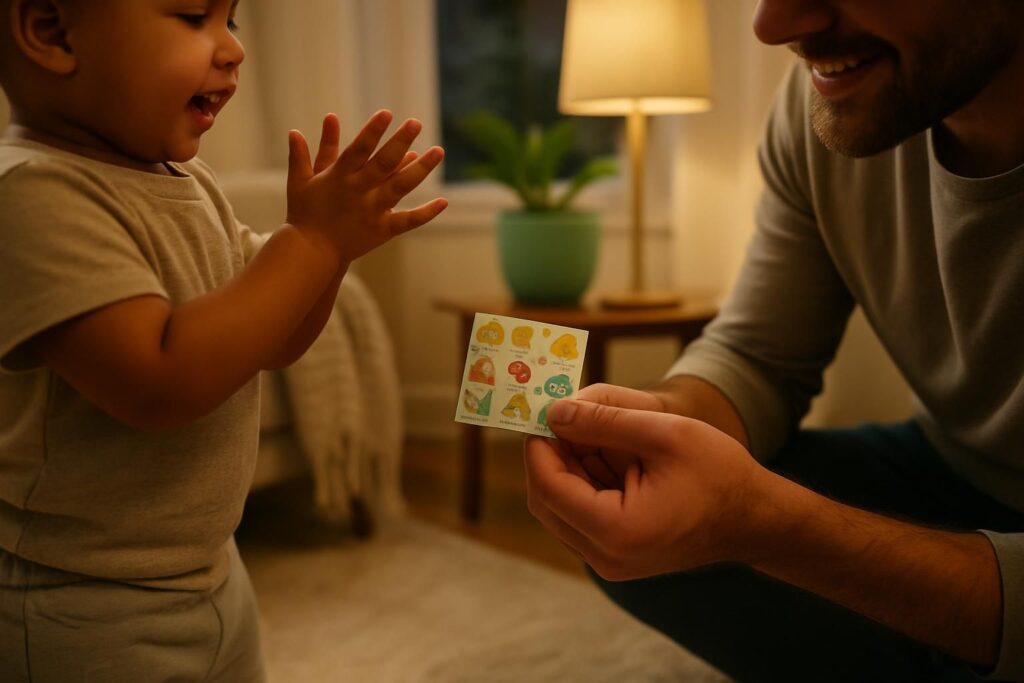
At five, stickers alone often don’t land the way they did at two, so it helps to tie the reward to something your child actually wants right now and keep it small and immediate rather than building toward something big and far off. A favorite snack, ten extra minutes of a preferred activity, or picking the next bedtime story all work better than a promise of a toy in two weeks.
The sticker cards that come with the training build in their own escalation: they run in four sizes, with 3, 5, 7 and then 9 squares, used in that order. The first card fills fast, so your child sees quickly that the system works, and each card after that takes a little longer to fill, which is what lets the habit outlast the stickers instead of stopping the moment the cards run out.
A pee certificate and a poop certificate mark the end of the week, and at five your child is old enough to genuinely understand what it stands for and to feel proud of it, rather than just liking the picture.
Praise works best when it names the behavior rather than the child: ‘you told me in time’ lands better over repetition than ‘good boy’ or ‘good girl’, since it points at the exact thing you want to see again.
This is the moment worth celebrating out loud, and this video is built for exactly that.
When this is a question for the doctor, not a training question
Some situations belong with a doctor or child health clinic before any restart, not after one that doesn’t work. A child who has never once been dry at any point, day or night, is one of them.
Withholding poop, painful or very hard stools, or soiling in underwear can point to constipation, and training on top of unresolved constipation tends to go badly in both directions. The National Institute of Diabetes and Digestive and Kidney Diseases notes that ongoing bladder and bowel control problems in children are worth raising with a doctor rather than managing alone (niddk.nih.gov). The same applies to pain or burning when peeing, frequent urgent trips, or urine that looks cloudy or smells strong, since these can signal a urinary tract infection rather than a training issue.
Daytime wetting that continues after a genuine, calm, well-run attempt is also worth a medical conversation rather than a third or fourth restart on your own. The same goes for bedwetting that continues well past the age most children have outgrown it, which is also covered on that NIDDK page.
The method described here is also used successfully with children who are autistic, have Down syndrome, or are non-verbal, usually over a longer stretch and by reading the child’s own signals rather than waiting to be told. The American Academy of Pediatrics covers this longer, signal-reading approach to toilet training children with developmental differences in more detail (healthychildren.org). None of this is something to diagnose or treat yourself. It’s simply the point where the right next call is to a doctor, not another sticker chart.
What to do if this attempt doesn’t work either
Stopping and waiting a few weeks is part of the method, not giving up on it. If a restart stalls out or turns into daily conflict again, the honest move is to pause rather than grind on through more weeks of fighting about it.
A real pause looks quiet: the diaper goes back on without comment, there are no reminders, no ‘remember what we talked about’, and no bargaining over it. The subject simply rests for a while so it stops being something your child braces for.
Watch for the same readiness signs coming back before you try again: longer dry stretches, more interest, less resistance to the idea of underwear. When you do restart, keep it short and contained, three focused days at home again, rather than letting it stretch into an open-ended, months-long project that never quite gets anywhere.
Most children are dry in the daytime in about a week once a focused attempt is underway, though some take as little as three days and others need two to three weeks, and there’s no guarantee attached to any of it. A child who isn’t ready yet should wait, and waiting is not a failure on anyone’s part.
Frequently asked questions
Is it normal for a 5 year old not to be potty trained?
Yes. Most children are dry in the daytime between ages 2 and 4, which makes five later than average, but a five-year-old who isn't trained yet is not rare and isn't a sign of something wrong with the child or the parenting. It often reflects a stalled earlier attempt, ongoing power struggles, or a specific fear rather than an inability to do it.
What is the hardest age to potty train?
There isn't a single confirmed hardest age, since readiness varies a lot by child. What tends to make an age hard is a mismatch between the method used and the child's stage: toddlers can resist for developmental reasons, while five-year-olds more often resist out of habit, boredom with being asked, or a past bad experience, which calls for a different approach, not more pressure.
Is it normal for a 5-year-old to still use diapers or pull-ups at night?
Yes. Nighttime dryness develops on its own, usually later timeline than daytime control, and many children still need pull-ups or protection overnight at five. It is a separate skill from daytime training and isn't the measure of whether daytime training has worked.
How long does it take to potty train a 5-year-old?
Most children become dry in the daytime in about a week once a focused, structured attempt begins, though some take as little as three days and others need two to three weeks. There are no guarantees with any method, and a child who is genuinely not ready yet should wait rather than be pushed through a timeline.
My 5-year-old refuses to poop on the toilet, what do I do?
This is very often tied to fear, a past painful bowel movement, or withholding, and it's worth a conversation with your doctor if stools are hard, infrequent, or your child is soiling underwear. If there's no medical concern, keep the pressure low, let your child choose when to sit, and avoid turning it into a standoff, since forcing the issue usually deepens the refusal.
Should my 5-year-old wear pull-ups during the day at school?
During an active restart, it's worth dropping daytime pull-ups in favor of plain cotton underwear, because pull-ups let a child skip feeling wet, which is exactly what teaches the body to notice the need to go. Keep pull-ups for sleep only, and talk to the teacher so school uses the same approach and spare underwear is on hand for accidents.
Ready for the next step?
The 7-Day Potty Training Video Course walks you through this program in forty short videos, grouped per day, with a digital AI coach you can ask a question at eleven at night on day four. The full handbook comes with it as a PDF to read and print. Nothing is shipped, so you can start today.
Sources
- American Academy of Pediatrics (healthychildren.org) (Most children reach daytime dryness between ages 2 and 4, and toilet training in the Un…)
- National Institute of Diabetes and Digestive and Kidney Diseases (NIH) (Bladder control problems and bedwetting in children are medical topics worth discussing…)
- American Academy of Pediatrics (healthychildren.org) (Toilet training a child with a disability or developmental delay often takes a longer,…)
This article was written with AI assistance and checked by Dustin van de Sande.