Pull-Ups or Underwear for Potty Training? Why Cotton Wins During the Day

Use plain cotton underwear during the day and keep pull-ups for sleep only. A child feels wetness in cotton right away and barely feels it in a pull-up, which is why cotton teaches the connection between the urge and the action. Most children are dry in the daytime in about a week. Night dryness is separate and comes later.
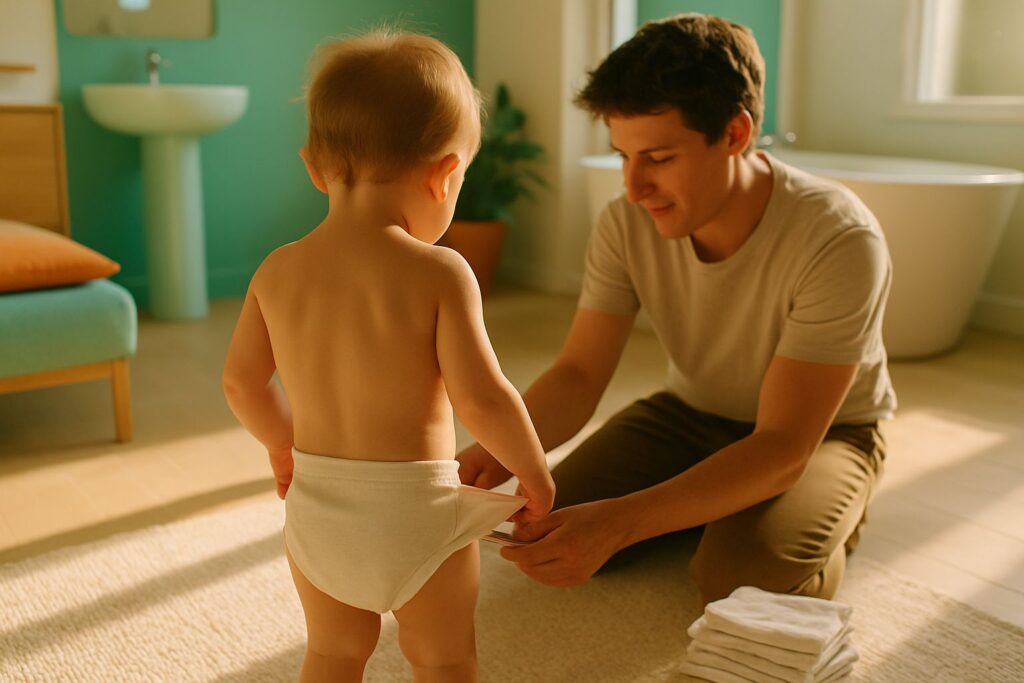
That one swap, diaper off and cotton underwear on, tends to make a real difference in how smoothly the week goes. Everything else in this article explains why, and what to do with the pull-ups you probably already bought.
Do pull-ups actually help with potty training?
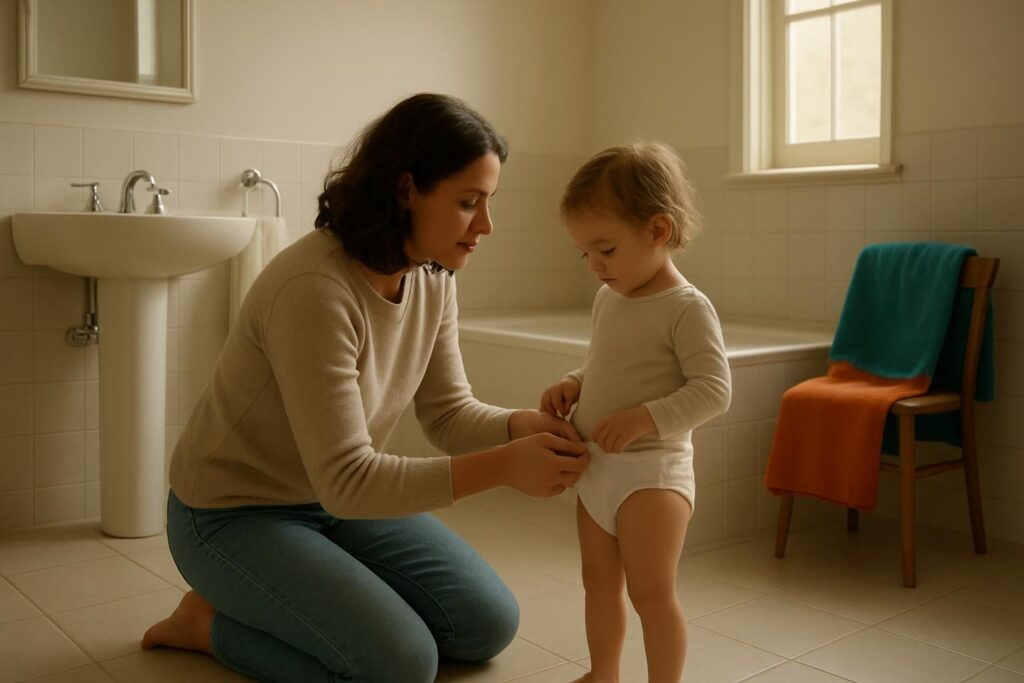
Pull-ups are absorbent, underwear-shaped diapers. They are convenient for you because they pull on and off like pants and handle a big leak without a mattress to wash. For your child, though, they are still a diaper, and a good one at that, which means wetness is wicked away before it registers on the skin.
That is exactly the problem during the training week. The whole point is for your child to feel wet, feel uncomfortable about it, and start connecting that feeling to the moment just before it happened. A pull-up quietly removes that feedback loop. It is not a bad product, it is simply built to do the opposite job of what the daytime training week needs.
Plenty of parents start with pull-ups anyway, because the packaging in the diaper aisle all but tells you to. There is nothing to feel bad about there. It is just worth knowing, before the week starts, that disposable pull-ups during the day usually slow things down rather than speed them up.
What is the difference between pull-ups, cloth training pants and regular underwear?
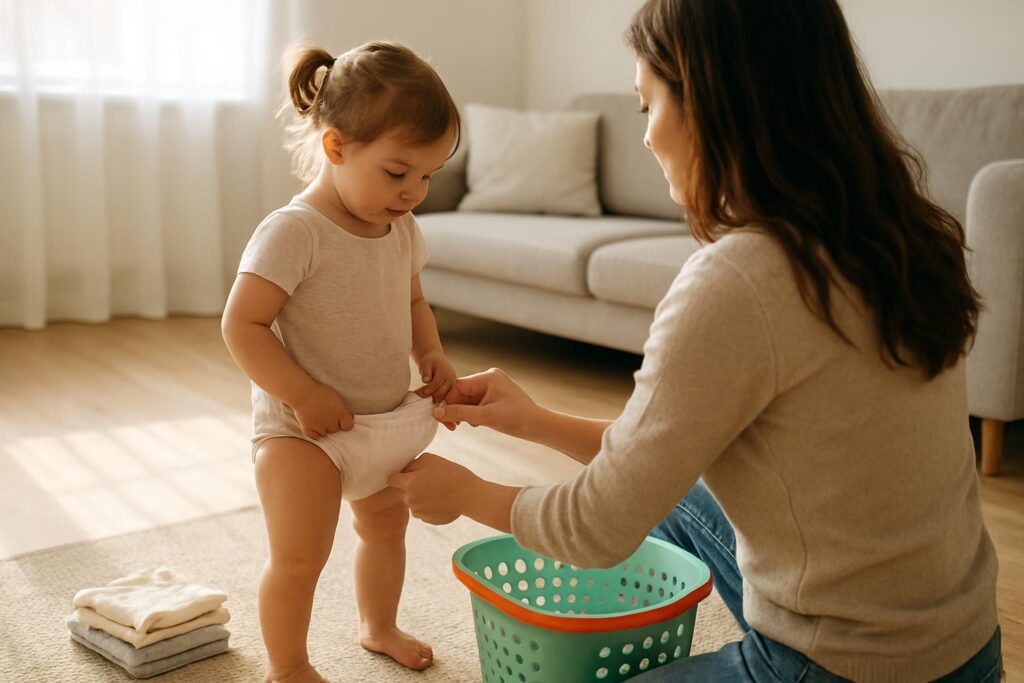
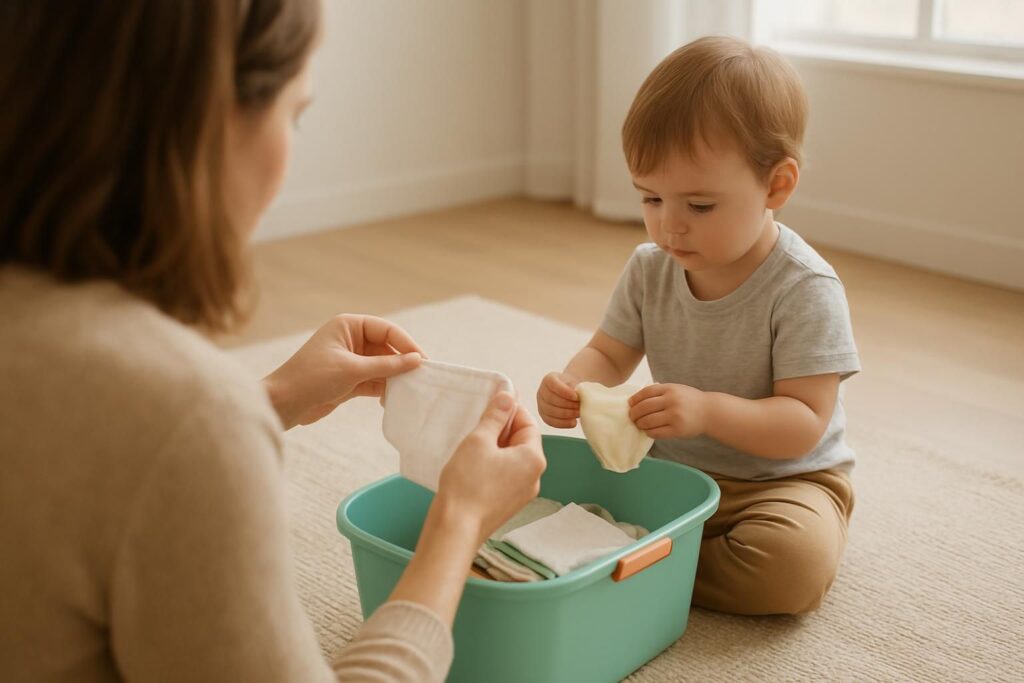
Disposable pull-ups are absorbent diapers shaped like underwear. Padded cloth training pants are washable underwear with an extra absorbent layer sewn in. Plain cotton underwear is ordinary underwear with no padding at all, the kind a child wears for the rest of childhood.
Padded cloth training pants sit in an awkward middle ground. They are better than disposables in one sense, since you can see and smell a wet pair, but the extra padding still softens the feeling for your child the same way a pull-up does. That muting effect is exactly why this is skipped in favor of plain cotton once the actual training starts.
| What it is | What your child feels | When it makes sense |
|---|---|---|
| Disposable pull-ups | Barely any wetness, wicked away fast | Sleep only |
| Padded cloth training pants | Muted wetness, softened by the padding | Rarely needed once training starts |
| Plain cotton underwear | Wet right away, uncomfortable, noticeable | Every daytime hour during training and after |
Why does the Potty Training Box Method use plain cotton underwear from day one?
The Potty Training Box Method is a day-by-day, seven-day program: the first three days are spent at home so your child learns the most in the least distracting setting, followed by short outings once the basics hold. Diaper comes off and plain cotton underwear goes on from the morning of day one, with no gradual transition period.
The aim is not a parent running a clock. It is reaching the moment your child says, unprompted, that they need to go. Instead of offering the potty on a fixed schedule, you ask your child directly, will you tell me when you need to pee, and let that question do the work a timer cannot.
Two moments stay on a routine forever, even once training is done: before and after sleep, and before you leave the house. Outside of those two checkpoints, the goal is always your child’s own signal, not yours. Accidents in the meantime are treated as information about timing and readiness, not as a failure on anyone’s part.
How many pairs of underwear do you need, and what else should be ready?
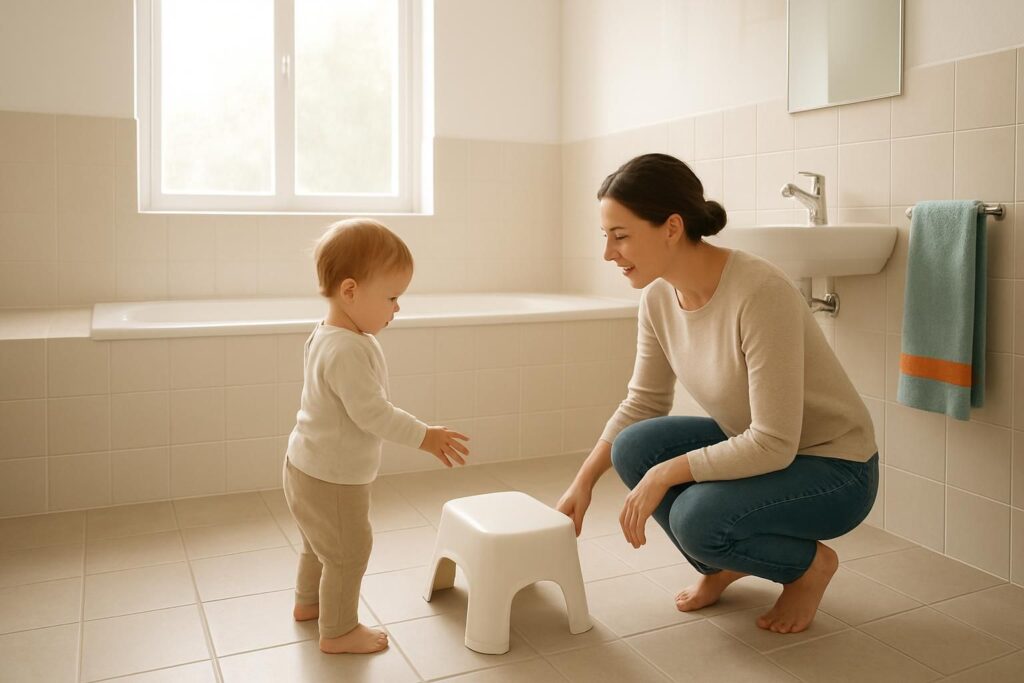
Plan on at least 15 pairs of plain cotton underwear so you are never doing laundry mid-afternoon. Beyond that, it helps to have a potty ready for the first few days, a toilet seat reducer and step stool for the move to the regular toilet, something to protect the mattress and sofa, a handful of small rewards, and pull-ups for sleeping.
Letting your child pick out their own underwear at the store, dinosaurs, trucks, whatever they are into that month, tends to make them more invested in keeping it dry. It is a small thing but it shows up in how carefully a kid handles day two and three. For sizes, fabric and exact counts, what underwear to buy and how many pairs walks through it in more detail.
As an Amazon Associate we earn from qualifying purchases. Some links in this article are affiliate links: if you buy through them we earn a small commission, at no extra cost to you, and it does not affect what we recommend.
A potty like the Ingenuity My Size Potty Pro and a step stool such as the Dreambaby Step Stool are the kind of practical pieces that make the week smoother without being part of any kit.
When should you switch from pull-ups to underwear?
Switch all at once, at the start of the training week, not gradually at the end of it. A slow taper keeps the wet feeling muted right through the part of the week where your child most needs to notice it.
Before you start, check that your child is actually showing signs of readiness:
- Staying dry for a couple of hours at a stretch
- Showing interest in the bathroom or the potty
- Being able to pull pants up and down alone
- Telling you, in words or gestures, that something is happening or about to
Take the readiness quiz if you are not sure yet.
A child who is frightened of the potty or the toilet is not ready, whatever the calendar says. Build familiarity first, in a relaxed, no-pressure way, and plan the actual training week for later. You can simply start when things look different, nothing about waiting sets you back.
If you are already a few days into training with pull-ups and want to switch mid-week, pick a clean break point, ideally a morning, explain simply that pull-ups are for sleep now and underwear is for the day, and go straight to cotton rather than easing in with one more pull-up afternoon.
What about daycare, car rides and the grocery store?
Keep the first three days at home as planned, then move to short outings in plain cotton underwear with a full change of clothes in the bag. A quick bathroom visit right before you leave the house, every single time, is one of the two fixed checkpoints that never goes away.
Tell daycare plainly what you are doing and ask them to use the same underwear, not a backup pull-up, so your child gets one consistent message rather than two different rules in two different places. Many parents find that a mismatch between home and daycare just makes the week more confusing for the child, not less.
A pull-up just for the car, just for the store, just this once, resets the exact signal your child is working to learn, because a pull-up quietly removes the discomfort that was teaching them to hold on and ask. If you want to see how a tighter, three-day version of this handles outings, how three-day potty training compares covers the same logic.
Why are pull-ups still fine at night?
Night dryness depends on bladder capacity and the body’s own overnight signals maturing, not on daytime training, and it typically comes along well after daytime control is solid. Pull-ups for sleep are not a step backwards and the method expects them the entire time daytime underwear is in use.
Calling them sleep pants rather than pull-ups, in whatever words your toddler understands, helps them read it as a different thing from daytime underwear instead of a demotion. For a realistic sense of how daytime and night-time dryness typically line up by age, day and night dryness by age is worth a look.
Bedwetting that continues past age 6 is worth raising with a doctor or child health clinic rather than solving at home, according to the American Academy of Pediatrics.
What if the first week does not go the way you hoped?
Day four or five is usually the hardest day, not day two, because that is when resistance tends to show up. By then your child is often bored of being asked will you tell me when you need to pee, over and over, and pushes back exactly where it hurts most.
The fix is usually to ask less, not more, and hand your child a little more responsibility for noticing it themselves. Why day 4 is the hardest day goes through what that looks like in practice.
Handle accidents calmly: change into dry cotton underwear without commentary, and move on. If it genuinely is not working after a real attempt, the method’s own advice is to stop and leave it a few weeks before trying again, rather than pushing through a week that has clearly stalled.
The method is also used successfully with autistic children, children with Down syndrome, and non-verbal children, usually over a longer stretch and by reading the child’s own signals closely rather than waiting to be told. For background reading, the American Academy of Pediatrics also covers toilet training children with special needs.
When an accident does happen, it can help to sit down together afterward rather than treat it as the end of the conversation.
Where the day-by-day plan comes in
An article can tell you to use cotton underwear and explain why. What it cannot do is tell you exactly what to do on day one, day two and day three, including the days that go sideways, or give you someone to ask at ten at night when your child suddenly refuses the bathroom entirely. For what day one actually looks like, that practical detail matters more than the theory.
The 7-Day Potty Training Video Course carries the same seven-day program as forty short videos, about three minutes each, grouped by day, with a digital AI coach built in to answer questions at any hour. The tracking schedule, sticker cards and certificates are included as printable parts of the course, so you print them at home as you go.
A picture book like Noa’s Potty Training Journey can also be a nice way to talk through the week with your child before it starts.
Frequently asked questions
Do you potty train with pull-ups?
No, not during the day. Pull-ups are kept for sleep, while daytime training uses plain cotton underwear so your child can feel wetness right away and connect it to the urge beforehand.
Should I use pull-ups or underwear during the day?
Use plain cotton underwear during the day. Pull-ups absorb wetness so efficiently that your child barely notices it, which removes the very feedback they need to learn when to go.
Are pull-ups bad for potty training?
Pull-ups are not bad, they are simply the wrong tool for daytime learning because they mute the wet feeling a child needs to notice. They remain a perfectly good choice for sleep throughout and after training.
Do cloth training pants work better than regular underwear?
No. Padded cloth training pants still soften the feeling of wetness the same way disposable pull-ups do, just to a lesser degree, which is why plain cotton underwear with no padding is used for daytime training instead.
Can you potty train without pull-ups at all?
Yes. Many families go straight from diapers to plain cotton underwear during the day and only bring pull-ups back out at bedtime, which is exactly how the daytime part of training is meant to work.
When should my child stop wearing pull-ups at night?
Night dryness depends on bladder maturity and tends to come well after daytime dryness is established, so there is no fixed week to aim for. If bedwetting continues past age 6, it is worth discussing with a doctor or child health clinic rather than managing it alone.
Ready for the next step?
The 7-Day Potty Training Video Course walks you through this program in forty short videos, grouped per day, with a digital AI coach you can ask a question at eleven at night on day four. The full handbook comes with it as a PDF to read and print. Nothing is shipped, so you can start today.
Sources
- American Academy of Pediatrics (Bedwetting that continues past age 6 is worth raising with a doctor or child health cli…)
- American Academy of Pediatrics (Children who are autistic, have Down syndrome, or are non-verbal are trained successful…)
This article was written with AI assistance and checked by Dustin van de Sande.